Showing posts with label Copyleft. Show all posts

Tuesday, August 10, 2010

Joel E. Siegel's 1982 Blade Runner review

Bill Blackwell's my new hero. He dug up the legendary 1982 Blade Runner review by Joel E. Siegel of Washington's City Paper.


Well, legendary in my own mind, at least. Joel E. Siegel, a jazz critic and teacher at Georgetown, was also the amazing film critic for the Washington City Paper. He was perhaps the first critic I ever really trusted; so often he pointed me to films that were great, or steered me clear of the phony and dishonest. Most importantly, he was the critic who "got" Blade Runner even as so many other critics I read didn't.

If I remember correctly, the general impression of Blade Runner among the mainstream critics was that it was a basically unsuccessful attempt to meld science fiction with the hard-boiled detective genre. Siegel, on the other hand, knew it was something special. He didn't know what, exactly. But he knew underneath the occasionally-ridiculous surface was something entirely new, something rare and shudderingly beautiful.

I read that review as a high school senior and I knew at once I had to see the film. So I watched Blade Runner. What Siegel saw was obvious to me, too.

I actually spoke to Siegel many years later, after Blade Runner had become an acknowledged classic with its influence seen everywhere. We first commiserated about the fact that he shared his name with the mustachioed douchebag film critic from Good Morning America, and he told me stories about his former colleague John Powers (another hero critic of mine, who I had read back when he wrote for the LA Weekly). Then we spoke about his Blade Runner review. Siegel said he had recently reread the review and he remembered the trouble he felt putting his feelings into words. He and I both agreed it remained perhaps the best cyberpunk film ever made.

Flash forward to 2007 and my post on Hidden Gems, in which I mentioned the Siegel review. In an aside, I lamented that the review wasn't available online. I must have communicated in that aside that I would really love to read the review again.

And there, for three years, the story rests...until today, when one Bill Blackwell sends me the following email totally out of the blue, no introduction, just this, along with -- MIRACLES! -- the original Joel E. Siegel review:

Like you back in 2007, I went in search of Joel E. Siegel's City Paper review of Blade Runner on the Net. Everything may be here somewhere, but not Joel's review. The City Paper's search system was no no help. I called the paper. I had to explain to two people there that they once had writing for them THE film critic of DC. No luck. The last option was to descend into my basement and look through my files. The review was there, but it was missing the date of publication, though it has to be from a July, 1982 issue. I hope you still have an interest.

(Oh I do, I do! Thank you, thank you, thank you, Mr. Blackwell!)


Sharp Blade: Ridley Scott’s Visual Banquet


By Joel E. Siegel
Washington City Paper

In 16 years of movie reviewing, I've never had as much trouble writing a column as this one. I've seen Blade Runner twice and have tried for three weeks to come to terms with it, but I still feel tongue-tied trying to deal with the critical problems it poses. It's easy enough to pinpoint the film's flaws, particularly its poorly written and developed screenplay and Harrison Ford's unambitious, crushingly dull performance. Yet I don't think I've ever been as spellbound at the movies as I was during both viewings of Blade Runner. In terms of design, special effects, and cinematography, it surpasses anything the screen has shown us so far. Each sequence, each shot, is brilliantly alive to the possibilities of what film can do.

Blade Runner deserves special membership in that fraternity of crazy, doomed films whose visionary achievements redeem cheesy ideas and slapdash narratives (D. W. Griffith’s Intolerance is probably the godfather of this group, which also includes Michael Powell's Stairway To Heaven, John Schlesinger's Far From the Madding Crowd, John Boorman's feverish duo Zardozand Exorcist 2 and, recently, Michael Wadleigh's Wolfen. It is perhaps no coincidence that most of the abovementioned filmmakers, like Blade Runner's Ridley Scott, are Englishmen, products of the culture that gave us visionaries like Milton and Blake.) What these films have in common, apart from critical and box-office failure, is the creation of worlds so obsessive, so vividly imagined and compulsively detailed that open-eyed viewers can't possibly dismiss them, no matter how strongly good sense says we should.

Blade Runner, set in Los Angeles in 2019, is a knockout from its very first shot—a long-held cityscape dominated by vast pyramidal structures and punctuated by buzzing aircraft and smokestacks belching flame. Early on, we learn that the city, like the film itself, is built on oppositions. Mammoth glass and steel highrises dominate the skyline; beneath them, in a gaseous half-light, sprawls a neon underworld, a mixture of Times Square and Hong Kong, where the darker and, the film suggests, least quenchable aspects of human nature hover in the shadowy, rain-swept streets.

This underworld is familiar to us. It's the tenderloin of a dozen world capitals, only dingier, more decadent, rotting in the future's noxious atmosphere. But the upper world, with its inlaid, highly textured, rectilinear motifs decorating both internal and external walls, is new to the eye. It looks like a universe designed by Louise Nevelson—elegant, tactile, chilly.

Scott and his talented crew of technicians have populated their world with wonders. Huge floating video cubes drift through the streets hawking candies and soft drinks. There's a cold storage Eye World where men in heated suits fabricate eyeballs for advanced robots. There's a television set capable of scanning, enlarging, and reproducing the most minute photographic details. (A complex photo-scanning sequence extends the visual and aural explorations of Blow Up and Blow Out. There's a lavish mansion in the sky filled with echoes of Citizen Kane's Xanadu, including a perched mechanical bird and an expansive, columned study. Scott mixes future with present, fantasy with reality. Long sequences in the film are set in the Bradbury Building, downtown L.A.'s most notable architectural landmark. But we see the Bradbury not in its restored spendor but in a state of ruin, with rain and debris staining its grilled walkways. The terrible and wonderful things about Blade Runner's view of the city of the future is how logically it extends trends evident in our present urban centers. The Oliver T. Carr malls and condos that nestle alongside slum apartment houses and strip joints are the roots of Scott's bi-level metropolis.

The narrative and dramatic elements of Blade Runner are not worthy of the film's visionary style. The Hampton Francher-Davis Peoples screenplay, adapted from Philip K. Dick's novel Do Androids Dream of Electric Sheep? attempts to transport a Raymond Chandler-like protagonist into the world of the future. In theory, the mixture of genres could work. After all, hardboiled detective fiction and sci-fi usually deal with the same question: how can one retain human values in an increasingly indifferent, mechanistic universe? But, as attempted in Blade Runner, the marriage of genres barely extends beyond self-congratulation over the originality of the conceit. The writers seem to feel that the very idea of placing a tough-guy hero in the midst of a futuristic city is so clever that no further development is required. As a result, the script is often foolishly coy; our intelligence is insulted while our eyes are being dazzled. Francher and Peoples aren't much better at exposition. Chunks of >action and motivation are missing, signs perhaps that the film was extensively cut before release.

It's more than a bit sentimental to believe that a Chandleresque character could survive the social and moral mutations that precede Blade Runner's society. (Even today, 37 years before the film takes place, one would have better luck enlisting the services of a private eye in the architectural anomie of Rosslyn or Crystal City than in the sleaziness of 14th Street. Today's tough guys have lost their affinity for the gutter.) According to rumors, the film's producers lost faith in the script's mating of tough guy and sci-fi during the final editing stages. Director Scott was reportedly taken off the picture, a voice-over narration was added to clarify the action, and a cop-out happy ending was patched on to lighten the film's deeply pessimistic view of the future.

The plot is a reworking of Fritz Lang's Metropolis and Jean-Luc Godard's Alphaville. (Both films are set in futures where people live in servile, robotlike existences, and Godard's picture even has a private eye protagonist.) Replicants, sophisticated robots designed for slave labor, have been created for use in colonizing remote "Off World" settlements. These replicants look exactly like human beings, and are as smart and far stronger than the people who created them. Six replicants, aware that their four-year termination dates are up, illegally return to earth and infiltrate Los Angeles. Former enforcer Deckard (Harrison Ford) is brought out of retirement to "retire" them. As in both versions of the classic Invasion of the Body Snatchers,  the only thing that separates replicants from humans is emotion; they have no real feelings or memories.

Deckard, a withdrawn man, is virtually a replicant himself, such a cold fish that he's known to his ex-wife as "sushi." Disciplined and repressed into mechanical numbness, he is awakened to feeling when he meets Rachel, an advanced experimental replicant who has been implanted with feelings and memories. The cool killer is surprised by a longing for tenderness and decency. The dialogue and screenplay indicate that Deckard is a man quietly at war with his vestigial conscience, a zombie with an appendix soul. Unfortunately, Harrison Ford's performance as Deckard is the ultimate expression of Hollywood he-man emptiness. In the great tradition of macho stiffs like Gregory Peck, Glenn Ford, and Dana Andrews, Ford numbly flexes his way through the film, never once suggesting any kind of internal conflict. It's a replicant performance, without a flicker of feeling or individuality illuminating the solemn male impersonation.

Deckard's climactic decision to run away with Rachel should yield a harrowing irony—the repudiation of a world of human beings grown so soulless that happiness and tenderness are only possible with a robot. But Ford plays his scenes so mechanically that these ironies are never awakened. When one recalls how much complexity and wit Humphrey Bogart and even Dick Powell brought to their interpretations of Philip Marlowe, it's evident how great a liability Ford's bloodless performance really is.

Too bad, because the rest of the cast is marvelous. Blond, muscular Rutger Hauer is visually and dramatically perfect as Roy Batty, the brightest and strongest of the rebel replicants. Hauer, who has the kind of looks and physique that Hitler must have dreamed about, offers a Miltonic version of the replicant-slave—the unjustly cast-out angel who hungers for revenge. Batty's Satanic, larger-than-life emotions contrast sharply with the fumblings of the burnt-out Deckard; his death scene in the rain, complete with released white dove, is tinged with a dizzily poetic comic book grandeur.

Darryl Hannah is affecting as Batty's cohort Pris, a Blondie punk clone with dark spray-painted eyes and greenish makeup who dies a spectacular twitching death. Joanna Cassidy is beautiful and arresting in her brief turn as Zhora, a replicant tart whose expiration through walls of neon-tinted glass quotes from the shoot-out finale of The Lady From Shanghai. William Sanderson is touching and funny as Sebastian, the genetic designer-misfit who lives in a decaying toy-filled apartment in the Bradbury Building. His performance is a witty evocation of all those doomed little fall guys played in 40s films noir by Elisha Cook Jr. Sean Young is a very beautiful Rachel and fully deserves her long, adoring close-ups. But her elaborate 40s hair-do, scarlet lips, padded shoulders, and painted nails are handicaps, old movie allusions that imprison her until she, literally, is allowed to let down her hair.

Blade Runner's strengths and weaknesses are, I think, direct expressions of its director's gifts and liabilities. Ridley Scott was a painter and worked as a set designer and TV commercial director before coming to feature films. His pictures to date, The Duellists and Alien, have been strong on design and visual texture, weak on narrative continuity and characterization. This time out, Scott's preoccupation with visual imagery dominates every other element of the film. Each shot is so finely detailed that a dozen viewings would be necessary for the eye to take in the film's full visual richness.

Even while my mind was rejecting Blade Runner, my eyes were popping at the film's splendors, and so I want to recommend it, very strongly. And not as dumb fun, either, the sort of pinhead claims Pauline Kael makes when she's shilling for junk like Flash Gordon or Star Trek. The eye has its own intelligence; we don't leave our minds at home when we visit a museum or art gallery. I've never seen an exhibition of paintings as exciting or original as the images contained in Blade Runner and so I'm recommending it for intelligent people to see and enjoy. One wishes the rest of the film lived up to the grandeur of its surface, but Scott and his crew have given us a visual banquet, something to be grateful for. •


----------------------------------------------------

I think later versions of Blade Runner showed that the film's narrative was deeper than Siegel gives it credit for. But he essentially nailed how profoundly the visual design of the film created a wholly new cinematic experience. Sadly, Joel E. Siegel died in 2004 at the relatively young age of 63. Happily, his visionary take on Blade Runner is finally available online. 

Sunday, April 04, 2010

iPad Pros & Cons


UPDATE: Harvard law professor Jonathan Zittrain has an excellent summary of the dangers of Apple's closed system here.

Like many, I am bemused by the Yin/Yang posts on BoingBoing from Xeni (Apple's iPad is a touch of genius) and Cory (Why I won't be buying an iPad, and think you shouldn't, either). I'm pretty firmly in the Cory camp on this one, but I think we do ourselves no favors when we understate the upside to the iPad.

Pro: The iPad is a revolutionary device. This seemed obvious to me the moment I saw Jobs demo it. The iPad is the first really useable, beautiful tablet and it will change the way we interact with information and technology--just the way the iPhone did. As Xeni points out, we have no idea all the transformations the iPad will wreak (here's one take), but it's definitely going to be a bumpy, exciting ride.

The iPad, frankly, is a sweet, sweet ride. Apple will sell a bazillion of these honeys. They have opened up the market for the unlocked tablets to follow.

Con: By being a locked, proprietary walled garden, the iPad contributes mightily to an anti-competitive ecosystem in which certain types of innovation--those that threaten the existing order--are stifled. It doesn't matter if a majority of its users aren't makers and hackers. Indeed, I'm sure the typical iPad customer doesn't want or need to root his or her device. But the fact that you can't has major repercussions. Makers and hackers innovate on behalf of the entire society, whether you know it or not. The iPad deliberately impedes this innovation, even as it facilitates other types of creativity.

The fundamental premise that every app anyone might want to make for the iPad has to pass through the narrow gatekeeper walls of Cupertino is creepy and ought to at least give anyone pause. The fact that you can "jailbreak" the device (what a telling term!) is actually a compelling argument not to buy it in the first place. If you need to jailbreak a device you own to do what you want with it (a move Apple claims is illegal, by the way), then it truly is Defective by Design.

I love my iMac but I would never buy an iPhone or an iPad. This is more than a personal choice; saying no to locked, proprietary technology is a political act on behalf of the society around me. I have an Android phone and am waiting excitedly for the emergence of Android or other unlocked tablets. Until then, I'll remain (sadly) un-tabletted.

(Photo credit: http://www.wired.com)

Sunday, March 21, 2010

On Magic and Technology: The Elephant in the Room

Technology giveth, and technology taketh away.
-Cory Doctorow, author and digital rights activist


Question: Your friend and fellow magician offers you a hard drive containing digital versions of virtually every major magic book, magazine and video produced over the last century. Do you accept it?

1. No thanks. Those are all copyrighted works and taking them would be tantamount to theft on a large scale, which could destroy the magic world and all its creators.
2. Hmmm…Those are all copyrighted works but I probably won’t ever buy most of them anyway, and it sure would be nice to be able to peruse this giant library.
3. Hell to the yeah! Information wants to be free, intellectual “property” is not property, sharing is not a crime, and making this available to every magician who wants it will have a revolutionary impact on the art.


-------------------

This post is long overdue. I have worked on this essay in one form or another for several years (one day, I'll bust out the Keynote version), but I have never been entirely comfortable with the way I managed to express my central point. So I’ll just come out and say it: The issue of digital file-sharing is a growing elephant in the room for the magic community and it’s about to become a huge, huge deal.

My previous post outlined my magical biography in depth for one very important reason-- to illuminate just how thoroughly my personal story is inseparable from that of the various communities in which I have pursued my art. Art and culture progress through the sharing of ideas and the creative building on what came previously. Magic in particular, as an occult (hidden) art, has always depended on the oral traditions, on the passing on of information through one-on-one exchanges. With the advent of technology, the sharing of magical information is taking an exponential leap forward.

Until about a decade ago, if you invented a new trick or move you could put it in print in a book or magazine, or you could just show it to your friends. If it spread more broadly, you might get credit for it and a bit of cachet at your local magic club. Only recently, with the democratization of technology, has the average magician gotten the wherewithal to actually produce and distribute his or her own ebooks and videos. The last decade has seen a concurrent explosion in new material, released through this relatively new distribution channel. Everyone can now try to monetize his or her creative output. Technology giveth.

But the very explosion in technology that facilitated this extraordinary new distribution paradigm also contains the seeds of its demise. The field of magic is about to be transformed by the same forces that transformed the music industry. These forces emerge from the explosive growth of peer to peer (P2P) and other file sharing technologies, which allow anyone to share any digital file with anyone else, anywhere in the world. Because of these technologies, and the fact that people by the hundreds of millions have adopted them, many culture watchers have seen the writing on the wall and declared the (historically brief) era in which music was bought and sold as a commodity to be effectively over. Something similar is about to happen to the world of magic books and videos. Technology taketh away.

Contrary to the blatant lies spouted by the recording industry, this state of affairs has largely benefited musicians. Most musicians never made much money on CD sales in any case (which partly explains why no artists have ever benefited from the recording industry's lawsuits against file sharers). Musicians have traditionally made most of their money from touring and merchandise. For the majority of bands, file-sharing has been a gift that extends their reach and fan base. If there’s one thing worse than having fans who don’t pay for your music, it’s having no one listen to your music in the first place. And, of course, the same digital progress that begat file sharing also yielded the social networking sites like MySpace, which have empowered musicians to control their own destinies beyond all previous imagining.

What has demolished the industry has helped its artists.

Technology giveth right back.


The End of Scarcity

Like music before the late 1990s, magic has always been a relatively scarce resource. If you are a beginner, your options for learning magic have historically been pretty limited. You can visit one of the few remaining brick and mortar magic shops or you can join one of the local magic clubs in your area. With the rise of the Internet, you can also buy magic online. If you don’t want to have to buy everything, you can peruse YouTube and try to extract meaningful magic lessons from the unorganized clips of varying quality others have posted.

To really gain deep knowledge of the art, however, you need access to a good magic library. Traditionally, such access only comes with a whole lot of cash, a job in a magic shop, or a visit to one of the few private magic libraries--the Magic Castle Library in Hollywood, for instance. If you don’t happen to be wealthy, live near a good magic library, or work at one of the handful of magic shops still in business, you have traditionally been pretty much out of luck. The unfortunate result of this sad state of affairs is that the art of magic has mostly been practiced by artists who—through no fault of their own—are not well read in the art.

That’s about to change. The magic world doesn’t know it yet, but it is on the verge of the most cataclysmic transformation since the rise of the Internet itself. The scarce resource of magic books and videos is about to become about as scarce as digital music files on a college campus, which is to say not scarce at all. The days in which young magicians had to painstakingly consider every book and video purchase are over. Welcome to the Universal Library, magic style.

The Universal Library, a decentralized digital library containing all the music, books, movies and other products of human creation is being created even as we speak, and the magic world is not immune from this game-changing revolution. A worldwide army of anonymous volunteers is discreetly digitizing magic books and videos and putting them up on the web. Vast swaths of the great works in the history of magic – books, magazines, videos – are already available on file-sharing networks, and this trend towards broad general availability will only increase in the coming years. The new democratization of magic information is an unprecedented boon to all the world’s magicians; imagine having your own 24/7 access to the greatest magical library ever created! But it also brings tremendous challenges as old business models cease to be valid in the new, networked world. Technology giveth and technology taketh away.


The End of Copyright?

The old paradigm for monetizing creative works involves putting them into a tangible form, such as a book, CD or DVD, and selling them. The digital revolution fundamentally subverts this model. Copies are freely made and easily distributed worldwide, so any business plan that depends on selling copies of information that exists digitally is in deep trouble.

The rise of the digital magic library brings with it a whole host of challenges, mostly centered around issues of copyright and ownership. To many people, including many content producers and owners, a world of free and unlimited copies of books, videos, and music boils down to one word: theft. Virtually all the files on the file-sharing sites are copyrighted, and many of them are currently in print.

The recording industry tried valiantly—some would say stupidly—to hold on to their dying paradigm, suing music fans for downloading music, and suing file-sharing sites like Napster for facilitating such activity. These lawsuits, while yielding the occasional Pyrrhic victory, did little to quell the explosion in file sharing. Music sharers simply moved to other sites using new, more protected technology and sharing has continued to grow exponentially. As an added insult, a generation of young music fans learned to loathe the music industry and its heavy-handed tactics.

The magic world is not an exact parallel to the music world, of course. The music industry was plagued by a predatory, top down hierarchy that exploited artists for years, and few people outside of EMI, Columbia, and RCA are lamenting its demise. Magic, on the other hand, is a largely decentralized, artist-centered industry. Individual magicians can and do put out their own books and videos, selling them from their personal websites to a small base of fans. Contrary to the music industry powerhouses, the recent growth of large magic industry players like Penguin, Ellusionist and Theory 11 has, by most accounts, been quite profitable for those creators lucky and talented enough to put out hit material.

What will happen when a critical mass of young magicians begins acquiring most of their magic for free through file-sharing sites? No one knows, of course, although early signs suggest we are about to find out. One result is that the next generation of magicians will likely be the most magically literate generation in history, with full access to a vast magical library. Another result is that certain creators, those who depend for their livelihood on selling magic books and videos, will have to adapt to this new reality and find a new business model. In an era in which digital copies are cheap and plentiful, a successful business model will be the one that finds other avenues to monetize.

More than one person has suggested to me that if everything is instantly available online for free, creators will simply stop releasing new material. If this were true, the music industry would have come to a stop over the last ten years. Yet musicians existed before there was a recording industry, and they will continue to exist after the recording industry in its present form has vanished.

In the case of magic, I feel confident that creators will continue to create, and they and their fans will find new ways to reward them for their creativity. This does not mean that every work that would have existed under the old model will necessarily also exist under the new one. Every business model has its pros and cons, and every creator must struggle to get paid under whatever model exists at the time. The restaurants in Hollywood are filled with actors who can’t get paid to act, the gas stations are packed with screenwriters who can’t get their movies made, schools are full of painters, law firms packed with musicians and novelists who gave up their dreams in order to pay the bills. Technology has opened up vast new opportunities, and closed a few, too.


Where Do We Go From Here?

Think back to the question that opened this essay. Which answer would you give to a friend who offered you that hypothetical vast digital library? I’m going to go out on a limb and say the younger you are, the higher the number you probably chose as an answer. In other words, if you are old enough to remember a time before there was an Internet, you are more likely to perceive of any unauthorized exchange of copyrighted material as theft. If you are in your thirties, you probably straddle both worlds, and if you are in your twenties or younger, you likely grew up downloading music, movies and TV shows and take it as a given that digital information flows freely on the Internet.

“When a 14 year old kid can blow up your business in his spare time, not because he hates you but because he loves you, then you got a problem.”
-Gordy Thompson, New York Times (as quoted by Clay Shirkey)

I love the above quote because it so neatly encapsulates the dramatic divide between those who chose answer number 1 and those who chose number 3. A 2007 New York Times Magazine profile of Columbia Records head honcho Rick Rubin is instructive. The article cites an internal focus group conducted with a group of their college-aged summer interns. Among the findings: “[young people] mostly steal music, but they don’t consider it stealing.” In other words, young people are either morally bankrupt (the traditional industry view) or they have emerged within a fundamentally new paradigm with totally different rules. Copyright laws, which were originally intended to protect creators, are now widely seen as an onerous tool for a small cadre of large content owners to protect their business interests. Such laws may well be obsolete, replaced with the most democratic system of information exchange in history.

The reason this matters was recently elucidated by the great copyright lawyer Lawrence Lessig in a speech to the Italian parliament. Lessig points out that our cultural and legal battles are more and more turning out to be battles against young people. Besides being ill-advised on moral and spiritual grounds, a battle against the next generation is an obvious strategic blunder; young people have the insurmountable advantage of time on their side. They are going to emerge victorious.

Technology giveth. The Internet has facilitated an extraordinary explosion in creative talent over the last decade. Young sensations like the Buck Twins, Daniel Garcia, and Ponta the Smith are undoubtedly much more widely known than they could ever have been a decade ago, with huge fan bases spawned by the Internet’s global reach. How will their fans support them in the future?

The magic world needs to start thinking about such questions now. Radiohead’s famous “tip jar” model, in which their fans decided how much if anything to pay for their album In Rainbows, is one possible model. Along with the “pay what you like” download, Radiohead also offered an $80 collector’s package containing a CD, a vinyl disc, and other selected merchandise. Early reports estimate the average price paid for the download was $6, with many fans opting for the collector’s package as well. With 1.2 million downloads, Radiohead earned somewhere in the vicinity of $7 million on their new CD in its first week of release. Such a number is extraordinary for any artist, and all the more so because every penny of it was given voluntarily by their most passionate fans, who could have downloaded the music for free directly from Radiohead’s website.

Is there a magician with the status of Radiohead willing to take the plunge? Imagine if Paul Harris decided to release his True Astonishment videos in low-resolution digital format online using the tip jar model—pay what you like, or nothing at all—alongside an optional full resolution version for a nominal charge, the beautiful boxed version with props for the usual fee, and even a “limited collector’s edition,” perhaps with a different box, or a signed limited edition of the Art of Astonishment books to accompany the videos. Such a move would instantly jump-start the new magic economy, re-establish Harris as the most forward-thinking magician of his era (yet again!), and leapfrog over the impending showdown between the “magic establishment” and the new generation of magic fans, for whom freely exchanged digital media is a fact of life.

Perhaps most importantly of all, it would ensure that the information in the videos, one of the most extraordinary collections of magical thinking to come out in the last ten years, would be more widely seen. Assuming Paul Harris and co-conspirator Bro Gilbert really intended for these videos to have a transformative effect on the magic world (as they stated they did), wouldn’t making the material available through the broadest range of options be the most efficacious strategy?

It will be up to the next generation to figure out the business model of the future. The universal magic library is coming, and no amount of railing against the new generation of magic file sharers will change the fundamental essence of the new media paradigm. The magic world must not demonize people who build digital libraries of “pirated” works, but must instead embrace the democratization of technology and make a concerted effort to find a way forward.

Technology giveth and technology taketh away. The time to start thinking about these issues is now.

Monday, February 08, 2010

Buck Twins meet Die Antwoord ("100% South African Culture" mix)

I was inspired by my (completely accidental) purchase of an English Laundry shirt on deep discount, a rare deck of Aristocrat 327 playing cards, and the double-edged brilliance of this week's mind-boggling Die Antwoord/Leon Botha conjunction. The Universe provides...

Buck Twins meet Die Antwoord ("100% South African Culture" mix)

Sunday, August 10, 2008

Top Copyright Lawyer on the Depressing State of Copyright Law

William Patry is one of the country's leading intellectual property lawyers, author of a seven-volume treatise on copyright law, and now senior copyright counsel for Google. Until recently, Patry also maintained a highly-regarded personal blog about copyright. On August 1st, however, Patry announced that he was bringing his blog to an end.

Patry cites two major reasons for the move. The first is personal. Patry is concerned that many people, including some in the press, continue to cite the blog in the context of his work at Google, despite his repeated insistence that it is a personal blog in no way affiliated with Google. In addition, he's tired of dealing with the inevitable crazies who pop out of the woodwork when you maintain such a public presence.

Patry's other reason for ending the blog?

The Current State of Copyright Law is too depressing.

Much like the U.S. economy, things are getting worse, not better. Copyright law has abandoned its reason for being: to encourage learning and the creation of new works. Instead, its principal functions now are to preserve existing failed business models, to suppress new business models and technologies, and to obtain, if possible, enormous windfall profits from activity that not only causes no harm, but which is beneficial to copyright owners. Like Humpty-Dumpty, the copyright law we used to know can never be put back together again: multilateral and trade agreements have ensured that, and quite deliberately.

Friday, July 04, 2008

Letter to Xeni

Hi Xeni,

I'm a big fan and I've read the entire comment thread -- over 1400 comments at the time of this writing, from beginning to end. First of all, I want you to know I'm so sorry for the way this whole thing has slapped you in such a public way. Whatever your transgression -- and I'm in the camp that thinks it should have been obvious that "upublishing" a huge batch of posts without saying anything is a pretty big one -- not many BB fans in that comment thread wish you any of the pain you must be experiencing.

So keep the faith. We love you all and we love the blog. We just want to hear from BoingBoing that we can still trust you.

PeaceLove

Wednesday, January 16, 2008

Macworld & EFF

I got to feel ridiculously hip yesterday, what with wandering Macworld and then schmoozing at EFF's 17th birthday party at the 111 Minna Gallery a few blocks down the road. The highlight of Macworld for me, besides playing with the new Macbook Air, was getting a chance to play an early version of Spore, genius Sims creator Will Wright's much delayed new wonder in which players get to create an entire universe, from single-celled organisms to highly customizable animals and creatures to galactic physics.

Check Wright's inspiring TED talk for a closer look.

In the picture, a guy is designing a creature, elongating and shaping the spine. You decide on the length, width, and placement of legs, eyes, mouth, and every other design element of the creature. Then, when he comes alive he moves according to your design and, presumably, some basic rules of anatomy and physiology. Tres cool.

Spore is the game my son and I and -- a great many other people -- have been most eagerly anticipating for several years. Wright's the kind of guy who won't release a game until it's really, truly ready, and I'm willing to believe Spore has required some seriously heavy-duty coding to bring to fruition. Previous release estimate put the date around March, but all I could get out of the EA reps was that the game would be released "sometime this year."

After following their heroic work for well over a decade, I finally joined the EFF at Macworld. Joining supports the leading voice for civil liberties in cyberspace and netted me a cool Hugh D'Andrade-designed tee shirt, too.


I ran into my buddy Bob around the iPod Touch display and we ended up going to dinner at Osha, a very nice Thai place right in the neighborhood. We watched a very cute redhead in a short skirt and white stockings getting a big takeout order. After dinner, we walked over to 111 Minna and discovered the cute redhead is an EFFer. I knew there was something special about her!

At the EFF party, I met Fred von Lohmann, Senior Intellectual Property Attorney, copyfight hero, and all-around nice guy. I've been a fan for years, and I complimented von Lohmann on his excellent interview in Steal This Film II, the fantastic free documentary all about the historic threat to free and open information exchange on the Internet.

I also had a nice long chat with Charles Choi, founder of Caachi.com a new indie film distribution site. With Caachi, filmmakers set their own prices for DRM-free downloads. Artists retain all rights to their work, along with 75 cents of every dollar their films take in. I wonder what percentage goes to the artists with Apple's newly-announced video download service?

In the corner, a couple of guys held court for a while with XO laptops from the One Laptop Per Child project. Impressions without actually playing with one: Very cool, stylish design, and pretty powerful for what it is. The guy doing the demo claims it's very easy to learn to use, especially for someone who has never before used anything else.

Then I met EFF's incoming webmaster Chris and his delightful girlfriend Hilary (one "l," thank you very much) and told them about the seminal role EFF has played over the last 17 years. I advised Chris to make sure the site steers everyone to the Join EFF page as clearly and conveniently as possible.

I even got to introduce Chris and Hilary to Fred von Lohmann, who wished Chris well in organizing a decade and a half's worth of documents into some coherent form!

Tuesday, January 15, 2008

Liveblogging from Macworld

I don't have much to say at the moment. I just think it's cool to be posting from the Blogger's Lounge at MacWorld, sponsored by Office 2008. I've already bumped into a couple of friends, one of whom will accompany me to the EFF 17th birthday party later.

Saw lots of cool Mac-related stuff and got to play with the new Macbook Air. Crazy. Also saw Richard Dreyfuss hanging outside the John Lennon Bus. Pics and impressions to follow.

Monday, March 12, 2007

Dylan Hears a Who - UPDATED


Via BoingBoing, here's a fantastically funny pseudo-mashup [No longer available here. See UPDATE below.] of "Bob Dylan" singing Dr. Seuss. The Cat in the Hat is a particular standout.

UPDATE 4/13/07: Apparently, the Theodore Geisel (Dr. Seuss) estate has no sense of humor and Kevin Ryan, the creator of the clever Seuss/Dylan mashup, had to take it down or risk costly litigation. Salon has the full story here.

Dylan Hears a Who is still available via P2P, naturally. The Dr. Seuss people come off as the ineffectual culture bullies they are.

Copyright laws these days punish creativity. Here's a great article about copyright and intellectual property by a musician who decided to post all his music on the Web for free. He also recounts the story of his gifted 18-year-old student whose creativity was rewarded with 2 -- two! -- cease and desist letters from big corporations. Recommended.

Thursday, December 29, 2005

Jackson Bollocks

Happy Holidays, everyone!

I'm in the middle of a fun back and forth with an Anonymous commenter who apparently takes exception to the premise of my previous post, the idea that mashups are worthy of consideration as Art. I've decided to pull the discussion out of the Comments section and relay them in this new post rather than spending all my energy on stuff that many readers will likely never see. (I'm leaving all original comments in place, too.)

I'm assuming that all the Anonymous commenters are the same person. If they're not, well, they are now.

-------------------------------------------
Here's the exchange so far (although I flipped the order slightly to improve the flow). Anonymous' comments in italics:

"The best mashups match beats and rythms, blending or contrasting tone and theme, into wholly new and original works."

WHOLLY NEW AND ORIGINAL WORKS???

Surely you jest...

...and the analogy to Picasso is absurd - Picasso mastered the form. Very different from taking two paintings and digitally laying them one over the other.


And my response:

Rare indeed is the work of art which does not in some way build upon existing sources. When two or more elements are combined to create a new work which comments on and expands on the sources, the new work is an original work of art.

I used Picasso to make a point, but I acknowledge in retrospect it may not have been the best choice since he DID in fact invent Cubism. But I think you'll find if you study Picasso that he lifted many forms from African art. This is the nature of art and culture.

Perhaps Roy Lichtenstein would be a clearer example of a major artist who appropriated material from popular culture and turned it into new works of art.

In music, avant-garde composer John Cage famously had a composition in which a bunch of people turned up radios set to random stations on pre-arranged cues. Imagine if some RIAA goon had been sitting in the audience taking notes ("Let's see, 12 seconds of The Beatles Lovely Rita, twenty seconds of Miles Davis, twenty-two seconds of Sinatra's Love and Marriage..."); Cage literally would have been unable to perform the work!

At any rate, I think American Edit is a superb work of art which is fundamentally different from Green Day's American Idiot. Obviously, "Dean Gray" took advantage of excellent source material, and their mashup honors Green Day while creating an original and fantastically energetic soundscape.

Remember, too, that this was a NON-COMMERCIAL work of art; no one ever attempted to make any money on this. The idea that artists can't freely make art unless they get "permission" strikes me as deeply offensive and anathema to a society that prides itself on its free exchange of ideas.

"In music, avant-garde composer John Cage famously had a composition in which a bunch of people turned up radios set to random stations on pre-arranged cues."

And it famously wasn't very popular. Coincidence? You decide...


Where did popularity enter the picture?

Kinda then depends on your definition of "make art."

If any hack with a computer can then sling together two existing works, then where's the art?

Here, I'll play: I'll drop paint splatters on a Sex Pistols album. Boom! Jackson Bollocks! See? I've made art!


[For my less hip readers, Anonymous is suggesting a hypothetical mashup between Abstract Expressionist genius Jackson Pollack, he of the "Action" paintings, and the seminal punk album, Never Mind the Bollocks, Here's the Sex Pistols, which sports one of the most famous covers in rock history.]

Jackson Bollocks? Brilliant! Pollack was the punk artist of his day!

In fact, sometimes inspiration like that can be better than you think; "Jackson Bollocks" would be a hell of a tee shirt! Of course, Art also depends on context; the same "Jackson Bollocks" tee shirt would have a different meaning coming from, say, David Byrne than it would if you saw it for sale at The Onion store. But I hate the idea that neither you nor I could legally create the shirt, regardless of context, even if we wanted to GIVE THEM AWAY and ask those who receive them to donate to alcohol and heroin rehab programs for starving punk painters.

Regardless, it is NOT the case that "any hack" slinging together two existing works can produce American Edit, any more then my ten-year-old slinging paint at a canvas can produce a Pollack. You're entitled to your opinion, of course, but if you can't see the Art in excellent mashups like American Edit or The Grey Album (or in Jackson Pollack, for that matter), then we probably don't have much more room for discussion.

There's a huge difference between 'influenced by' and 'lifted outright.' If you don't see that then we're speaking two different languages.

The term "lifted outright" is the same as "stolen," which seems a ridiculous term for an openly acknowledged remix. After all, American Edit is very much a tribute to American Idiot, and as such it has a significanly deeper meaning if you're familiar with the original work and understand the relationship between the two -- and the social and political meaning of mashups in general.

Incidentally, if you want to see "lifts," go check out The Chronicles of Narnia: The Lion, The Witch, and the Wardrobe, a film in which half the shots (the interesting ones) are lifted straight from the Lord of the Rings trilogy. Strange, I didn't see any attribution in the credits...

-----------------------------------

[A big shout out to Anonymous for the title of this post -- which I shamelessly appropriated.]

Tuesday, December 20, 2005

Fun with Mashups

'Tis is the season of the mashup. Mashups are the combining of two or more songs into a new musical collage. The best mashups match beats and rythms, blending or contrasting tone and theme, into wholly new and original works. The concept of mashups has been around for years; one of the earliest popular examples, a 1978 novelty song known as Stairway to Gilligan's Island, inserted the lyrics to the Gilligan's Island theme song into the music of Stairway to Heaven. (Full story here).

Back in the day, such mashups had to be done acoustically; with the rise in digital media extraordinary musical collages can now be done by enthusiastic fans with computers and talent.

Unfortunately, such mashups don't sit well at all with the recording industry, which prefers to attack fans rather than encourage them. Stairway to Gilligan's Island was banned almost from the moment it first appeared (but -- thank God for the Internet! -- it's once again widely available via P2P). The most famous example occurred with last year's The Grey Album, DJ Dangermouse's excellent collage mix-up of The Beatles The White Album and JayZ's The Black Album. Despite being selected as the number one album of the year by Entertainment Weekly, The Grey Album received a "cease and desist" letter from Beatles song publisher EMI, which effectively outlawed the music. (Have no fear; it's still widely available here and via P2P, samizdat music for a revolutionary digital generation.)

EMI's heavy-handed attempt to ban the album earned them much contempt in cyberspace, and on Grey Tuesday (February 24th, 2004) hundreds of Websites carried mirrors of the complete Grey Album in protest. Far from stopping this new work of art, EMI in fact brought it worldwide exposure.

BoingBoing's Cory Doctorow summed it up nicely:

Copyright maximalists like to contrast copyright with the old system of patronage, when you could only make art if you could convince the Pope or a duke or a king that your art was worthy. Patronage really distorted creative expression, and copyright did indeed promise to decentralize authority over what kind of art was permitted.

But the EMI rep's answer to the Grey Album is patronage. "You must not make this art unless we permit it." If you work for one of a few big record companies, you can use their legal apparatus to clear the material you want to use in a mashup. Otherwise, your art is illegal and will be censored.

I think patronage is wrong -- I agree with the maximalists here. Let's end it. Let's share these mashups, make samples without permission, and continue to produce art without permission from the latter-day aristocracy of creativity.


Cut to the present. Another great mashup, this one a remix version of Green Day's phenomenally popular American Idiot called American Edit. The mashup's creators, who go by the Green Day-flipping handle "Dean Gray," release their extraordinary album and ten days later they, too, get a "cease and desist" order, this one from Warners, Green Day's label. Another "Grey Tuesday" (December 13th, 2005), roughly a quarter million downloads, more embarrassment for the recording industry, and worldwide publicity for American Edit, which is still also available all over the Net via P2P (and HIGHLY recommmended by yours truly).

Here are a couple of other mashup albums to whet your appetite:

Q-Unit: Greatest Hits combines 50 Cent and Queen. The results are fun, if less revelatory than those in American Idiot. The back cover art is a terrific visual mashup: 50 Cent reimagined as Freddy Mercury!

And, just in time for Christmas, the funky Santastic: Holiday Boots 4 Your Stockings.

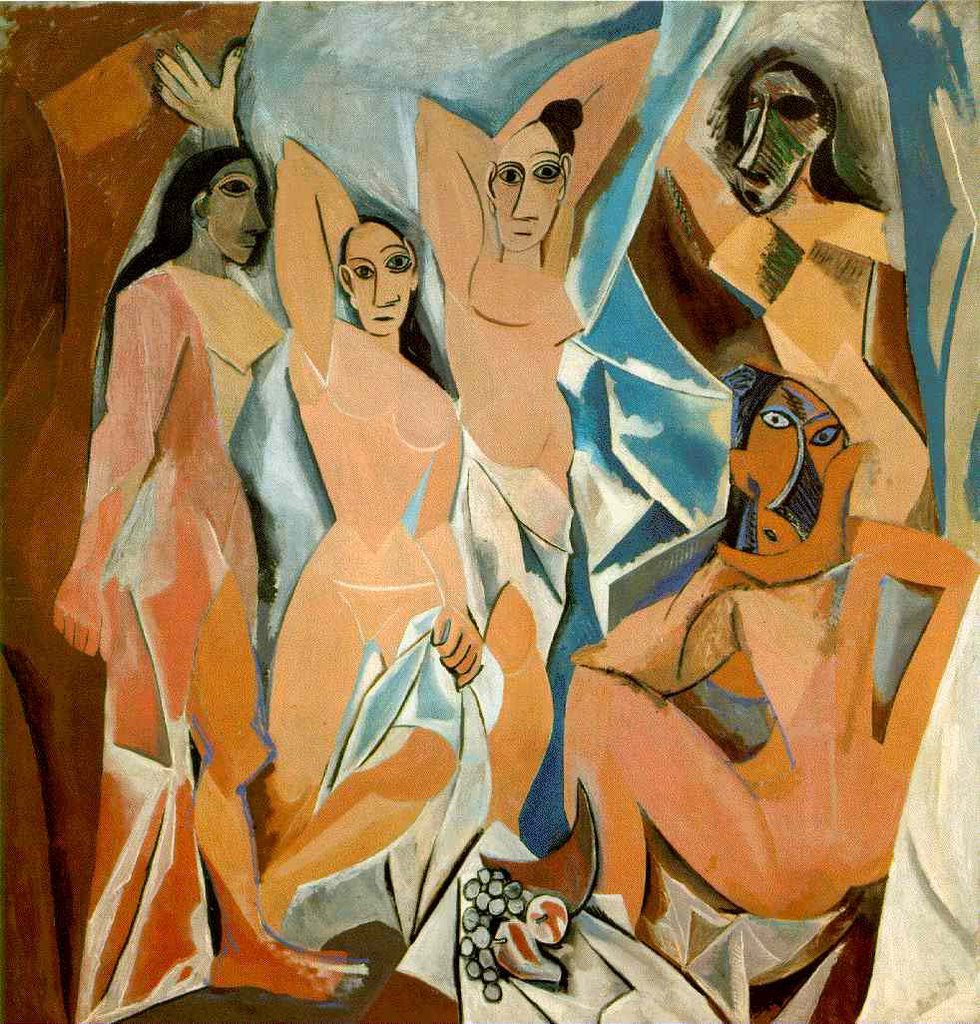
Imagine if Picasso had received a "cease and desist" order from reps for the African sculptors who inspired his seminal 1907 classic Les Demoiselles d'Avignon. He might have painted Blue and Rose people for his entire career!

Sunday, November 13, 2005

A Funny Thing

The other day, as my nine-year-old son Daniel sat on the couch leafing through a book called Star Wars: Incredible Cross-Sections, I began ripping Marianne Faithfull's 2000 CD Vagabond Ways onto my iBook.

For readers unfamiliar with Faithfull, she was a beautiful but vapid teenage folkie with a string of minor (and quite ghastly) hits in the mid-sixties who became famous as Mick Jagger's girlfriend, got heavily into drugs and alcohol, wound up a homeless junkie, then somehow re-emerged in the Eighties with the most extraordinarily poetic whore and whiskey voice ever heard in rock and roll (she also sings Kurt Weil, brilliantly).

I had gotten Vagabond Ways out of the library and I hadn't actually listened to it yet. As the eponymous first song was ripping it began playing -- a haunting, plaintive lament delivered with fifty-four-year-old Faithfull's world-weary grace.

Oh, doctor please, oh, doctor please.

At this point Daniel looked up from his book and said, "Dad, can we listen to something else?"

Well, there's no accounting for taste, I thought. I said, "This is great stuff..."

I drink and I take drugs, I love sex and I move around a lot.

At this point, I was looking right at Daniel, and he at me. I think I managed a slight comic roll of the eyes as I made my way calmly to the laptop to pause it and find "something else."

I had my first baby at fourteen.

Picture the scene. The music has stopped. Daniel and I are looking at each other. He has obviously heard this lyric, but I see no particular reaction -- though no particular disinterest, either. So I start laughing. And he starts laughing. And next thing we know we're both in hysterics, I because I have no idea what he's making of what we just heard, and he for some unknown reason -- perhaps because he's smart enough to know transgressive when he hears it.

Beautiful moment.

-----------------------------------

We spent the rest of the afternoon listening to Beethoven's Wig.