Wednesday, August 17, 2005

The Real One that Didn't Get Away


Ota Janacek
Czech, 1981
Yugoslavian Fisherman

Tuesday, August 16, 2005

The One That Didn't, Part 2 -- The Castle

So I got this amazing book for twelve dollars, the copy of Hofzinser given by Faucett Ross to Dai Vernon back in 1932. And I actually KNOW Vernon, not well, but I see him all the time at the Castle and I've hung out with him on a few occasions. He's even seen my act in the Close-Up Room; he said, "Very nice!" on the way out and I have to believe it was more than courtesy that he said it.

It's 1990, Vernon's 96 years old, and here's this book he signed in 1932, when he was already 38, and I realize, "Jesus, he's been around for a helluva' long time!"

So when I get back to L.A. I call up my buddy T.A. Waters, the brilliant mentalist who wrote "Mind, Myth, and Magic," one of the, oh, ten best books ever written on mentalism. T.A.'s one of those remarkable people who know quite a bit about a wide range of subjects, with a specialty in the subterrenean side of things, the occult, the strange, the magical, and the dark. But he's not a dark guy; he's a lot of fun to hang out with. And I'm pretty sure he likes me, because I'm smart.

He taught me a lot, particularly that you could be very smart and very knowledgeable (about magic and other things) and believe, based on the evidence you have seen and the people you know, that the world is stranger than any of us really think. Yes, T.A. was definitely one of the more influential people in my life.

So I tell T.A. about this amazing find, this book given to the Professor (as Vernon was known to the magical community) back in 1932. And I tell him it must be worth a pretty penny. And he says, "Well it would have been worth more a few years ago, but the book's been reissued so it's not as rare anymore." I remember being surprised at how non-savvy he was about collectibles. It seemed obvious to me that the main value in the book was in its extraordinary provenance, not the rarity of the book itself.

But my question to T.A. was, "Should I return it to him? I only paid twelve bucks for it and I think it might be cool for him to get it back."

T.A.'s answer was classic. "Well, he gave away everything he ever owned so I doubt he'd want it back. But if you do give it to him, you should definitely wait until Larry Jennings and Bruce Cervon [well-known "inner circle" close-up magicians who frequented the Castle for years in order to hang around and learn from Vernon] and a few others are there with him and see you do it. You don't need to be excessively honorable."

The truth was, I didn't really want to give it back to Vernon, since I knew it was valuable, both dollarwise and as a fascinating, unique collectible. But I thought it would be noble to try. So I went to the Professor the next time I was at the Castle and told him about the book. "Do you want it back, Professor?"

"No, I don't want that back!" he said dismissively and without further interest. So I had it free and clear.

The next time I went to the Castle, which was a few days later, I brought the book. I showed it to John Carney, who had studied with Faucett Ross while growing up in Iowa (Carney had the best line ever about Iowa: "When I tell people I'm from Iowa they always say, 'Oh Iowa! I've been to Columbus...[pause]...and I love potatoes!'")

So I showed it to Carney and he took one look and said, "That's Faucett's handwriting," which really made it more "real," somehow.

And on that night, Larry Jennings offered me $500 for it, and Jim Patton (the Magical Bartender) sighed when he saw it and then snorted when I told him what I'd paid for it. And up in the library (it was still "up" in those days, before it moved to the basement), I showed it to some guy I didn't really know who said he was a collector. He offered me $500 for it, too.

That was fifteen years ago. Vernon is long gone, Jennings is gone, T.A. is gone, Bill Larsen, the magical owner of the Magic Castle, is long gone...

But I've still got my book.

Sunday, August 14, 2005

The One That Didn't - Part One

What an interesting experience, this blog! On my last post, the great item that "didn't get away" is a magic book I found for a super bargain price (more on that in a moment). However, rereading the post I suddenly realized it's NOT about the book, which I got for a song (hence no heady deliberation and choice of options to buy or not to buy), but about a particular painting my soon-to-be-ex-wife and I aquired in Prague for our tenth anniversary. So I've decided to split this into two separate stories, both interesting in their own way.

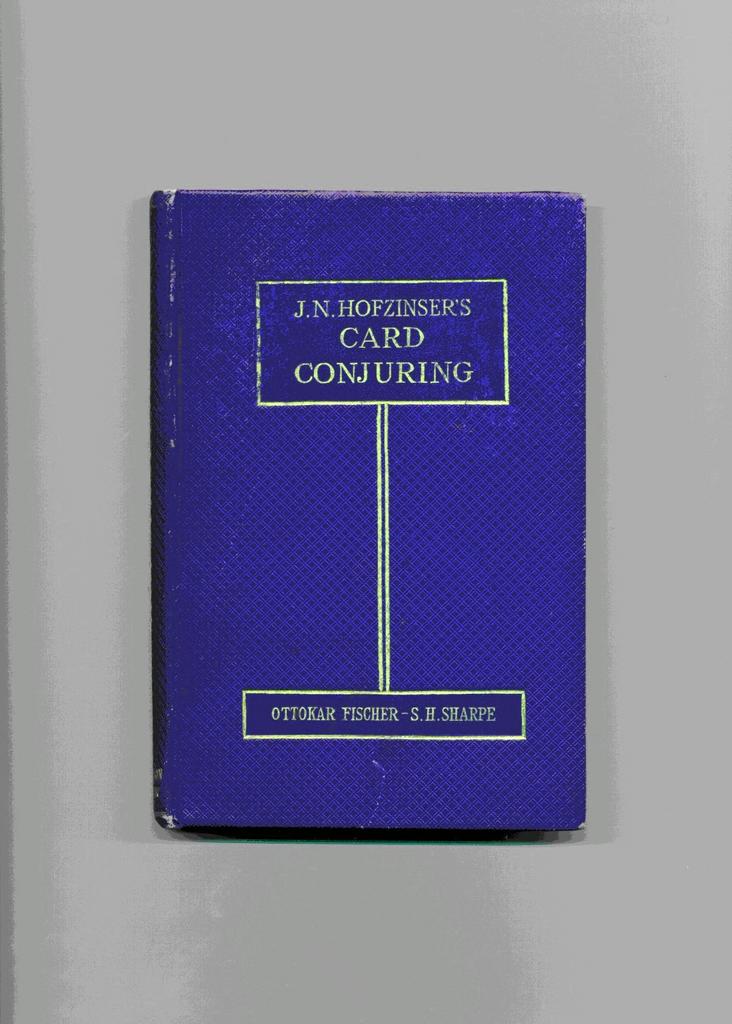
It's August 10th, 1990 (I still have the receipt), and I'm visiting a friend in Chicago, on the campus of my old alma mater, the University of Chicago. I pop into Powell's Bookstore, a famous used book store on 57th, right in the neighborhood. I'm perusing the used magic books (in the "Games" section -- shows you the respect with which magicians are held), and out of the corner of my eye I see an old blue spine with gold lettering, "Hofzinser."

Hofzinser, for my non-magician friends, was a stupendous "drawing room" conjuror in nineteenth-century Vienna. He invented a number of standard moves and, more importantly, plots, in use by card magicians to this day. Ricky Jay included a tribute to Hofzinzer in his Obie Award Winning Ricky Jay and His 52 Assistants, closing the first section of his show by performing one of the master's elegantly structured tricks.

So my hand shot out and grabbed the book, hoping against hope that it wouldn't be fifty dollars or so, since I knew I'd be tempted but didn't really know what the book was worth.

The book turned out to be the first English language edition (by S.H. Sharpe in 1931) of Ottokar Fischer's classic work, Hofzinser's Card Conjuring (1910), a book that was to have an enormous impact on the whole generation of close-up artists who "set the ground" for modern close-up, all the way up to Dai Vernon, who famously attributed his advice to "be natural" directly to Hofzinser.

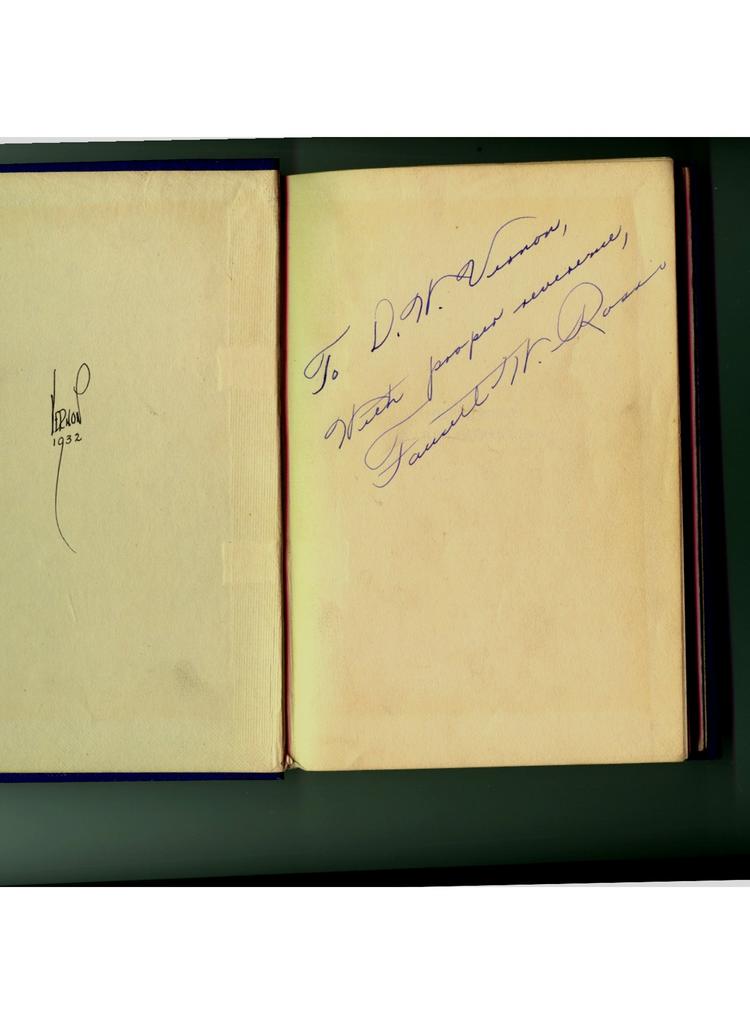
As I checked the inside cover I was delighted to see a price of $12 on the inside cover, a bargain for this book, even fifteen years ago. But I was even more delighted to see the inscription, "To D.W. Vernon, with proper reverence, Faucett W. Rossio."

In other words, this is a copy of Hofzinser that Faucett Ross (as he's better known to magicians), friend and confidante of Vernon's (and later mentor to noted close-up performer and teacher John Carney) gave to his buddy Dai Vernon. And, Holy Shit! Vernon himself signed and dated it "1932!"

Twelve bucks. THIS one I got! And since I'm tired, you'll have to wait until the next post for the story of what happened when I went back to L.A. with the book and showed up at the Magic Castle with it.

And then after that, the real One That Didn't Get Away -- and why maybe it should have.

Friday, August 12, 2005

Ones that Got Away (and One that Didn't)

Everyone has a story like this. Back in 1963, my aunt and uncle in New York went to the fiftieth anniversary exhibit commemorating the legendary 1913 Armory Show, in which America got its first major public glimpse of such future modern luminaries as Picasso, Braque, Matisse, Brancusi, and Duchamp (whose Nude Descending a Staircase #2 was a scandalous cause celebre).

So my aunt and uncle were checking out the show, perusing these now-legendary paintings, some of which were for sale (priced in the six-figure range, which was a lot of money back then). There were also paintings by well-known "second wave" Moderns for sale, too. The one they fell in love with, the one that tempted them, was an early painting by Stuart Davis, which was selling for the eminently-reasonable-but-too-much-for-young-teachers price of $12,000.

They came, they saw, they were very tempted...but in the end they decided that what must have been a year's salary (I'm guessing here, actually I have no idea) was a bit too dear to spend on a piece of art, lovely or not.

I have no idea what a Stuart Davis sells for these days, but I'm sure you could add a couple of extra zeros to the 1963 price and probably still fall quite short...

My own experience like this happened about fifteen years ago in L.A. I was wandering through a very nice art gallery in Santa Monica and I happened upon an extraordinary piece of art glass unlike anything I had ever seen before. It was dark electric violet with a a rather striking yellow accent, about two feet tall and shaped like a willowy flowing sea creature. The price was $6000, which was too much money for me to seriously consider-- but low enough for me to seriously consider (IF you know what I mean).

The artist was, it turned out, a pretty famous glass artist with his own glass school in Seattle; I looked through a book of his work and vowed to remember his name.

My more art-centric readers will no doubt have guessed that the piece was by Dale Chihuly, now an internationally famous artist (not just "glass" artist) and an artist for whom smaller, inferior works fetch $25-50,000. The piece I passed on looked somewhat like the one below, but much much nicer: a bit taller and darker (dark electric purple with a psychedelic yellow accent) and more vaselike, and more flowing. And backlit, like the one in the photo.


I'll swear to this day that I've yet to see another Chihuly piece as nice as the one I passed up. Damn. If only...

Chihuly's forms have been heavily imitated over the past fifteen years, but back then this was a stunning and unexpected piece. Chihuly almost single-handedly transformed the field of blowing glass into an accepted, legitimate Art. I consider him to be as important an artist as Frank Lloyd Wright, and would be honored to have his work in my home.

Truly, the increase in value of the piece would be immaterial to me; If I had it I'd never sell it.

Next up: The extremely nice magic-related collectible that didn't get away, or My very very very good day at the used bookstore.

Thursday, August 11, 2005

UPDATED: Hip-Hop and the Mainstream - Growing Pains

It seems that whenever I post about hip-hop my darling readers become inflamed, but in this case I can't resist. The SF Chronicle has an article in the Datebook section today titled Who would have thought it? Rap legend RZA hangs out, chats at Commonwealth Club gig.

It's a pleasant enough article, but the premise -- that it's somehow newsworthy when a hip hop artist gets taken seriously by the straightlaced Commonwealth Club -- demonstrates clearly just how out of touch the mainstream press really is, even in left-leaning San Francisco. After all, as a founding member of the seminal hip-hop collective Wu-Tang Clan and a successful film composer to boot, the 39-year-old RZA is a major modern artist by almost any standard. The fact that he's (presumably) virtually unknown to a large percentage of the Chronicle's readership is as much a commentary on their ongoing failure to adequately cover an important artist than on the supposed "clash of cultures" being covered.

My fur ruffled a bit at the opening paragraph:

What becomes a legend most? When the legend in question is the man behind one of the most influential hip-hop crews in history, the answer is not a public affairs forum such as the Commonwealth Club. But then, most musical artists don't philosophize about chess and martial arts and Islam and the mythology of organized crime.

Notice the patronizing tone and assumption of that last sentence, that "musical artists" (a clever shorthand for "hip-hop artists") are not cultured, educated about their work and the world around them, or diverse in their interests. If you doubt my take on this, try to imagine that a pop writer like, oh, Stephen King was the subject of the article instead. But then, most writers don't philosophize about chess.... Or how about if the article was about a different kind of "musical artist?" But then, most opera singers don't philosophize about chess....

In any of the above examples, readers would immediately smell something foul. "What do you mean, 'Most writers don't philosophize about chess...?' Writers are an intelligent, worldly lot!" Apparently, this kind of inherent respect doesn't extend to hip-hop artists, at least in the SF Chronicle.

Somewhat later in the article (on the back page), writer Neva Chonin asserts: It shouldn't have worked, this collision of disparate worlds of a stodgy public affairs forum and a profane street poet.... This would seem to score one for hip-hop, but is it necessary to refer to one of the most successful and influential recording artists of the last decade as a "profane street poet?"

Just calling out for a little respect, that's all. The day hip-hop is truly accepted as another valid art form will be the day a visit to the Commonwealth Club by a hip-hop artist ceases to be news.

UPDATE - August 31, 2005

Today's Chronicle has a letter to the editor (scroll down a bit) from one Max Woodworth in Taipei, Taiwan (I guess the mail from Taiwan travels really slowly). Woodworth essentially covers the same ground I did (though much more eloquently) in six paragraphs. I like his closing section:

...The forum could not have been a testament to hip-hop's "new place in the cultural canon" for the simple reason that hip-hop is not new, neither as an art form nor as part of our cultural canon. Practically every facet of our popular culture bears the marks of hip-hop, and this has been the case for about 20 years.

From speech to clothing to mannerism, hip-hop is everywhere and has been for a long time. The real shock should be that RZA hadn't been invited a decade ago to the Commonwealth Club. But I'm grateful, at least, that the forum was covered. It's a start.


As an update to my update, I Googled "Max Woodworth Taipei Taiwan" and discovered that he is a correspondant for the Taipei Times. At least, I assume he's the same Max Woodworth; I'll let you know if anything else turns up.

Monday, August 08, 2005

LSD and Schizophrenia

In a comment last week, JB asked: Have you ever thought that perhaps schizophrenics are in a permanent state of delusion, much like someone on LSD or some other hallucinogen?

This very view dominated psychedelic research in it's first ten years, this notion that LSD mimicked psychosis or schizophrenia. It wasn't until the 1960s that a different paradigm emerged to describe the effects of psychedelics, when people who weren't researchers started to use them recreationally and, echoing their use throughout history, sacramentally.

In fact, I disagree with the inherent premise of the question, that LSD and other psychedelics create delusional thinking. People seldom become delusional on LSD; certainly it can happen and certainly this aspect of LSD seems to be very similar to what many people believe the experience of schizophrenia to be like. But overwhelmingly it's the wrong metaphor -- for both psychedelics and schizophrenia.

The most interesting work with psychedelics arises from their use in illuminating aspects of the physical, emotional, spiritual, or metaphysical world we live in. Schizophrenia, on the other hand, is pretty much defined by the inability to accurately perceive one of more of these aspects and the concomitant inability to function in the real world. Psychedelics like LSD can be extremely useful in sensitizing therapists to the "real feel" of schizophrenia by illuminating the kind of extreme shifts in consciousness experienced by those suffering from the disease. But therapists should never forget that their ability to distinguish psychedelic effects from "normal" consensual reality sets them apart from true schizophrenics.

Interestingly, in the early years of LSD research (1950s and early 1960s) LSD was explored as a treatment for schizophrenia. Check here for an overview of some early, extremely promising research with schizophrenic children. Can you imagine the brave soul who would ask to try out such research today?

Unfortunately, all research was abruptly halted in 1966 when politics overrode science and LSD was outlawed. The extraordinary potential of these substances remains tragically underexplored, although groups like the Multi-Disciplinary Association of Psychedelic Studies (MAPS) are doing yeoman's work in fighting for funding and approval for research into these substances. A brief perusal of their site gives hope that we are entering a new age of psychedelic exploration.

God, I love this blog!

Not much to add, except it's one more miracle brought to me by the Internet! Lemme' hear a "Hallelujah!"

Seriously, man, I just love that I have place to throw out ideas as I see fit, to try to pour the most interesting parts of myself out there into the world. Obviously, there are areas I don't go into, but by and large my passions are on the screen for all to see. I've been without evening Internet access these last couple of weeks so my posting has tended to be of a less personal nature. (I can't compose a personal entry at work, that just doesn't...work, for me.)

Perhaps as aspects of my personal life become clearer I'll be more inclined to post about them. Perhaps.

I'm also thinking seriously of starting a spinoff blog for my film reviews. That way, others who love film as I do will have a place to go see my (hopefully interesting) take on various films without having to dig through this blog to find them. I think I have excellent taste and a unique background, having studied film extensively (with the late Gerald Mast, author of numerous standard texts on film history) and having also worked in the film industry in the late Eighties/early Nineties, in L.A., New York, and Prague.

At any rate, even if absolutely no one wants to read them, at least I'll have a place to put all my reviews and an extra, public motivation to keep doing them...

Saturday, August 06, 2005

The Iraq War Fatalities Project

I have added a link at right to the elegant and elegaic Iraq War Fatalities Project. I note that Iraqi casualties are not listed, which makes the war, terrible though it looks, seem signifantly less obscene. With civilian casualty estimates ranging from 25,000 to 100,000 or more, it is important to remember Robert Fisk's comment that, "War is about human suffering and death."

Is this being done in my name?

Wednesday, August 03, 2005

R.I.P. Mark Chorvinsky

Mark Chorvinsky, founder of Strange Magazine has died of cancer at 51. I knew Mark somewhat when I worked at Dream Wizards, his legendary gaming store in Rockville, Maryland way back in the (gasp!) late Seventies. I was never into gaming; I worked the magic counter (at one point, I demoed magic at Dream Wizards and the late great Al's Magic Shop at the same time).

One of the fellow magi I used to hang out with was a talented kid named Alain Nu, who now has his own TV show. On the Magic Cafe Forum a couple of weeks ago, Alain said, "I really mean it when I say that [Chorvinsky] was my greatest influence in mentalism. He was the man who showed me the 'real world' of strange phenomena!"

Unfortunately, at the time I was working for Mark I was a diehard CSICOP skeptic. I knew nothing and cared nothing about the serious investigation of strange scientific anomolies; as far as I was concerned, it was all bunk and those who took such subjects seriously were deluded cranks. Not the best attitude to take if I wanted to be friends with Mark!

Mark was definitely ahead of his time in both the world of gaming and that of borderland scientific research. I wish I could have had the chance to meet him again as an open-minded adult.

Tuesday, July 26, 2005

Funny Bitter Bush Jokes

McSweeneys has a fabulous article by Matt Alexander called, ALTHOUGH I LIKE A GOOD GEORGE W. BUSH JOKE AS MUCH AS THE NEXT GUY, SOME OF THEM SEEM GRATUITOUS AND MEAN-SPIRITED. Some of the highlights:

A doctor, a lawyer, and an accountant all die and go to heaven on the same day. When they get to the Pearly Gates, they are greeted by St. Peter. St. Peter says, "Scott McClellan is a lying sack of shit and I'd tell him so myself if he weren't going straight to hell when he dies."


Did you hear that Bill Clinton hired a new intern? It turns out that his old intern had to go home and spend time with her family after her brother was killed in Iraq.


Ouch!

1. Drop Acid 2. Jump Out the Window

The title refers to a famous urban legend suggesting that many hippie kids took LSD and jumped out of windows, thinking they could fly. In fact, psychedelic historians are forever pointing out that there's only one documented case in which LSD and window-jumping are linked, that of U.S. Army/CIA germ warfare researcher Frank Olsen, who was famously dosed by the evil Sidney Gottlieb in 1953, went psychotic, and jumped out of a hotel window to his death a few weeks later.

Now it turns out even this story might have been a cover for a more ominous truth underneath. In his new book A Voice for the Dead: A Forensic Investigator's Pursuit of the Truth in the Grave, George Washington University Law and Forensic Science Professor James Starrs (who's best known for his new autopsy on Jesse James) devotes an eye-opening chapter to the Olsen case. Working with Olsen's son Eric, Starrs and a distinguished team of forensic specialists exhumed Olsen's body, conducted a fresh autopsy, and concluded that Olsen received a blow to the head before he "jumped" out the window. Based on this and other new research, Starrs suggests the CIA had Olsen murdered when they discovered he was about to resign (and possibly go public with his dirty knowledge) following a suddden flowering of conscience.

The full text of Starr's chapter on the Olsen investigation is available here, as part of the Olsen family's Frank Olsen Legacy Project, a website devoted to the circumstances and investigation surrounding Olsen's life and death. Starr's conclusion merits repeating:

From my view and that of the clear majority of my team members, with all the other investigative details, as well as what we found scientifically, Dr. Olson's death was not a suicide. The probabilities, taken together, strongly and relentlessly suggest that it was a homicide.

-----------------------------------------------------

I'm sure it's a bit boring to read my constant hat-tipping to BoingBoing, but they keep delivering the goods. They first covered the venal Sidney Gottlieb here in an excerpt from editor Mark Frauenfelder's new book THE WORLD'S WORST: A Guide to the Most Disgusting, Hideous, Inept and Dangerous, People, Places and Things on Earth (Gottlieb took the "Maddest Mad Scientist" nod). After several reader comments (featuring more good links), Frauenfelder followed up with this story from another reader, plus comments with even more links.

An intriguing ancillary thread for magicians is the weaving in and out presence of John Mullholland, New York magi and eventual accumulator of the astoundingly large Mullholland Collection of magic books and memorabilia (formerly curated by Ricky Jay, now owned -- at a cost of $2.2 million -- by David Copperfield). Apparently, Mullholland worked for the CIA, training them in secret methods of delivering coded messages and surreptitious poisons, as well as other black arts. He was contracted by the CIA to write a book on the subject, though it's not clear whether he actually ever wrote the book. If he did, it remains classified to this day.

Monday, July 25, 2005

Wow, a mention in Slate!

I just discovered (by accident) that Bidisha Banerjee mentioned my recent post on the Pear research in his June 20th blog roundup in Slate. I did a Google "I'm Feeling Lucky" search for PeaceLove's Musings and Banerjee's column came up. Scroll down past the Judicial appointments discussion for the brief mention.

Slate is owned by Microsoft and is one of the best-known news sites on the web. How exciting -- for me, at least!

Thursday, July 21, 2005

Art of Science

Princeton has announced the winners of the First Annual* Art of Science Competition. From the site:

This spring we asked the Princeton University community to submit imagery produced in the course of research or incorporating tools and concepts from science....

The resulting assembly of images presents a fascinating and beautiful cross section of the arts and sciences at Princeton. It celebrates the aesthetics of research and the ways in which science and art inform each other.


The image above didn't win, but it's my personal favorite (probably due to my longstanding love of Kandinsky and the Constructivists). It's called Dynamic Asset Allocation in Freight Transportation, and it's modeled from a PhD dissertation relating to "stochastic, integer multicommodity flow problems" (there'll be a quiz on this later). Fallopian (below), which depicts its namesake as seen from a uterus, is also quite stunning.


Check out the whole gallery here.

---------------

* I had an English teacher in high school who hated the term "First Annual." "How can the first of anything be 'annual?'" she would ask. You can PLAN for it to be annual, but it won't be 'annual' until at least the second time it happens." Well, I guess Princeton disagrees with her.

Was I misinformed, all those years ago?


(Thanks to BoingBoing for the link.)

Wednesday, July 20, 2005

Fleep

Fleep is an amazing existential journey in 42 panels. Creator Jason Shiga says:

[Fleep] is about a man who wakes up in a telephone booth which has been mysteriously selaed in an envelope of concrete. Using only the contents of his pockets (two pens, a paperback novel, three coins and 20 ft of unwaxed dental floss) our hero must fashion and execute an escape plan before he runs out of oxygen.

The results are spare and gripping. Unfortunately, Shiga seems to have dropped off the map; the most recent news I could find on him is on his website from September, 2003.

------------------------------

Tip O' the Hat to Magic Circle Jerk for the pointer.

Tuesday, July 19, 2005

From Wired News: Mind May Affect Machines

Well, it sure is nice to see coverage of parapsychology (psi) research showing up in a fairly mainstream source like Wired News!

This article reports on research at the Princeton Engineering Anomalies Research program (Pear) purporting to show that our state of mind can have subtle but significant effects on machines. Longtime readers (over two months!) will recall that early on I posted a back and forth debate on the merits of parapsychology research (see here, and then, if you're still interested, here, here, here, here, and here). The gist of the argument against psi research seems to be that 1. it does not follow the standard rule of being replicable in a variety of settings and conditions, and 2. the results make no sense according to current scientific knowledge and therefore must be wrong.
The Wired article pretty much avoids addressing the second point, but it does a good job illustrating the controversy at the heart of the first, quoting skeptics who tried and failed to replicate the experiments as well as discussing meta-analyses done over the years that have found the effects to be real, significant, and replicable. And they quote Dean Radin, who I cited in my previous posts:

Radin, who is not affiliated with Pear, dismisses critics who say the group isn't practicing solid science.

"This field has received far more scrutiny and criticism than many other ordinary fields," Radin said. "The people who do this kind of research are well aware that their research has to be done better. The Pear lab has taken the best principles of rigorous science and applied it to extremely difficult questions and come up with some pretty interesting answers."


No new ground is covered here, but it's nice to see a balanced view showing up someplace where intelligent, informed people can actually have a chance to consider both sides of the issue and draw their own conclusions. Even if your own conclusion is that there's not enough information to draw a definitive conclusion, this is a big improvement over the credulous paranormal coverage found in tabloid television or the biased anti-psi slant that generally permeates the mainstream media.

I predict that a revolution in how we perceive the interaction of consciousness and the "material world" will happen within our lifetimes. Stay tuned.

Monday, July 18, 2005

Houdini Speaks! - UPDATED

Courtesy of the massive Internet Archives ("Universal Access to Human Knowledge"), here's a 1914 Edison Wax Cylinder of Houdini pitching his Water Torture Cell. It's a rather stilted delivery, but at least you get to hear his voice.

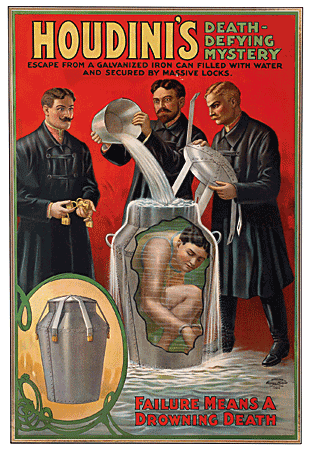
While we're on the subject, if you have an extra $50,000+ you might want to consider putting in a bid for the Milk Can poster below. The sellers claim it's one of only three extant original copies of the 1908 classic. Drool!

UPDATE: I was outbid. My high bid was $29.95 and the poster sold for $68,404. Damn. So close...

Monday, July 11, 2005

Incredible Optical Illusions - UPDATED


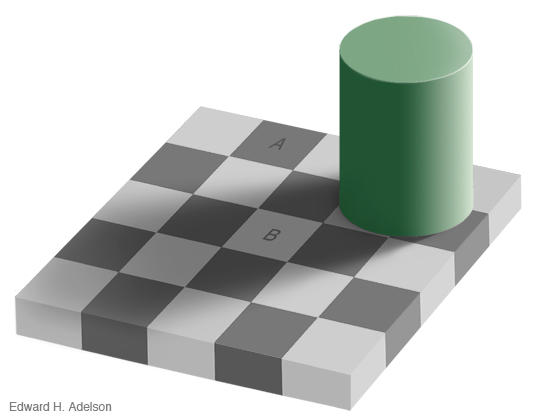
Check out the incredible optical illusion at left. It's one of those checkerboards in which two different squares, in this case A and B, turn out to be exactly the same shade of grey. (For a full explanation and proof, check here.) Normally, when I see these types of illusions I can kind of squint and see that they're actually the same. Not so with this one; I actually had to put Post-It's on my computer to convince myself! (see below)


Incidentally, if you're into optical illusions, the mother of all optical illusion pages is Akiyoshi's Illusion Pages. Akiyoshi Kitaoka is an Associate Professor of Psychology at Ritsumeikan University in Kyoto, Japan, and he specializes in the study and design of trippy "visual illusions" like the one below. Some of these are absolutely mind-blowing; you gotta' love a page with this serious warning at the outset:

Caution: This page contains some works of "anomalous motion illusion", which might make sensitive observers dizzy or sick. Should you feel dizzy, you had better leave this page immediately.


Tip O' the Hat (TOTH) to blogger.com for adding image capability right into their package. The Checkerboard Illusion has been around for a while, but I was recently reminded of it and called to really examine it by a report on Rocketboom, a fantastic daily 3-minute news roundup featuring the adorable Amanda Congdon. Rocketboom is pretty much what we all wish the daily news shows could be: incisive, sharp, and witty.


UPDATE: I forgot to also mention Caltech Professor Al Seckel's homepage, which contains much info about optical illusions including a whole section on his extraordinary book, Masters of Deception: Escher, DalĂ­ & the Artists of Optical Illusion. Also check out the vast gallery at eyetricks. Lots to peruse here!

Saturday, July 09, 2005

Brief Film Review - Code 46

Code 46 is a pretty spectacular film by Michael Winterbottom starring Tim Robbins as an investigator in the near-future (or alternative present) who uses "empathy" (essentially a form of high-tech mindreading) to figure out who has been smuggling forged identity chips out to the lower classes in a desert city called "Shanghai." He meets and falls for Samantha Morton (genius star of Morvern Callar and Minority Report), and finds himself covering for her when he determines that she's the culprit.

Code 46 manages on a very low budget the extraordinary task of creating a desolate futuristic world out of the present. It's most obvious stylistic antecedent is Goddard's Alphaville, in which modern Paris stands in for the city of the future. It's a weird, sad film about lonely alienated people, blending a kind of THX 1138 sterility with a postmodern glass and steel iciness in an ozone-hole world.

I used the term "spectacular" because it's the word that came to me most strongly when the film was over. The film isn't spectacular in the "spectacle" sense; in fact it's a rather low-key and detatched work. What's spectacular, to me, is Winterbottom and screenwriter Frank Cottrell Boyce's extraordinary control over tone and rhythm. Code 46 is spectacular in the manner of a Bresson film or a De Chirico painting.

Director Winterbottom is on my hero list for the ascerbically jaunty 24 Hour Party People, a free-wheeling film about the rise of Manchester's legendary Factory Records which, in it's heyday, produced killer acts like Joy Division and Happy Mondays. 24 Hour Party People was also written by Boyce, and it's astonishing to see two such 180-degree opposite works come from the same creative minds. I'd definitely put Winterbottom on my list of directors to watch, and I look forward to checking out some of his earlier collaborations with Boyce, like Welcome to Sarajevo and The Claim.

Cool Hamburger Trick

Here's a really neat video of Japanese magician Cyril Takayama Blaine-ing a bunch of spectators on the street. Now, if only he can turn hamburgers into veggie burgers...

Shout out to Pagliacci for the link and further info. If you're a magic fan, this is a good one to add to your Bloglines feeds.

Thursday, July 07, 2005

Cultured Meat?

I'm an ethical vegetarian, so I was intrigued by this story at We Make Money Not Art about the potential to produce meat in the lab.

Two new techniques of tissue engineering may one day lead to large scale production of lab grown meat that tastes like beef, poultry, pork, lamb or fish and has the texture of meat...

I'm not a fan of bioengineered food; the potential for unknown ramifications from both the use of these new "frankenfoods" and the elimination of Mother Nature's own natural whole foods is incalculable -- and scary as hell. On the other hand, I'm even less fond of the barbaric meat industry, with its pollution, waste, and lifelong torture and summary execution of billions of cows, sheep, chickens, and pigs. (KFC alone slaughters over 850 million chickens per year.)

Frankly, I'd prefer if the whole world went vegetarian, but this at least offers hope to reduce the total cruelty in the world. Manufacturing meat would also end the rampant overuse of antibiotics (over 70% of the antibiotics in use go to farm animals).

All in all, since I'm not going to eat it anyway, I'd opt for the Frankenmeats.