Showing posts with label Personal. Show all posts

Monday, January 23, 2012

Steve Aoki & Datsik at the Bill Graham Auditorium

I accompanied my 16 year old son and his friends to the Bill Graham Civic Auditorium Saturday night to see Rockstar Energy Drink Presents Dim Mak's Deadmeat Tour featuring the young dubstep hotshot Datsik and superstar producer/DJ Steve Aoki. Crowd: 7000.

Okay, first of all I was one of the oldest people in the place. The kids all had a great time. Average age of the crowd: 17. Average girl's shorts length: micro-mini (not that I noticed). For boys in the target demographic, there's a lot to recommend about this concert.

I'm a big electronica fan, so I'm comfortable with the genre. Datsik had a strong set and tore up the joint. He was the reason my kids wanted to come; they didn't really know much about Aoki before tonight. I suspect a lot of the boys in the audience were brought in by Dasik, who plays a pretty industrial brand of dubstep.

The girls were there for Aoki and they went wild. For my money, his set was somewhat generic. I'm not into corporate-sponsored music, with tour sponsor Rockstar being a particular target of wrath, both for their connection to gaybasher/hatemonger Michael Savage and for just basically peddling addictive, caffeinated shit to young people. Largely absent was the spirituality and tribalism of a genuine rave. Aoki mainly set a tune spinning then got up and pranced around the stage like a rock star.

Aoki's schtick is spraying champagne and cake, which seemed kind of pointless to me. Is he trying to establish his punk bona fides? I guess I like my art to have a point. Color me picky. Years ago, raves eschewed cult-of-personality deification; they were all about the music and the tribal gathering. Raves were anti-establishment gatherings, often held in secret. How far we've come! (Fallen?)

I read somewhere that Aoki started out politically active. While at UC Santa Barbara he majored in women's studies and immersed himself in the punk scene. Somewhere along the way, he decided to let that go. Why? Perhaps that's a natural progression; Aoki is a 1%er from a world of 1%ers. His dad Rocky Aoki founded Benihana restaurants, his half sister is the supermodel Devon Aoki.

This concert felt like a well-oiled corporate machine. I was a bit put off that Aoki had a merch signing at 9, right in the middle of Dasik's set. The timing seemed pretty disrespectful toward his fellow artist. 


During the show, I and all 3 kids with me got separately approached and asked if we knew where to find "pills" (ecstasy). Although I'd prefer my son and his friends avoid such substances, I also want them to be safe. I warned my kids they should assume anyone asking like that is an undercover cop. Our toxic drug war and criminal justice system is far more dangerous to kids than any drugs.

Worst moment: After the show, we fought our way up to the front to quickly buy a couple of shirts then get in line to have them signed by Aoki (another signing). A particularly thuggish security goon named Rick (he tried to intimidate me when I asked his name) was yelling out, "IF YOU'RE GOING TO BUY SOMETHING, BUY IT! IF NOT, MOVE ON!" Then Rick yelled out, "HE WILL ONLY SIGN THINGS YOU BUY RIGHT NOW!" I explained that we were holding shirts we had just bought 30 seconds ago before we got in the signing line. Rick yelled again, "HE'S NOT SIGNING IT. HE'S ONLY SIGNING THINGS YOU BUY RIGHT NOW!"

So my son had to leave with his brand-new Aoki shirt unsigned. This abusive guard was yelling at all the kids ten feet away from Aoki and he never said a thing about it. Not a pleasant way to leave the show.

But all the beautiful kids had a good time, so I can't really complain too much. The high percentage of girls in attendance seemed to helped ensure all the boys pretty much behaved themselves. I never saw any unruly behavior or ill-treatment. 


Kudos to the Bill Graham Civic Auditorium for having water fountains on both sides of the hall. I assume they're required by law to have them (no doubt they eat into those $3/bottle water sales) but they make for a much safer and more pleasant concert experience for all the pacifier-sucking #MollyPills kids.


I dig Aoki's energy, and he seems like a genuinely nice guy. But I wish he held on to a bit of his early activism. He seems to have made peace with the establishment -- hell, he seems to BE the establishment -- and for an artist that's never a good thing.


Tuesday, August 10, 2010

Joel E. Siegel's 1982 Blade Runner review

Bill Blackwell's my new hero. He dug up the legendary 1982 Blade Runner review by Joel E. Siegel of Washington's City Paper.


Well, legendary in my own mind, at least. Joel E. Siegel, a jazz critic and teacher at Georgetown, was also the amazing film critic for the Washington City Paper. He was perhaps the first critic I ever really trusted; so often he pointed me to films that were great, or steered me clear of the phony and dishonest. Most importantly, he was the critic who "got" Blade Runner even as so many other critics I read didn't.

If I remember correctly, the general impression of Blade Runner among the mainstream critics was that it was a basically unsuccessful attempt to meld science fiction with the hard-boiled detective genre. Siegel, on the other hand, knew it was something special. He didn't know what, exactly. But he knew underneath the occasionally-ridiculous surface was something entirely new, something rare and shudderingly beautiful.

I read that review as a high school senior and I knew at once I had to see the film. So I watched Blade Runner. What Siegel saw was obvious to me, too.

I actually spoke to Siegel many years later, after Blade Runner had become an acknowledged classic with its influence seen everywhere. We first commiserated about the fact that he shared his name with the mustachioed douchebag film critic from Good Morning America, and he told me stories about his former colleague John Powers (another hero critic of mine, who I had read back when he wrote for the LA Weekly). Then we spoke about his Blade Runner review. Siegel said he had recently reread the review and he remembered the trouble he felt putting his feelings into words. He and I both agreed it remained perhaps the best cyberpunk film ever made.

Flash forward to 2007 and my post on Hidden Gems, in which I mentioned the Siegel review. In an aside, I lamented that the review wasn't available online. I must have communicated in that aside that I would really love to read the review again.

And there, for three years, the story rests...until today, when one Bill Blackwell sends me the following email totally out of the blue, no introduction, just this, along with -- MIRACLES! -- the original Joel E. Siegel review:

Like you back in 2007, I went in search of Joel E. Siegel's City Paper review of Blade Runner on the Net. Everything may be here somewhere, but not Joel's review. The City Paper's search system was no no help. I called the paper. I had to explain to two people there that they once had writing for them THE film critic of DC. No luck. The last option was to descend into my basement and look through my files. The review was there, but it was missing the date of publication, though it has to be from a July, 1982 issue. I hope you still have an interest.

(Oh I do, I do! Thank you, thank you, thank you, Mr. Blackwell!)


Sharp Blade: Ridley Scott’s Visual Banquet


By Joel E. Siegel
Washington City Paper

In 16 years of movie reviewing, I've never had as much trouble writing a column as this one. I've seen Blade Runner twice and have tried for three weeks to come to terms with it, but I still feel tongue-tied trying to deal with the critical problems it poses. It's easy enough to pinpoint the film's flaws, particularly its poorly written and developed screenplay and Harrison Ford's unambitious, crushingly dull performance. Yet I don't think I've ever been as spellbound at the movies as I was during both viewings of Blade Runner. In terms of design, special effects, and cinematography, it surpasses anything the screen has shown us so far. Each sequence, each shot, is brilliantly alive to the possibilities of what film can do.

Blade Runner deserves special membership in that fraternity of crazy, doomed films whose visionary achievements redeem cheesy ideas and slapdash narratives (D. W. Griffith’s Intolerance is probably the godfather of this group, which also includes Michael Powell's Stairway To Heaven, John Schlesinger's Far From the Madding Crowd, John Boorman's feverish duo Zardozand Exorcist 2 and, recently, Michael Wadleigh's Wolfen. It is perhaps no coincidence that most of the abovementioned filmmakers, like Blade Runner's Ridley Scott, are Englishmen, products of the culture that gave us visionaries like Milton and Blake.) What these films have in common, apart from critical and box-office failure, is the creation of worlds so obsessive, so vividly imagined and compulsively detailed that open-eyed viewers can't possibly dismiss them, no matter how strongly good sense says we should.

Blade Runner, set in Los Angeles in 2019, is a knockout from its very first shot—a long-held cityscape dominated by vast pyramidal structures and punctuated by buzzing aircraft and smokestacks belching flame. Early on, we learn that the city, like the film itself, is built on oppositions. Mammoth glass and steel highrises dominate the skyline; beneath them, in a gaseous half-light, sprawls a neon underworld, a mixture of Times Square and Hong Kong, where the darker and, the film suggests, least quenchable aspects of human nature hover in the shadowy, rain-swept streets.

This underworld is familiar to us. It's the tenderloin of a dozen world capitals, only dingier, more decadent, rotting in the future's noxious atmosphere. But the upper world, with its inlaid, highly textured, rectilinear motifs decorating both internal and external walls, is new to the eye. It looks like a universe designed by Louise Nevelson—elegant, tactile, chilly.

Scott and his talented crew of technicians have populated their world with wonders. Huge floating video cubes drift through the streets hawking candies and soft drinks. There's a cold storage Eye World where men in heated suits fabricate eyeballs for advanced robots. There's a television set capable of scanning, enlarging, and reproducing the most minute photographic details. (A complex photo-scanning sequence extends the visual and aural explorations of Blow Up and Blow Out. There's a lavish mansion in the sky filled with echoes of Citizen Kane's Xanadu, including a perched mechanical bird and an expansive, columned study. Scott mixes future with present, fantasy with reality. Long sequences in the film are set in the Bradbury Building, downtown L.A.'s most notable architectural landmark. But we see the Bradbury not in its restored spendor but in a state of ruin, with rain and debris staining its grilled walkways. The terrible and wonderful things about Blade Runner's view of the city of the future is how logically it extends trends evident in our present urban centers. The Oliver T. Carr malls and condos that nestle alongside slum apartment houses and strip joints are the roots of Scott's bi-level metropolis.

The narrative and dramatic elements of Blade Runner are not worthy of the film's visionary style. The Hampton Francher-Davis Peoples screenplay, adapted from Philip K. Dick's novel Do Androids Dream of Electric Sheep? attempts to transport a Raymond Chandler-like protagonist into the world of the future. In theory, the mixture of genres could work. After all, hardboiled detective fiction and sci-fi usually deal with the same question: how can one retain human values in an increasingly indifferent, mechanistic universe? But, as attempted in Blade Runner, the marriage of genres barely extends beyond self-congratulation over the originality of the conceit. The writers seem to feel that the very idea of placing a tough-guy hero in the midst of a futuristic city is so clever that no further development is required. As a result, the script is often foolishly coy; our intelligence is insulted while our eyes are being dazzled. Francher and Peoples aren't much better at exposition. Chunks of >action and motivation are missing, signs perhaps that the film was extensively cut before release.

It's more than a bit sentimental to believe that a Chandleresque character could survive the social and moral mutations that precede Blade Runner's society. (Even today, 37 years before the film takes place, one would have better luck enlisting the services of a private eye in the architectural anomie of Rosslyn or Crystal City than in the sleaziness of 14th Street. Today's tough guys have lost their affinity for the gutter.) According to rumors, the film's producers lost faith in the script's mating of tough guy and sci-fi during the final editing stages. Director Scott was reportedly taken off the picture, a voice-over narration was added to clarify the action, and a cop-out happy ending was patched on to lighten the film's deeply pessimistic view of the future.

The plot is a reworking of Fritz Lang's Metropolis and Jean-Luc Godard's Alphaville. (Both films are set in futures where people live in servile, robotlike existences, and Godard's picture even has a private eye protagonist.) Replicants, sophisticated robots designed for slave labor, have been created for use in colonizing remote "Off World" settlements. These replicants look exactly like human beings, and are as smart and far stronger than the people who created them. Six replicants, aware that their four-year termination dates are up, illegally return to earth and infiltrate Los Angeles. Former enforcer Deckard (Harrison Ford) is brought out of retirement to "retire" them. As in both versions of the classic Invasion of the Body Snatchers,  the only thing that separates replicants from humans is emotion; they have no real feelings or memories.

Deckard, a withdrawn man, is virtually a replicant himself, such a cold fish that he's known to his ex-wife as "sushi." Disciplined and repressed into mechanical numbness, he is awakened to feeling when he meets Rachel, an advanced experimental replicant who has been implanted with feelings and memories. The cool killer is surprised by a longing for tenderness and decency. The dialogue and screenplay indicate that Deckard is a man quietly at war with his vestigial conscience, a zombie with an appendix soul. Unfortunately, Harrison Ford's performance as Deckard is the ultimate expression of Hollywood he-man emptiness. In the great tradition of macho stiffs like Gregory Peck, Glenn Ford, and Dana Andrews, Ford numbly flexes his way through the film, never once suggesting any kind of internal conflict. It's a replicant performance, without a flicker of feeling or individuality illuminating the solemn male impersonation.

Deckard's climactic decision to run away with Rachel should yield a harrowing irony—the repudiation of a world of human beings grown so soulless that happiness and tenderness are only possible with a robot. But Ford plays his scenes so mechanically that these ironies are never awakened. When one recalls how much complexity and wit Humphrey Bogart and even Dick Powell brought to their interpretations of Philip Marlowe, it's evident how great a liability Ford's bloodless performance really is.

Too bad, because the rest of the cast is marvelous. Blond, muscular Rutger Hauer is visually and dramatically perfect as Roy Batty, the brightest and strongest of the rebel replicants. Hauer, who has the kind of looks and physique that Hitler must have dreamed about, offers a Miltonic version of the replicant-slave—the unjustly cast-out angel who hungers for revenge. Batty's Satanic, larger-than-life emotions contrast sharply with the fumblings of the burnt-out Deckard; his death scene in the rain, complete with released white dove, is tinged with a dizzily poetic comic book grandeur.

Darryl Hannah is affecting as Batty's cohort Pris, a Blondie punk clone with dark spray-painted eyes and greenish makeup who dies a spectacular twitching death. Joanna Cassidy is beautiful and arresting in her brief turn as Zhora, a replicant tart whose expiration through walls of neon-tinted glass quotes from the shoot-out finale of The Lady From Shanghai. William Sanderson is touching and funny as Sebastian, the genetic designer-misfit who lives in a decaying toy-filled apartment in the Bradbury Building. His performance is a witty evocation of all those doomed little fall guys played in 40s films noir by Elisha Cook Jr. Sean Young is a very beautiful Rachel and fully deserves her long, adoring close-ups. But her elaborate 40s hair-do, scarlet lips, padded shoulders, and painted nails are handicaps, old movie allusions that imprison her until she, literally, is allowed to let down her hair.

Blade Runner's strengths and weaknesses are, I think, direct expressions of its director's gifts and liabilities. Ridley Scott was a painter and worked as a set designer and TV commercial director before coming to feature films. His pictures to date, The Duellists and Alien, have been strong on design and visual texture, weak on narrative continuity and characterization. This time out, Scott's preoccupation with visual imagery dominates every other element of the film. Each shot is so finely detailed that a dozen viewings would be necessary for the eye to take in the film's full visual richness.

Even while my mind was rejecting Blade Runner, my eyes were popping at the film's splendors, and so I want to recommend it, very strongly. And not as dumb fun, either, the sort of pinhead claims Pauline Kael makes when she's shilling for junk like Flash Gordon or Star Trek. The eye has its own intelligence; we don't leave our minds at home when we visit a museum or art gallery. I've never seen an exhibition of paintings as exciting or original as the images contained in Blade Runner and so I'm recommending it for intelligent people to see and enjoy. One wishes the rest of the film lived up to the grandeur of its surface, but Scott and his crew have given us a visual banquet, something to be grateful for. •


----------------------------------------------------

I think later versions of Blade Runner showed that the film's narrative was deeper than Siegel gives it credit for. But he essentially nailed how profoundly the visual design of the film created a wholly new cinematic experience. Sadly, Joel E. Siegel died in 2004 at the relatively young age of 63. Happily, his visionary take on Blade Runner is finally available online. 

Saturday, July 03, 2010

On Allen Ginsberg & Collateral Murder


I saw the best minds of my generation destroyed by madness, starving hysterical naked,
dragging themselves through the negro streets at dawn looking for an angry fix...

I have been surprised over the last week or so that so many of my friends have no idea who Allen Ginsberg is, or the significance of his Beat poem Howl, which I used as the backing drone for Bushmaster Crazyhorse Howl. My film professor at Foothill told us he used to keep a copy of Howl in his back pocket; many young people did, back in the day. Howl, with its cry to explode the stifling wasteland of mid-1950s conformity, its call for mental and sexual liberation is, along with Jack Kerouac's On the Road and William Burroughs Naked Lunch, a key document in the founding of the Sixties counter-culture revolution.

Furthermore, Howl has particular resonance for people in the San Francisco Bay Area. The release of Howl is inextricably linked to the great City Lights bookstore in North Beach, perhaps the most famous independent bookstore in the country and still owned and operated by the 91-year-old Beat poet and artist Lawrence Ferlinghetti. When Ferlinghetti published Ginsberg's Howl and Other Poems in 1956, he was arrested on obscenity charges -- a landmark free speech case he later won, and one about to be memorialized in an upcoming film called Howl that is due out in September. (I'm sure Ginsberg, an outspoken homosexual at a time when being Out was rare, would be amused to see himself portrayed by the handsome actor James Franco.)

For his own part, Allen Ginsberg became a major figure in the counterculture throughout the Sixties and beyond, right up to his death from cancer in 1997. He led the chanting at the Human Be-In in Golden Gate Park in 1967 and pursued a singular path as a free-speech and human rights activist. Later in his life he taught literature at Brooklyn College where my uncle, as Chairman of the English Department, was ostensibly Ginsberg's boss. My uncle was somewhat awed by his colleague: "He's so famous. He'll fly off to have dinner with the Rolling Stones in Paris, or Havel in Prague, then come back and teach his class."


My original conceit with Bushmaster Crazyhorse Howl was to intercut clips from the Wikileaks Collateral Murder video with superficial Hollywood depictions of the world, including the world of warfare and violence. The Collateral Murder video is the leaked video of an American Apache helicopter in Iraq gunning down about a dozen mostly unarmed Iraqis, including two Reuters journalists. The Army later lied and claimed U.S. soldiers were engaged in a firefight when the killings occurred but the video is clear and unambiguous on that point. The Iraqis are merely walking along the road when the Apache crew receives authorization to kill them all.

The dispassionate voices of the Apache crew and their HQ commanders contrast with the horror of the damage they inflict--not only on the original group of Iraqis but also on some brave men who drive up in a van to rescue the wounded, plus two young children in the van who are also badly hurt. The closing line I use, "Well, it's their fault for bringing their children to a war" sums up the heartless depersonalization of war, and an astonishing lack of compassion on the part of the speaker. All of Bagdhad is a war zone; the Americans made that way.

Hollywood, of course, loves to play war, especially when they get to condemn it as something bad while still masturbating in its visual and visceral glory. I purposefully picked clips of violence and warfare that were outside the standard Hollywood formula. Tropic Thunder, You Don't Mess with the Zohan and Hot Fuzz are all broad comedies, while The Watchmen is a very deep, dark satire. Alan Moore's original graphic novel of The Watchmen is one of the strongest examinations of American hegemony, and Zach Snyder's improbably great film adaptation captures the fascist underpinnings of superherodom in general, and American superherodom in particular, with dazzling panache. In the book and the film, the reluctant blue giant Dr. Manhattan proves such an effective weapon in the American arsenal that the Vietcong insist on surrendering to him personally.

By coincidence I had the audio of Ginsberg reading Howl; somewhere along the way I realized it would make a keen backdrop to the casual brutality of the Collateral Murder video. If nothing else, Howl is a call to end top-down command structures and allow the full flowerings of creativity and freedom to bloom. The poem still packs a wallop over 50 years after it came out because its vision, hellish and beautiful, feels extremely contemporary. In some ways, the Collateral Murder video seems to point to the poem's relevance.

The addition of the Stockhausen quote was a happy flash of inspiration for me. Stockhausen's point, which is undeniably true, is that the 9/11 terrorists managed to make a stronger statement and jolt the world's citizens out of their consensual trances more powerfully than all the artists in the world ever could. He was obviously not saying he approved of the attacks, or that it was acceptable to make "art" that killed thousands. But he nevertheless got figuratively crucified for saying what he said. The first casualty of war, even before truth, is nuance.

Best of all, opening with the Stockhausen quote gave me a chance to use a couple of the composer's dischordant compositions as the background chaos unfolds. Stockhausen is one of the most influential avant-garde composers of the 20th century, counting among his influences such artists as Phillip Glass (who makes an appearance on the final music swell, care of The Watchmen), David Byrne and seminal industrial electronic artists like Kraftwork. Few people listen to Stockhausen's stuff these days because most of it, like the pieces I used, is pretty unwelcome listening. It's perfect for Bushmaster Crazyhorse Howl, though; in this context it actually seems to make perfect sense.

Thursday, June 24, 2010

Bushmaster Crazyhorse Howl

Bushmaster Crazyhorse Howl: In which Allen Ginsberg meets Collateral Murder...and Karlheinz Stockhausen is redeemed. I'm very pleased with how this one turned out. Does it work for you?


Monday, June 21, 2010

Gerry Hiken: Portrait of the Artist as an Old Man


I've been remiss about updating this blog, partly since blogging is sooo 2005. I'm much more active on Twitter now (@magicpeacelove); that 140 character limit is very alluring, since it forces me to distill my thoughts into discrete, crisp bits without overwriting.

At any rate, I suppose I should post that I've reentered the filmmaking game, at least to the extent that I have made a couple of shorts I'm quite happy with. The first is an 11-minute documentary about my pal Gerry Hiken, an American treasure who has been a professional actor for 60 years (that's Gerry on the right, in a recent production of the play Twentieth Century). In the film, Gerry muses on the artist's life, how to be a great actor, and what it means to approach death.

I had many technical nightmares trying to get this made. Final Cut Pro refused to install on my Snow Leopard-running iMac and I ended up having to push iMovie well beyond what it's made for to get this where I wanted it. The newest version of iMovie is made for home movie assemblage, and a lot of basic editing tools somehow got left off.

I'll discuss my second short, Bushmaster Crazyhorse Howl, in an upcoming post. For that one I actually wiped my hard drive, installed the old version of Leopard, and managed to get Final Cut Pro installed as well. Beautiful program; I learned it over the weekend and pulled an all-nighter to cut the film.

Anyway, without further ado I present to you: Gerry Hiken: Portrait of the Artist as an Old Man.

Monday, March 22, 2010

BBC Special on ESP feat. Richard Wiseman and...

I just YouTubed a fun BBC report on ESP and psi research from sometime around 1994. It features the now-famous psychologist and magician Richard Wiseman (still with hair) and other researchers.

The guy Wiseman tests for Macro PK looks oddly familiar...

Sunday, March 21, 2010

On Magic and Technology: The Elephant in the Room

Technology giveth, and technology taketh away.
-Cory Doctorow, author and digital rights activist


Question: Your friend and fellow magician offers you a hard drive containing digital versions of virtually every major magic book, magazine and video produced over the last century. Do you accept it?

1. No thanks. Those are all copyrighted works and taking them would be tantamount to theft on a large scale, which could destroy the magic world and all its creators.
2. Hmmm…Those are all copyrighted works but I probably won’t ever buy most of them anyway, and it sure would be nice to be able to peruse this giant library.
3. Hell to the yeah! Information wants to be free, intellectual “property” is not property, sharing is not a crime, and making this available to every magician who wants it will have a revolutionary impact on the art.


-------------------

This post is long overdue. I have worked on this essay in one form or another for several years (one day, I'll bust out the Keynote version), but I have never been entirely comfortable with the way I managed to express my central point. So I’ll just come out and say it: The issue of digital file-sharing is a growing elephant in the room for the magic community and it’s about to become a huge, huge deal.

My previous post outlined my magical biography in depth for one very important reason-- to illuminate just how thoroughly my personal story is inseparable from that of the various communities in which I have pursued my art. Art and culture progress through the sharing of ideas and the creative building on what came previously. Magic in particular, as an occult (hidden) art, has always depended on the oral traditions, on the passing on of information through one-on-one exchanges. With the advent of technology, the sharing of magical information is taking an exponential leap forward.

Until about a decade ago, if you invented a new trick or move you could put it in print in a book or magazine, or you could just show it to your friends. If it spread more broadly, you might get credit for it and a bit of cachet at your local magic club. Only recently, with the democratization of technology, has the average magician gotten the wherewithal to actually produce and distribute his or her own ebooks and videos. The last decade has seen a concurrent explosion in new material, released through this relatively new distribution channel. Everyone can now try to monetize his or her creative output. Technology giveth.

But the very explosion in technology that facilitated this extraordinary new distribution paradigm also contains the seeds of its demise. The field of magic is about to be transformed by the same forces that transformed the music industry. These forces emerge from the explosive growth of peer to peer (P2P) and other file sharing technologies, which allow anyone to share any digital file with anyone else, anywhere in the world. Because of these technologies, and the fact that people by the hundreds of millions have adopted them, many culture watchers have seen the writing on the wall and declared the (historically brief) era in which music was bought and sold as a commodity to be effectively over. Something similar is about to happen to the world of magic books and videos. Technology taketh away.

Contrary to the blatant lies spouted by the recording industry, this state of affairs has largely benefited musicians. Most musicians never made much money on CD sales in any case (which partly explains why no artists have ever benefited from the recording industry's lawsuits against file sharers). Musicians have traditionally made most of their money from touring and merchandise. For the majority of bands, file-sharing has been a gift that extends their reach and fan base. If there’s one thing worse than having fans who don’t pay for your music, it’s having no one listen to your music in the first place. And, of course, the same digital progress that begat file sharing also yielded the social networking sites like MySpace, which have empowered musicians to control their own destinies beyond all previous imagining.

What has demolished the industry has helped its artists.

Technology giveth right back.


The End of Scarcity

Like music before the late 1990s, magic has always been a relatively scarce resource. If you are a beginner, your options for learning magic have historically been pretty limited. You can visit one of the few remaining brick and mortar magic shops or you can join one of the local magic clubs in your area. With the rise of the Internet, you can also buy magic online. If you don’t want to have to buy everything, you can peruse YouTube and try to extract meaningful magic lessons from the unorganized clips of varying quality others have posted.

To really gain deep knowledge of the art, however, you need access to a good magic library. Traditionally, such access only comes with a whole lot of cash, a job in a magic shop, or a visit to one of the few private magic libraries--the Magic Castle Library in Hollywood, for instance. If you don’t happen to be wealthy, live near a good magic library, or work at one of the handful of magic shops still in business, you have traditionally been pretty much out of luck. The unfortunate result of this sad state of affairs is that the art of magic has mostly been practiced by artists who—through no fault of their own—are not well read in the art.

That’s about to change. The magic world doesn’t know it yet, but it is on the verge of the most cataclysmic transformation since the rise of the Internet itself. The scarce resource of magic books and videos is about to become about as scarce as digital music files on a college campus, which is to say not scarce at all. The days in which young magicians had to painstakingly consider every book and video purchase are over. Welcome to the Universal Library, magic style.

The Universal Library, a decentralized digital library containing all the music, books, movies and other products of human creation is being created even as we speak, and the magic world is not immune from this game-changing revolution. A worldwide army of anonymous volunteers is discreetly digitizing magic books and videos and putting them up on the web. Vast swaths of the great works in the history of magic – books, magazines, videos – are already available on file-sharing networks, and this trend towards broad general availability will only increase in the coming years. The new democratization of magic information is an unprecedented boon to all the world’s magicians; imagine having your own 24/7 access to the greatest magical library ever created! But it also brings tremendous challenges as old business models cease to be valid in the new, networked world. Technology giveth and technology taketh away.


The End of Copyright?

The old paradigm for monetizing creative works involves putting them into a tangible form, such as a book, CD or DVD, and selling them. The digital revolution fundamentally subverts this model. Copies are freely made and easily distributed worldwide, so any business plan that depends on selling copies of information that exists digitally is in deep trouble.

The rise of the digital magic library brings with it a whole host of challenges, mostly centered around issues of copyright and ownership. To many people, including many content producers and owners, a world of free and unlimited copies of books, videos, and music boils down to one word: theft. Virtually all the files on the file-sharing sites are copyrighted, and many of them are currently in print.

The recording industry tried valiantly—some would say stupidly—to hold on to their dying paradigm, suing music fans for downloading music, and suing file-sharing sites like Napster for facilitating such activity. These lawsuits, while yielding the occasional Pyrrhic victory, did little to quell the explosion in file sharing. Music sharers simply moved to other sites using new, more protected technology and sharing has continued to grow exponentially. As an added insult, a generation of young music fans learned to loathe the music industry and its heavy-handed tactics.

The magic world is not an exact parallel to the music world, of course. The music industry was plagued by a predatory, top down hierarchy that exploited artists for years, and few people outside of EMI, Columbia, and RCA are lamenting its demise. Magic, on the other hand, is a largely decentralized, artist-centered industry. Individual magicians can and do put out their own books and videos, selling them from their personal websites to a small base of fans. Contrary to the music industry powerhouses, the recent growth of large magic industry players like Penguin, Ellusionist and Theory 11 has, by most accounts, been quite profitable for those creators lucky and talented enough to put out hit material.

What will happen when a critical mass of young magicians begins acquiring most of their magic for free through file-sharing sites? No one knows, of course, although early signs suggest we are about to find out. One result is that the next generation of magicians will likely be the most magically literate generation in history, with full access to a vast magical library. Another result is that certain creators, those who depend for their livelihood on selling magic books and videos, will have to adapt to this new reality and find a new business model. In an era in which digital copies are cheap and plentiful, a successful business model will be the one that finds other avenues to monetize.

More than one person has suggested to me that if everything is instantly available online for free, creators will simply stop releasing new material. If this were true, the music industry would have come to a stop over the last ten years. Yet musicians existed before there was a recording industry, and they will continue to exist after the recording industry in its present form has vanished.

In the case of magic, I feel confident that creators will continue to create, and they and their fans will find new ways to reward them for their creativity. This does not mean that every work that would have existed under the old model will necessarily also exist under the new one. Every business model has its pros and cons, and every creator must struggle to get paid under whatever model exists at the time. The restaurants in Hollywood are filled with actors who can’t get paid to act, the gas stations are packed with screenwriters who can’t get their movies made, schools are full of painters, law firms packed with musicians and novelists who gave up their dreams in order to pay the bills. Technology has opened up vast new opportunities, and closed a few, too.


Where Do We Go From Here?

Think back to the question that opened this essay. Which answer would you give to a friend who offered you that hypothetical vast digital library? I’m going to go out on a limb and say the younger you are, the higher the number you probably chose as an answer. In other words, if you are old enough to remember a time before there was an Internet, you are more likely to perceive of any unauthorized exchange of copyrighted material as theft. If you are in your thirties, you probably straddle both worlds, and if you are in your twenties or younger, you likely grew up downloading music, movies and TV shows and take it as a given that digital information flows freely on the Internet.

“When a 14 year old kid can blow up your business in his spare time, not because he hates you but because he loves you, then you got a problem.”
-Gordy Thompson, New York Times (as quoted by Clay Shirkey)

I love the above quote because it so neatly encapsulates the dramatic divide between those who chose answer number 1 and those who chose number 3. A 2007 New York Times Magazine profile of Columbia Records head honcho Rick Rubin is instructive. The article cites an internal focus group conducted with a group of their college-aged summer interns. Among the findings: “[young people] mostly steal music, but they don’t consider it stealing.” In other words, young people are either morally bankrupt (the traditional industry view) or they have emerged within a fundamentally new paradigm with totally different rules. Copyright laws, which were originally intended to protect creators, are now widely seen as an onerous tool for a small cadre of large content owners to protect their business interests. Such laws may well be obsolete, replaced with the most democratic system of information exchange in history.

The reason this matters was recently elucidated by the great copyright lawyer Lawrence Lessig in a speech to the Italian parliament. Lessig points out that our cultural and legal battles are more and more turning out to be battles against young people. Besides being ill-advised on moral and spiritual grounds, a battle against the next generation is an obvious strategic blunder; young people have the insurmountable advantage of time on their side. They are going to emerge victorious.

Technology giveth. The Internet has facilitated an extraordinary explosion in creative talent over the last decade. Young sensations like the Buck Twins, Daniel Garcia, and Ponta the Smith are undoubtedly much more widely known than they could ever have been a decade ago, with huge fan bases spawned by the Internet’s global reach. How will their fans support them in the future?

The magic world needs to start thinking about such questions now. Radiohead’s famous “tip jar” model, in which their fans decided how much if anything to pay for their album In Rainbows, is one possible model. Along with the “pay what you like” download, Radiohead also offered an $80 collector’s package containing a CD, a vinyl disc, and other selected merchandise. Early reports estimate the average price paid for the download was $6, with many fans opting for the collector’s package as well. With 1.2 million downloads, Radiohead earned somewhere in the vicinity of $7 million on their new CD in its first week of release. Such a number is extraordinary for any artist, and all the more so because every penny of it was given voluntarily by their most passionate fans, who could have downloaded the music for free directly from Radiohead’s website.

Is there a magician with the status of Radiohead willing to take the plunge? Imagine if Paul Harris decided to release his True Astonishment videos in low-resolution digital format online using the tip jar model—pay what you like, or nothing at all—alongside an optional full resolution version for a nominal charge, the beautiful boxed version with props for the usual fee, and even a “limited collector’s edition,” perhaps with a different box, or a signed limited edition of the Art of Astonishment books to accompany the videos. Such a move would instantly jump-start the new magic economy, re-establish Harris as the most forward-thinking magician of his era (yet again!), and leapfrog over the impending showdown between the “magic establishment” and the new generation of magic fans, for whom freely exchanged digital media is a fact of life.

Perhaps most importantly of all, it would ensure that the information in the videos, one of the most extraordinary collections of magical thinking to come out in the last ten years, would be more widely seen. Assuming Paul Harris and co-conspirator Bro Gilbert really intended for these videos to have a transformative effect on the magic world (as they stated they did), wouldn’t making the material available through the broadest range of options be the most efficacious strategy?

It will be up to the next generation to figure out the business model of the future. The universal magic library is coming, and no amount of railing against the new generation of magic file sharers will change the fundamental essence of the new media paradigm. The magic world must not demonize people who build digital libraries of “pirated” works, but must instead embrace the democratization of technology and make a concerted effort to find a way forward.

Technology giveth and technology taketh away. The time to start thinking about these issues is now.

Saturday, March 20, 2010

My magic biography, and why it matters

As a magician, I have been extremely lucky throughout my life. I first got into magic while living overseas, when my dad bought me a magic set as a gift. Shortly thereafter, on a return visit to the U.S. he stopped into Tannen's and picked up a bunch of starter tricks on their recommendation, tricks which just happened to include two very good effects (Hot Rod & Svengali Deck) and one flat-out masterpiece (Invisible Deck). More trips back to the U.S., and more visits to Tannen's and some other magic shops, stocked my drawers with enough material that I was able to start doing kid shows at the ripe old age of 10 or so. The following year, I met Doug Henning backstage at The Magic Show and got a mention in the New York Times.

When I moved back to the Washington DC area in 1977, I was delighted to find a magical co-conspirator named Greg living right down the street from me. We began hanging around Al’s Magic Shop, which (lucky me!) turned out to be one of the greatest magic shops in the nation. We made ourselves enough of a pest that Al soon hired us as weekend demonstrators; throughout my junior high and high school years I attended the parallel school of Al’s Magic, where my teachers included not only Al and the other talented folks who worked there but also people like Tim Conover, Harvey Rosenthal, Larry Davidson, Jack Birnman, Scotty York, Bob Kohler, and David Williamson. In our spare time, Greg and I worked at Dream Wizards, a legendary D&D supply place (never my thing) with a separate magic section, right when they were releasing the brilliant John Kennedy’s first great effects – Floating Bill (which kick-started the IT craze), Impossible Matrix and his Card Stab routine. I still remember having throwing card battles in the parking lot with a 14-year-old Alain Nu.

My affiliation with Al's was fortuitous for another reason as well; my downtime was inevitably spent perusing the ample “library” Al called his stock, and working on new material with my colleagues and magical friends who stopped by the shop. I bought plenty of books in those days, too; my personal library contains some of the classic books of the day (Lorayne, Ammar, and a lot of Kaufman titles). But my great blessing was in the unusual combination of access to material, access to great minds and a place to hone my craft day in and day out.

In my high school years, Bob Sheets and Steve Spill opened up the Brook Farm Inn of Magic in my neighborhood, so naturally I used to hang out there and watch lots of great magic. Not only did I see their excellent regular dinner show on several occasions, I also caught Ricky Jay’s one-man show there long before Jay became a darling of the David Mamet/NY theater/film intelligentsia crowd. In short, the Washington, DC area was a mecca for great magicians in the late 70s and early 80s, and I was lucky enough to become plugged into the zeitgeist and to mine a particularly rich vein of talent.

These same years, my family would vacation in Sarasota, Florida where, (synchronicity, anyone?) there happened to be an excellent magic-themed restaurant called The Magic Moment (sadly, it closed in 1991). I showed up one day, auditioned for owner Chris Moore, and wound up with a regular Christmas season gig table-hopping alongside some excellent pros, including the very gentlemanly Paul Cummins.

By the time I graduated college and moved to L.A., I had put in my 10,000 hours. I promptly became a regular at the Magic Castle, performing in the close-up room at least once a year. I hung out there 2 or 3 times a week for 6 years, doing a ton of magic around the Castle for delighted overflow crowds, and also became a regular denizen of the extensive Castle library. During this time, the list of colleagues and mentors I hung out with is almost embarrassingly extravagant: Dai Vernon, Charlie Miller, Bruce Cervon, Larry Jennings, Billy McComb, Bob Jardine, Bill Goodwyn, Ray Cosby, Alfonso, T.A. Waters, Franz Harary, John Carney, Kevin James, Nicholas Knight, Tony Clark, Christopher Hart, Mickey O'Connor, Dan Sylvester, Joe Monte, Paul Harris, Jerry Andrus…

I left LA to wander Europe and ended up spending two and a half years in Prague, that most magical of cities. In that time, I became a mini-celebrity in the Praha magic scene, one of the only really top notch close-up performers in the area (another being my good friend Petr Kasnar). I hung out with the magic club (which consisted of a lot of drinking, except I don't drink), lectured at their conventions, and just generally enjoyed my status as the King of the Lilliputians.

Back in the U.S., I spent a couple years in the DC area largely out of magic (what with a wife and a new baby). I still checked in with Al's now and then, and I may have even filled in behind the counters once or twice. A move to Chicago put me in touch with a whole new group centered around the regular Saturday gathering at another legendary shop, Magic Inc., where the great Jay Marshall held forth in all his bawdy glory. I was never able to hang out there as often as I would have liked but I did nevertheless make one more talented magical friend and, all too briefly, another great friend, the husband and co-conspirator of a delightful puppeteer (R.I.P. Lon).

A move to Silicon Valley put me in touch with my latest, perhaps greatest magical community, one blessed with a disproportionate number of extremely talented young magicians (a post-David Blaine generation, you might say). I am honored to consider myself something of a mentor to one or two of them, and just as thrilled to consider every one of them my teachers as well. Examples of these rising young talents are Chris "Orbit" Brown, about whom I wrote this;, a hyper-talented contact juggler named Chris Bruner, who also happens to be one of the most naturally gifted close-up artists I've seen in a long time; Michael Feldman, who's now a semi-regular performer at Jamy Ian Swiss' Monday Night Magic; Theron Schaub; Josh Logan; the becoming-legendary Ricky Smith; Brian Hart; and my good friend John Bodine, whose reputation is beginning to precede him. This is also the community that, slightly before I got there, birthed the extraordinary Buck Twins.

Within this same amazing community, I have a bunch of magical friends roughly my own age and generation, including people like Kim Silverman, another magician of fast-growing reputation who I'm pretty certain does the best versions of Ninja Rings and Ring on Cord done by anyone, anywhere; Kent Gunn, who has done some truly pioneering work on the Cups and Balls; Scott Emo of Sacred fame; and Will Chandler, proprietor of our own Magic Castle North, The Magic Garage.

The point of this brief biography is that I have been extremely lucky to find myself immersed in such a diverse series of magical communities and have always been honored to be both the giver and receiver of magical wisdom. I have been the recipient and beneficiary of an extraordinary amount of generosity and knowledge, freely given by mentors and peers. Magic, like most arts, grows through this free exchange. The art of magic has evolved enormously in the past dozen or so years for reasons I will go into in my next post, but the upshot is that all the power in the art, all the potential and wonder, springs from the open sharing that governs this and any other art. Magic grows when creative people give freely of their time and energy.

Next: Why it matters, or The Elephant in the Room

Monday, February 08, 2010

Buck Twins meet Die Antwoord ("100% South African Culture" mix)

I was inspired by my (completely accidental) purchase of an English Laundry shirt on deep discount, a rare deck of Aristocrat 327 playing cards, and the double-edged brilliance of this week's mind-boggling Die Antwoord/Leon Botha conjunction. The Universe provides...

Buck Twins meet Die Antwoord ("100% South African Culture" mix)

Friday, February 05, 2010

All White Basketball League - Unseen Footage!

The Whites Only Basketball League, as discussed a few weeks back on BoingBoing, Rachel Maddow and elsewhere, seemed like a dumb, racist idea. Now we see in this never before seen footage that those white players are amazing!

Saturday, April 25, 2009

I Am a Japanese Synthesizer

I was recently inspired to check the interwebs for Petr Skoumal's "I am a Japanese Synthesizer," which was a big hit when I was living in Prague back in '94. Not only is it glorious fun, but Skoumal was fifty-six at the time, a most welcome and delightful addition to all the twenty-somethings normally seen on the Czech version of MTV at the time.


I was dreaming that U.S. MTV would play this and make this guy a breakout star. Never happened, natch. The paucity of imagination on MTV by that point was complete.

Saturday, January 31, 2009

The Magic Garage

The Magic Garage is serious business. We are not amused.

Original

Tuesday, January 29, 2008

Disaster on Lego World

My son has just completed his first short film, about a UFO attack on Lego World. Contains horrible violence and bloodied, dismembered Lego dudes.

Sunday, January 20, 2008

Richard Dreyfuss@Macworld

I mentioned a few days ago seeing Richard Dreyfuss, the actor from Jaws and The Goodbye Girl, hanging around at Macworld. Well, I had a Close Encounter of the Star Kind and I snapped a surreptitious pic for you, Dear Reader.


I wasn't going to add this coda but what the hell. You see, when I saw Richard Dreyfuss, all I could think of was a little anecdote in uber-producer Julia Phillips' memoir, You'll Never Eat Lunch in This Town Again. Phillips and Erica Jong* were hanging out with Dreyfuss:

“Whaddyou mean, angry fucking?” Erica says, egging him on. She and I exchange an I’ll-never-fuck-this-one look. Oh, please. Dreyfuss is a little shorter than me, and has taken to calling me “boss” as in, “Hi, boss,” then pecking me, sonlike, chastely on the cheek.

Dreyfuss pulls himself up to his full height, which is not much, and puffs out his chest. He dryhumps the air, his arms around an invisible whore, and as he screams, “I hate you I hate you I hate you…” one hand smacks his phantom lover about the head and shoulders. We crack up, but in my mind he has moved from a maybe to a never.


So that's what I thought of when I saw Richard Dreyfuss.


* So worth a click, just for the audio. At the moment, it's Jong reading her own poem Smoke on Vanessa Daou's trippy electro-jazz album Zipless: Songs From the Poems of Erica Jong.

Wednesday, January 16, 2008

Macworld & EFF

I got to feel ridiculously hip yesterday, what with wandering Macworld and then schmoozing at EFF's 17th birthday party at the 111 Minna Gallery a few blocks down the road. The highlight of Macworld for me, besides playing with the new Macbook Air, was getting a chance to play an early version of Spore, genius Sims creator Will Wright's much delayed new wonder in which players get to create an entire universe, from single-celled organisms to highly customizable animals and creatures to galactic physics.

Check Wright's inspiring TED talk for a closer look.

In the picture, a guy is designing a creature, elongating and shaping the spine. You decide on the length, width, and placement of legs, eyes, mouth, and every other design element of the creature. Then, when he comes alive he moves according to your design and, presumably, some basic rules of anatomy and physiology. Tres cool.

Spore is the game my son and I and -- a great many other people -- have been most eagerly anticipating for several years. Wright's the kind of guy who won't release a game until it's really, truly ready, and I'm willing to believe Spore has required some seriously heavy-duty coding to bring to fruition. Previous release estimate put the date around March, but all I could get out of the EA reps was that the game would be released "sometime this year."

After following their heroic work for well over a decade, I finally joined the EFF at Macworld. Joining supports the leading voice for civil liberties in cyberspace and netted me a cool Hugh D'Andrade-designed tee shirt, too.


I ran into my buddy Bob around the iPod Touch display and we ended up going to dinner at Osha, a very nice Thai place right in the neighborhood. We watched a very cute redhead in a short skirt and white stockings getting a big takeout order. After dinner, we walked over to 111 Minna and discovered the cute redhead is an EFFer. I knew there was something special about her!

At the EFF party, I met Fred von Lohmann, Senior Intellectual Property Attorney, copyfight hero, and all-around nice guy. I've been a fan for years, and I complimented von Lohmann on his excellent interview in Steal This Film II, the fantastic free documentary all about the historic threat to free and open information exchange on the Internet.

I also had a nice long chat with Charles Choi, founder of Caachi.com a new indie film distribution site. With Caachi, filmmakers set their own prices for DRM-free downloads. Artists retain all rights to their work, along with 75 cents of every dollar their films take in. I wonder what percentage goes to the artists with Apple's newly-announced video download service?

In the corner, a couple of guys held court for a while with XO laptops from the One Laptop Per Child project. Impressions without actually playing with one: Very cool, stylish design, and pretty powerful for what it is. The guy doing the demo claims it's very easy to learn to use, especially for someone who has never before used anything else.

Then I met EFF's incoming webmaster Chris and his delightful girlfriend Hilary (one "l," thank you very much) and told them about the seminal role EFF has played over the last 17 years. I advised Chris to make sure the site steers everyone to the Join EFF page as clearly and conveniently as possible.

I even got to introduce Chris and Hilary to Fred von Lohmann, who wished Chris well in organizing a decade and a half's worth of documents into some coherent form!

Tuesday, January 15, 2008

Liveblogging from Macworld

I don't have much to say at the moment. I just think it's cool to be posting from the Blogger's Lounge at MacWorld, sponsored by Office 2008. I've already bumped into a couple of friends, one of whom will accompany me to the EFF 17th birthday party later.

Saw lots of cool Mac-related stuff and got to play with the new Macbook Air. Crazy. Also saw Richard Dreyfuss hanging outside the John Lennon Bus. Pics and impressions to follow.

Thursday, August 09, 2007

Hidden Gem: Company Man

I love finding maligned film gems, those pictures that open to disastrous reviews, get dumped by the studio, and slowly build their small, passionate cult following through word-of-mouth by ardent devotees. Once in a while, a single passionate critic can sway me to check something out. Blade Runner was one such film. It was pretty universally panned when it came out. But I happened to be lucky enough to read a review by the excellent Joel E. Siegel (as distinct from the Joel Siegel who reviewed films on Good Morning America) in the Washington, DC City Paper. Siegel's original 1982 review isn't online, alas, but it basically said, Ignore those other critics; this film is amazing. [UPDATE: Siegel's review is here.]

On the strength of that one review, I saw Blade Runner when it came out and was blown away. Blade Runner was lucky. It somehow survived its original dumping and is now widely considered the best cyberpunk film ever made.

Other films aren't as lucky. John Boorman's 1990 Where the Heart Is is another favorite I saw on the strenth of a single review (John Powers in the L.A. Weekly? 8/9/10 NOTE: Nope, Charles Taylor in Salon). Where the Heart Is is another one of those horribly reviewed films that turns out to be astonishing, a very beautiful farce about creation and destruction, love and magic. The only excuse I can think of for its generally terrible reviews is that it's too European for mainstream American critics--even though it takes place in New York and stars Dabney Coleman, Uma Thurman, Suzy Amis, and Joanna Cassidy.

Here's a really longshot film for you to put on your Netflix queue: Company Man. I first read about the film back in 2002 in Esquire Magazine. Film critic Tom Carson, defending a film almost universally deplored, called Company Man "the funniest cold war farce I've ever seen." Carson had been a State Department brat during the time period and he thought the film captured, in it's own wacky way, the real feel of that world.

I'm a State Department brat myself, though from a somewhat later period. Carson sounded as if he knew what he was talking about, and I loved his passion in defending the film: "About midway through, I was marveling that a movie this sharp and entertaining could have gotten such dismissive, peeved critical notices." Carson's review really sold me on the film and I've wanted to see it ever since.

Well I just caught Company Man on IFC (Independent Film Channel), and I thought it was one of the funniest things I've seen in a long time. Carson wasn't kidding; I checked the external reviews off the Internet Movie Database (IMDB), and the general consensus is scathing. People hated this movie, and in some cases thought Sigourney Weaver, John Turturro, Dennis Leary, Allan Cummings, and a host of other big name actors gave career-worst performances. Virtually everyone, excepting Carson, found the whole production completely flat and cheap.

Metacritic, which assignes a meta-rating to films based on an overview of a large number of critics nationwide gave Company Man an 18. Out of 100. Next to the 18, which has a red background, is the color key: Extreme dislike or disgust. That's only two points up from Showgirls (16) and two points down from Corky Romano (20).

They're all wrong. They had no idea what they were seeing. The film's a scream.

Through the Miracle of the Internet (and it is a Miracle), I found the original review I read in a doctor's waiting room over five years ago:

In From the Cold

Company Man reminded me of Dick, another one of those films funny to those who remember thirty- to forty-year-old history with something akin to fondness. And another political farce (this one about Watergate) you may want to check out.

8/9/10 Update: Siegel's Blade Runner review, along with the story behind it is here.

Thursday, November 09, 2006

Thanks, Blogger!

Labels at last! Labels at last! Thank God Almighty I have labels at last!

It always struck me as a tad unseemly to complain about a free service, but the lack of post labels on Blogger has been the one thing that has tempted me to move my blog elsewhere. Without labels, older posts just kind of vanish into the ether of the "Archives" at the right, and most visitors are unlikely to feel much motivation to go digging in there. So the magicians who visit this blog and find hardly any magic-related posts may be disinclined to go searching for my occasional posts on that subject.

No longer. Blogger has finally updated their service with post labels and I have wasted no time in categorizing my stuff and sticking the labels at right. For instance, I have a bunch of magic posts (forty-five, if my labeling is accurate), including six David Blaine posts. The ability to categorize and make easily searchable large amounts of data is one of the hallmarks of the modern Web and it has been a major failing of Blogger that basic tagging hasn't been available until now.

The ability to label posts is pretty fundamental to blogging, and it facilitates certain types of posting. For instance, I threatened long ago to start posting mini-reviews of all the films I see. But the lack of labeling discouraged this enterprise. Blogger didn't offer any way for me to point readers easily to a complete list of all my reviews, and I knew that once posted the reviews would quickly disappear into the ether. I actually considered starting a separate blog just for movie reviews.

All that has changed. It's a new day at PeaceLove's Musings! Stay tuned.

Tuesday, October 24, 2006

Miscellaneous Musings

1. Via Wonkette: Over half or Americans now favor impeachment for President Bush. Isn't that called a "mandate?"

2. Via CNN: SF hero Craig Newmark of Craigslist has no intention of selling the site anytime soon. This represents a nearly supernatural resistance to the lure of super-dooper weath. Think about it for a moment. Could you resist a nine (or ten) figure offer dangled in front of you?

Also in the above article is the tidbit that MySpace, which Rupert Murdoch's News Corp bought less than a year ago for $580 million, is now valued at $15 billion -- a decent ROI by most standards.

3. NORML has a just come out with an extensive review of the recent scientific literature (2000-2006) on medical marijuana . There have been over 700 articles in the first part of 2006 alone, mostly from countries other than our own. Conditions for which cannibis and cannabinoids show promise include Alzheimers, Cancer, and Hepatitis C.

No wonder the powers-that-be fight it so ferociously.

In related news, the Drug War Clock tallies over 643,000 people arrested for cannabis offenses so far this year.

And finally:

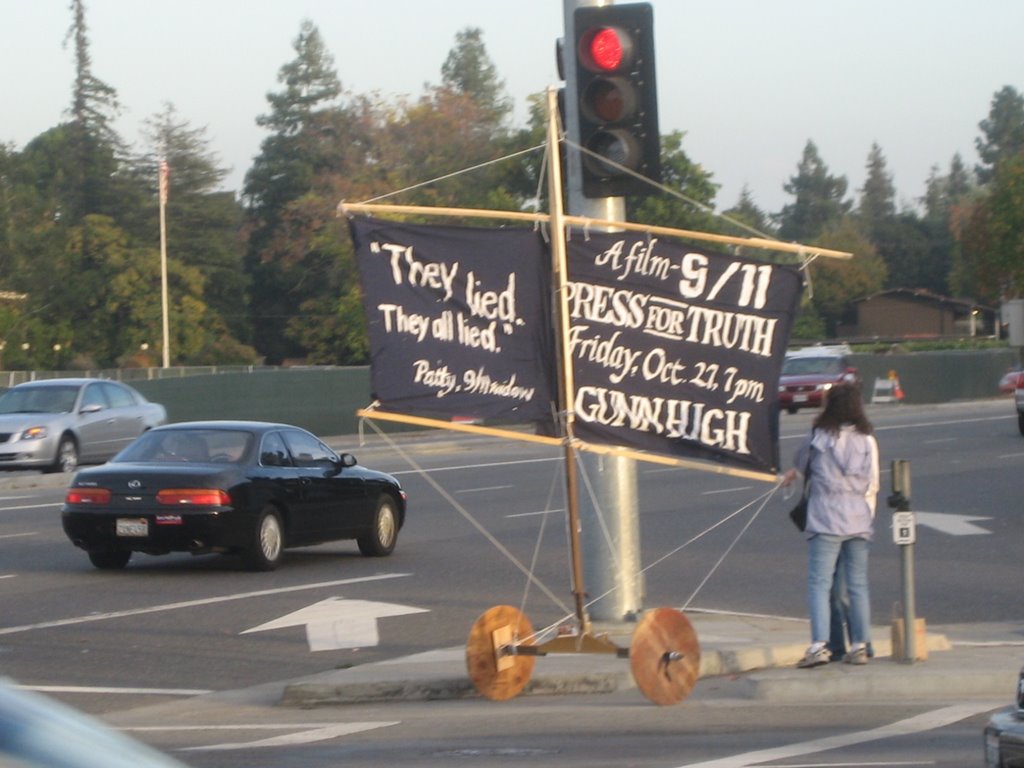
4. Seen across the street: These folks built this cool wheeled wooden ship-thingy to promote the Palo Alto premiere of 9/11 Press for Truth, a film about the struggle between grieving 9/11 families and the White House.

Wednesday, October 18, 2006

New Year's Eve Tickets Available Now!

I'm pretty excited about my upcoming New Year's Eve show! It should be quite a blowout; get your tickets early!


-------------------------------------
TOTH 2 C.K.