Showing posts with label Art. Show all posts

Saturday, July 03, 2010

On Allen Ginsberg & Collateral Murder


I saw the best minds of my generation destroyed by madness, starving hysterical naked,
dragging themselves through the negro streets at dawn looking for an angry fix...

I have been surprised over the last week or so that so many of my friends have no idea who Allen Ginsberg is, or the significance of his Beat poem Howl, which I used as the backing drone for Bushmaster Crazyhorse Howl. My film professor at Foothill told us he used to keep a copy of Howl in his back pocket; many young people did, back in the day. Howl, with its cry to explode the stifling wasteland of mid-1950s conformity, its call for mental and sexual liberation is, along with Jack Kerouac's On the Road and William Burroughs Naked Lunch, a key document in the founding of the Sixties counter-culture revolution.

Furthermore, Howl has particular resonance for people in the San Francisco Bay Area. The release of Howl is inextricably linked to the great City Lights bookstore in North Beach, perhaps the most famous independent bookstore in the country and still owned and operated by the 91-year-old Beat poet and artist Lawrence Ferlinghetti. When Ferlinghetti published Ginsberg's Howl and Other Poems in 1956, he was arrested on obscenity charges -- a landmark free speech case he later won, and one about to be memorialized in an upcoming film called Howl that is due out in September. (I'm sure Ginsberg, an outspoken homosexual at a time when being Out was rare, would be amused to see himself portrayed by the handsome actor James Franco.)

For his own part, Allen Ginsberg became a major figure in the counterculture throughout the Sixties and beyond, right up to his death from cancer in 1997. He led the chanting at the Human Be-In in Golden Gate Park in 1967 and pursued a singular path as a free-speech and human rights activist. Later in his life he taught literature at Brooklyn College where my uncle, as Chairman of the English Department, was ostensibly Ginsberg's boss. My uncle was somewhat awed by his colleague: "He's so famous. He'll fly off to have dinner with the Rolling Stones in Paris, or Havel in Prague, then come back and teach his class."


My original conceit with Bushmaster Crazyhorse Howl was to intercut clips from the Wikileaks Collateral Murder video with superficial Hollywood depictions of the world, including the world of warfare and violence. The Collateral Murder video is the leaked video of an American Apache helicopter in Iraq gunning down about a dozen mostly unarmed Iraqis, including two Reuters journalists. The Army later lied and claimed U.S. soldiers were engaged in a firefight when the killings occurred but the video is clear and unambiguous on that point. The Iraqis are merely walking along the road when the Apache crew receives authorization to kill them all.

The dispassionate voices of the Apache crew and their HQ commanders contrast with the horror of the damage they inflict--not only on the original group of Iraqis but also on some brave men who drive up in a van to rescue the wounded, plus two young children in the van who are also badly hurt. The closing line I use, "Well, it's their fault for bringing their children to a war" sums up the heartless depersonalization of war, and an astonishing lack of compassion on the part of the speaker. All of Bagdhad is a war zone; the Americans made that way.

Hollywood, of course, loves to play war, especially when they get to condemn it as something bad while still masturbating in its visual and visceral glory. I purposefully picked clips of violence and warfare that were outside the standard Hollywood formula. Tropic Thunder, You Don't Mess with the Zohan and Hot Fuzz are all broad comedies, while The Watchmen is a very deep, dark satire. Alan Moore's original graphic novel of The Watchmen is one of the strongest examinations of American hegemony, and Zach Snyder's improbably great film adaptation captures the fascist underpinnings of superherodom in general, and American superherodom in particular, with dazzling panache. In the book and the film, the reluctant blue giant Dr. Manhattan proves such an effective weapon in the American arsenal that the Vietcong insist on surrendering to him personally.

By coincidence I had the audio of Ginsberg reading Howl; somewhere along the way I realized it would make a keen backdrop to the casual brutality of the Collateral Murder video. If nothing else, Howl is a call to end top-down command structures and allow the full flowerings of creativity and freedom to bloom. The poem still packs a wallop over 50 years after it came out because its vision, hellish and beautiful, feels extremely contemporary. In some ways, the Collateral Murder video seems to point to the poem's relevance.

The addition of the Stockhausen quote was a happy flash of inspiration for me. Stockhausen's point, which is undeniably true, is that the 9/11 terrorists managed to make a stronger statement and jolt the world's citizens out of their consensual trances more powerfully than all the artists in the world ever could. He was obviously not saying he approved of the attacks, or that it was acceptable to make "art" that killed thousands. But he nevertheless got figuratively crucified for saying what he said. The first casualty of war, even before truth, is nuance.

Best of all, opening with the Stockhausen quote gave me a chance to use a couple of the composer's dischordant compositions as the background chaos unfolds. Stockhausen is one of the most influential avant-garde composers of the 20th century, counting among his influences such artists as Phillip Glass (who makes an appearance on the final music swell, care of The Watchmen), David Byrne and seminal industrial electronic artists like Kraftwork. Few people listen to Stockhausen's stuff these days because most of it, like the pieces I used, is pretty unwelcome listening. It's perfect for Bushmaster Crazyhorse Howl, though; in this context it actually seems to make perfect sense.

Thursday, June 24, 2010

Bushmaster Crazyhorse Howl

Bushmaster Crazyhorse Howl: In which Allen Ginsberg meets Collateral Murder...and Karlheinz Stockhausen is redeemed. I'm very pleased with how this one turned out. Does it work for you?


Monday, June 21, 2010

Gerry Hiken: Portrait of the Artist as an Old Man


I've been remiss about updating this blog, partly since blogging is sooo 2005. I'm much more active on Twitter now (@magicpeacelove); that 140 character limit is very alluring, since it forces me to distill my thoughts into discrete, crisp bits without overwriting.

At any rate, I suppose I should post that I've reentered the filmmaking game, at least to the extent that I have made a couple of shorts I'm quite happy with. The first is an 11-minute documentary about my pal Gerry Hiken, an American treasure who has been a professional actor for 60 years (that's Gerry on the right, in a recent production of the play Twentieth Century). In the film, Gerry muses on the artist's life, how to be a great actor, and what it means to approach death.

I had many technical nightmares trying to get this made. Final Cut Pro refused to install on my Snow Leopard-running iMac and I ended up having to push iMovie well beyond what it's made for to get this where I wanted it. The newest version of iMovie is made for home movie assemblage, and a lot of basic editing tools somehow got left off.

I'll discuss my second short, Bushmaster Crazyhorse Howl, in an upcoming post. For that one I actually wiped my hard drive, installed the old version of Leopard, and managed to get Final Cut Pro installed as well. Beautiful program; I learned it over the weekend and pulled an all-nighter to cut the film.

Anyway, without further ado I present to you: Gerry Hiken: Portrait of the Artist as an Old Man.

Monday, February 08, 2010

Buck Twins meet Die Antwoord ("100% South African Culture" mix)

I was inspired by my (completely accidental) purchase of an English Laundry shirt on deep discount, a rare deck of Aristocrat 327 playing cards, and the double-edged brilliance of this week's mind-boggling Die Antwoord/Leon Botha conjunction. The Universe provides...

Buck Twins meet Die Antwoord ("100% South African Culture" mix)

Saturday, October 10, 2009

Book Review: The Brief Wondrous Life of Oscar Wao


Phenomenal. Junot Diaz is an amazing writer.

I picked this up on a whim at the library after seeing it in the zeitgeist for the last year or so. It's a dazzling, crackling book, the story of a fat Dominican sci-fi geek in Brooklyn, of his older, hottie sister, and of their mother and her horrifying backstory in the Dominican Republic (the DR), which was ruled from 1930-1961 by a psychopathic tyrant, a totalitarian Sauron (Diaz's term) so brutal he made Saddam Hussein seem like a lightweight.

Diaz's cast of characters includes many real-life international playboy evildoers dropped into footnotes like devils from some parallel Gatsby, and he mixes hyper-nerd pop culture and Spanglish with authority and a supremely deft touch. For such a pain-filled book, Diaz never loses sight of either the humanity of his protagonists or the absurdly black humor of their world. Best of all, The Brief Wondrous Life of Oscar Wao is a ripping yarn from beginning to end.

Sunday, January 04, 2009

An Awesome Book


Happy New Year!

Unleash your inner-dreamer with artist Dallas Clayton's lovely new "kids" book, An Awesome Book, a side-scrolled treat.

Tuesday, February 19, 2008

NYC in Words

Alex Gopher's short animated film The Child envisions a Manhattan constructed entirely of words. The nominal plot follows a young couple rushing to the hospital to deliver their baby. I don't know if Gopher's trying to illuminate an obscure neurological condition or simply creating a compelling textual road trip, but the result is trippy and moving.

Sunday, January 13, 2008

3 Graphic Designers + 4 Days = D-Day Invasion

This astonishing clip demonstrates that the days in which you needed the GNP of a small country to make an effects-heavy blockbuster are coming to an end. The clip supports my contention from a few days ago that the balance of power has shifted quite dramatically in the film industry.

In my previous post, I mentioned that big time film and television artists will start creating their own media companies, owning every step in the production process and eliminating the parasitic middlemen called studios. Apparently, this process is already underway. Artists and writers are teaming up with geeks to create their own production partnerships, entirely independent from the studios.

The time is ripe for a bottom-up reinvention of the film and television industry. Both technology and society have evolved exponentially since the last writers' stike, way back in 1988. The current writers' strike is the biggest mistake the AMPTP has ever made, and the blowback could prove fatal.

Wednesday, August 08, 2007

Flesh


French photographer, graphic artist and filmmaker Edouard Salier has created quite a splash with Flesh (2005), a ten-minute meditation on the merger of erotica and violence. Reaction on the blogosphere has been decidedly mixed. Xeni Jardin of BoingBoing recently called it "9/11-themed CGI terror-rotica," but added, "I don't know that I'm a fan of it, or not." Count me a fan. Flesh is a stunning, visionary work, even in its heavily degraded YouTube version. The Strikeback Films website has some much crisper clips; this must look amazing on the big screen.

YouTube link (NSFW, and you may need to log in and promise you're over 18 to view it.)

I sympathize with reviewers who find Flesh merely pornographic and empty, but to my eyes it's neither. Unclear it may be, but the horror and decadence on display certainly seems to express uncomfortable truths about fundamentalism, Islamofascism, and American hedgemony. I recommend the explanatory commentary on the website's About section for more details.


Just in case you were unclear about Salier's intentions, here's his earlier (2004) 4-minute short Empire. It's a decidedly more low-key work, but no less uncomfortable for it. The degraded YouTube clip is again a bit hard to read; that's military hardware moving across the screen.

Thursday, June 07, 2007

A New Kind of Surrealism - Updated

Update: The old link died. I Googled "super cool pic" and found this new one:

This is absolutely trippy.

Hold the mouse button down and slowly move around. The old link was full-screen; this one, unfortunately, is not. But it's still rockin' cool.

Saturday, November 11, 2006

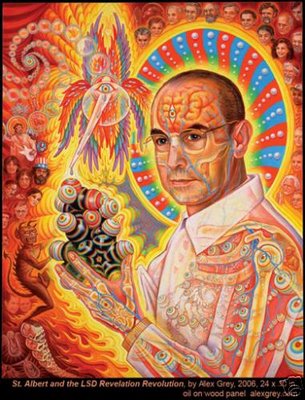
Alex Grey's St. Albert on Ebay


Oh lordy, get your checkbooks ready! Psychedelic artist Alex Grey and the Multi-Disciplinary Association for Psychedelic Studies (M.A.P.S.) have teamed up to auction off the last remaining print of St. Albert and the LSD Revelation Revolution, created to honor Dr. Albert Hoffman, the father of LSD. This print is number 1 of 50 and was personally signed by Hoffman shortly after his 100th birthday celebration earlier this year in Basel, Switzerland.

Opening bid is $3000 and all proceeds will be divided evenly between a M.A.P.S.-sponsored Swiss end-of-life research study (the first legal research with LSD in 35 years) and Grey's trippy Chapel of Sacred Mirrors project.

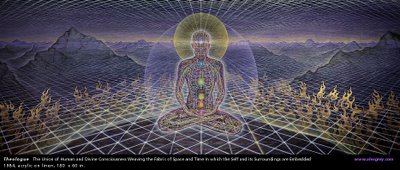
Alex Grey is probably the most gifted visionary artist alive. My favorite painting of his is 1984's Theologue (below, click the image for a bigger, better version at Grey's Web site). I think Theologue is as good a depiction of a transcendent experience as I've ever seen anywhere. I urge you to wander Grey's site if you haven't seen his work. It's truly mind-blowing and very, very beautiful.

Thursday, November 09, 2006

Balloon Art Borat


Russian doctor-turned-balloon-artist Irina made this beautiful Borat in ballons. It's been bouncing all over the Web, including a prominent nod on Defamer.

The movie's extremely funny, too. Uncomfortable but funny.

Thursday, November 02, 2006

Pollack Breaks the Record

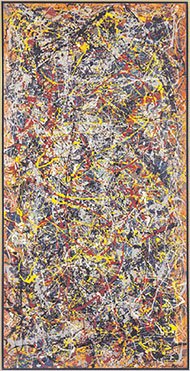
In my recent Picasso Musings post I mentioned that I'd love to have a Jackson Pollack painting in my personal collection. Coincidentally, David Geffen just sold Pollack's 1948 No. 5 to a Mexican financier named David Martinez for a record-breaking $140 million.


The picture above is how the New York Times displayed the painting, although I've never seen a huge Pollack displayed vertically, like this. I wouldn't be surprised if it's supposed to be horizontal.

UPDATE, January 25, 2007: Okay, I've had enough of seeing it vertical. I'm quite sure the painting should look like this:


Pollack is an acquired taste, but once he grabs hold of you his greatest works don't let go easily. I'm not normally envious of super-wealth, but this is one 4' x 8' painting I'd like to have on my wall.

Wednesday, October 18, 2006

Picasso Musings

Regular readers might remember my post about the Online Picasso Project, a delirous joy for fans of that seminal artist. Today comes a double shocker.

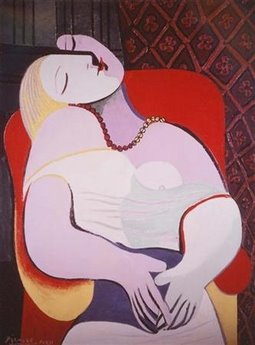
First, I'm amazed that my absolute favorite Picasso, La Reve (The Dream) (1932) is in private hands. Casino magnate Steve Wynn owns it as part of his vast collection.

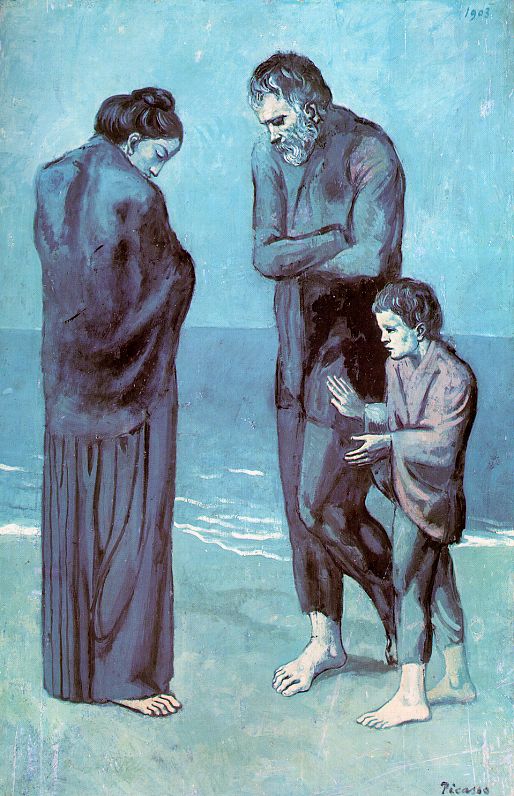
I'm pretty much sold on Picasso as the most important visual artist of the first half of the twentieth century (I think a good argument could be made that Andy Warhol holds that distinction for the second half). Even before he invented Cubism and changed all the rules of visual expression, Picasso was already the supernaturally talented painter of a slew of Blue Period masterpieces like The Old Guitarist (1903) and The Tragedy (1903) (below), both painted when he was only twenty-two, as well as the amazing Rose Period paintings like The Family of Saltimbanques (1905) (also below) and many others.


At the ripe old age of twenty-six Picasso invented Cubism, a paradigm shift so tectonic that he could hardly match it again, although he continued to create brilliant work right up to his death in 1973 at the age of ninety-two.

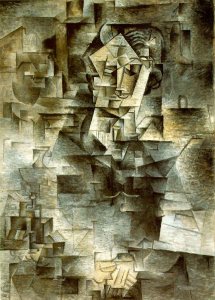
I'm a huge Cubism nut and I think Picasso brought a more focused intensity, more genius, really, to his Cubist works than any other artist ever managed. Check out the spare monochromatic complexity of his famous 1910 portrait of the art dealer Daniel-Henry Kahnweiler, on the right.

But for sheer beauty -- in form, color balance, sensuality, and passion -- I'll take La Reve any day. Painted when Picasso was fifty-one, this painting of his mistress Marie-Thérèse Walter is a true work of love. Marie-Thérèse never looked so beautiful; check out his other portraits from the same year if you don't believe me. The work is suffused with an intense eroticism; note the dual reading as both a front portrait and a profile view with penis -- presumably the artist's -- above her face.

La Reve is the Picasso I'd most like to have hanging on my wall at home (next to Matisse's The Dance, Jackson Pollack's Lavender Mist, and something by Jasper Johns -- as long as I'm designing my dream collection).

I was shocked to discover that La Reve is privately owned. That was the first surprise. Then I had an extra pang when I read the news today that Wynn was going to sell it (for a record $139 million) until he accidentally put his elbow through it while showing it to some celebrity friends.

Nora Ephron was there, and she blogged about it here. The New Yorker also has a nice story about the incident.

I can't imagine actually owning such a famous masterpiece in the first place. But if I did own La Reve, I certainly can't see myself ever selling it (assuming that, like Wynn, that I didn't really need an extra $139 million). Donate it to a museum, sure. But sell it to another wealthy private collector? I mean, why?

Be that as it may, I think it would definitely ruin my whole week if I accidentally punched a hole in it. Maybe Wynn needed that little lesson to remind him of why he collects great art in the first place. He and his wife have decided to repair La Reve and keep it after all.

Now isn't that a touching story?

Saturday, June 10, 2006

The Art of Science 2

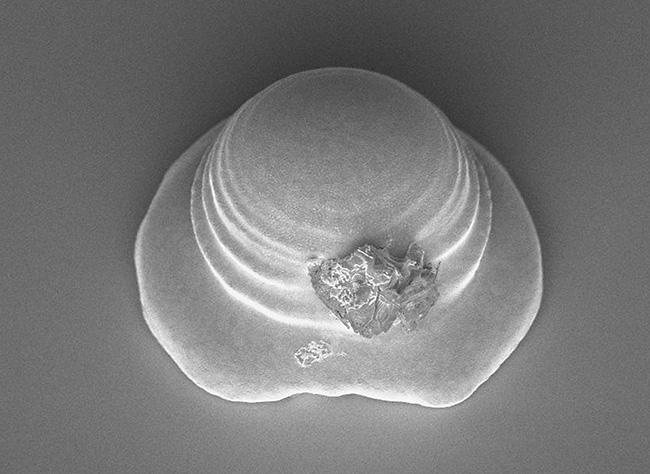
Faithful readers will no doubt remember Princeton's "Art of Science" contest, which I posted about back in July. Well, they're at it again; the 2nd annual Art of Science contest is over, and the winners and runner-ups are available for viewing. Easter Bonnet (pictured) is a particular standout; it's a laser etching with a speck of dust and has a diameter about half that of a human hair.


Interior Vacuum Vessel NSTX is also pretty cool, depicting a magnetic fusion device at the Princeton Plasma Physics Laboratory.


And Defense to Offense is a dazzling psychedelic vision of Venezuelan butterflies.

Monday, May 15, 2006

Burden to Ono to Blaine


In the comments to my recent MCJ on Blaine post, JB makes an important point about Blaine's willingness to sacrifice almost everything for his art. The magic boards are full of skeptics trying to convince themselves and others that the whole aquarium stunt was just a trick (maybe a seven-day 3D holographic projection while Blaine sat at home watching cable?), but it's quite obvious that he essentially did what he said he did. It also seemed pretty clear to me that his failure at the end was not planned, that he was geniunely moved by the love from the crowd (those tears were real), and that he really does undergo extraordinary mental, physical, and spiritual experiences while carrying out his performances. How could you spend 60 hours in a block of ice, 44 days fasting in a suspended glass box, or 7 days on public display underwater and NOT learn something?


Chris Burden

In a way, Blaine really belongs in the category of "conceptual artist," with an obvious influence being the artist Chris Burden. Burden is most famous for 1971's Shoot, in which he had a friend, yes, shoot him in the arm. Although it was ostensibly a commentary about Vietnam and our culture of violence, Burden's personal exploration of pain and death has resonances far beyond the merely political.

Fortunately, Blaine seems uninterested in physical mutilation as self-expression. Unlike, say, Criss Angel, Blaine never reveals the slightest trace of machismo, or even body centrism. He trains intensively to prepare for his stunt performances, but his goal is never to punish his body. It's no coincidence, of course, that he displays his body at every turn as a way to create aesthetic resonance in his work via the physical beauty of his body. Nevertheless, Blaine seems like the kind of guy who would willingly lose fifty pounds, or gain it, if it facilitated a performance.

Can you see Criss Angel deliberately losing fifty pounds off that sculpted body in order to survive a long, drawn-out performance? Angel is much more of a magician and stuntman than Blaine. Blaine is concerned mainly with head spaces and spiritual ideas...in short, with conceptual art.

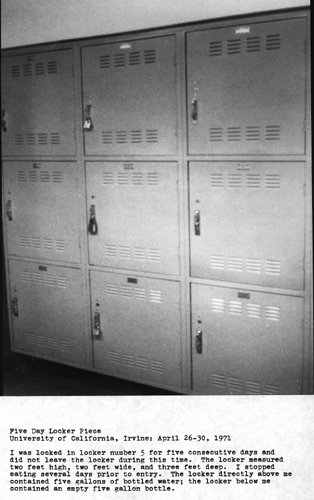
Chris Burden's Five Day Locker Piece is a direct antecedent to Blaine:

Chris Burden
Five Day Locker Piece
University of California, Irvine:
April 26-30, 1971

I was locked in locker number 5 for five consecutive days and did not leave the locker during this time. The locker measured two feet high, two feet wide, and three feet deep. I stopped eating several days prior to entry. The locker directly above me contained five gallons of bottled water; the locker below me contained an empty five gallon bottle.


I don't know if Five Day Locker Piece is a work of conceptual art, performance art, or political theater, but there's something very beautiful about that description, about the symmetry of the bottles above and below, and about the way the whole work is constrained and contained. If Burden were performing that in my neck of the woods, I might be drawn to pay those lockers a visit, just to be in the presence of an ongoing work of Art.

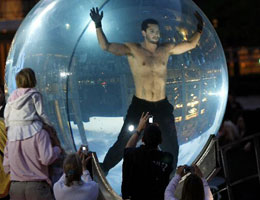
That same energy pervades Blaine's work. For Drowned Alive, Blaine added a powerful visual component. The sight of this extraordinary guy magnified by the curve of the tank was tremendously evocative. I wish I could have been in New York when Blaine was in that aquarium. I would have loved to visit him.

Yet Blaine has distinguished himself by accomplishing something none of the conceptual artists of the past managed; he figured out how to become famous and beloved before he began his stunts. He became a celebrity by making friends with the world, by bringing joy and wonder into peoples' lives. As a result, Blaine brings a tremendous amount of goodwill to the table, not just from the intelligensia and the art-academy elites, but from "regular" people as well.


Yoko Ono

Long before she met John Lennon, Yoko Ono was a fairly well-known member of the Fluxus art movement, a "famous for fifteen people" conceptual artist in the elite art world. I recently watched a moving short film of Yoko Ono's Cut Piece, a 1965 performance in which Ono sat on the stage at Carnegie Hall and invited audience members to come up and cut off pieces of her clothing. The piece encompasses many themes -- about gender, violence, sensuality and sexuality, among others. Its context, the rarified art world of New York, ensured that it would be analyzed and dissected, that viewers would attempt to extract meaning from the work. That it would be taken seriously.

The fact that Cut Piece has a frivolous, occasionally playful quality does not detract from its essential seriousness as a work of art. The pre-Lennon Ono is not playing games, and she's not wasting her time (and a perfectly good dress) for nothing. She has something to say, and this is her way of communicating it.

As soon as Ono hooked up with Lennon, and her fame grew exponentially outside of the intelligensia, the criticism began. The experimental works on which she had earned her reputation (and totally captivated the most cerebral, difficult of the Beatles) were exposed to a larger audience unschooled in the language of conceptual and performance art. The mainstream turned against Ono with astonishing viciousness (the fact that she was widely -- and incorrectly -- perceived as having caused the breakup of the Beatles didn't help). She was attacked as a no-talent hack, a shameless self-promoter who simply rode the coattails of her superstar husband.


David Blaine

Interestingly, Blaine is in a similar situation; his fame has exposed his conceptual art to a society unprepared to take it seriously.

David Blaine is in a no-win situation with critics. The moment he branches off into truly unique and daring territory, he is maligned as a shameless self-promoter. It's as if now that Blaine is famous he is no longer allowed to do conceptual art. I don't know if the New York art world embraces Blaine, but they certainly should. Of course, if they are as driven by jealousy as the magic world they probably hate him, too.

Andy of MCJ nailed it in the post I cited at the beginning; the vitriol directed at Blaine tells us more about the haters than about the Artist. Chris Burden was widely ridiculed for Shoot, since it's easier to dismiss and ignore than to wonder why an intelligent person would have himself shot as an artistic statement. Yoko Ono's screeching and wailing performances are similarly reviled as "bad music," a stance which so obviously misses the point that it hardly deserves to be considered as serious criticism.

David Blaine's every move is centered around presenting a vision of humanity that is generous and expansive, and his work encompasses some of the deepest, most personal exploration imaginable, presented in the most public possible manner. And yet he is presumptively dismissed by a large swath of the chattering class, including many people who would embrace Blaine as a genius -- if only he were an penniless conceptual artist submerged in an aquarium in an uptown gallery.

-----------------------------------------------------

There is an astonishing moment in the Drowned Alive special, in which Blaine is interviewing Aaron Ralston, the 27 year-old hiker who cut off his own arm in order to free himself from a boulder that had him trapped. Ralston recounts how he began to lose all hope of rescue. He considered cutting off his own arm, but he only had a cheap, lightweight knife that would never make it through his bone.

Then Ralston discovered that he could get the boulder under which he was trapped to move. The young hiker knew that he would not be able to get it off his arm, but he realized that he could use the boulder to crush his bones, which would facilitate cutting off his arm.

As he pulled the boulder over his arm, Ralston relates, the pain was so excruciating that his very definition of pain had to be recalibrated. And yet, he claims that it was also the most liberating moment of his life. He literally felt reborn in that moment, and empowered. Ralston knew in that moment that he would save himself and live.

This is the key moment in the Drowned Alive special, since it describes the transmutation of exteme situations into profound spiritual epiphanies. David Blaine is a spiritual seeker, a man who seeks the light at the end of his carefully constructed tunnels. And he invites his audience to watch his every move, to participate with their love and encouragement.

David Blaine did it all on his own. He is a famous, rich conceptual artist and he definitely has something to say. He uses magic as one of his expressive tools, but he also uses endurance "stunts," which are really a form of performance art.

Blaine doesn't talk about meaning very much, except in the most general terms. He says he likes to push himself, to explore the limits of his abilities. But he never engages in deep philosophical or aesthetic discussions about his themes and purpose, which leads shallow naysayers to conclude that he has none.

Utter foolishness. Blaine is way too smart to punish himself for nothing.

He is also regularly dismissed as a con man, or a shameless publicity hound; he tortures himself with these stunts, the saying goes, and laughs all the way to the bank.

David Blaine doesn't need to do such things anymore. He doesn't need the money and he doesn't need the grief.

His fame is entirely earned. He has performed some of the most extreme conceptual art ever, and done so with grand showmanship, and a beautiful and inspiring sense of theater. Best of all (and most annoying to the Blaine bashers), Blaine never tries to ascribe any huge meaning to his performance pieces. He just does them and lets the world react.

That, my friends, is High Art.

Thursday, July 21, 2005

Art of Science

Princeton has announced the winners of the First Annual* Art of Science Competition. From the site:

This spring we asked the Princeton University community to submit imagery produced in the course of research or incorporating tools and concepts from science....

The resulting assembly of images presents a fascinating and beautiful cross section of the arts and sciences at Princeton. It celebrates the aesthetics of research and the ways in which science and art inform each other.


The image above didn't win, but it's my personal favorite (probably due to my longstanding love of Kandinsky and the Constructivists). It's called Dynamic Asset Allocation in Freight Transportation, and it's modeled from a PhD dissertation relating to "stochastic, integer multicommodity flow problems" (there'll be a quiz on this later). Fallopian (below), which depicts its namesake as seen from a uterus, is also quite stunning.


Check out the whole gallery here.

---------------

* I had an English teacher in high school who hated the term "First Annual." "How can the first of anything be 'annual?'" she would ask. You can PLAN for it to be annual, but it won't be 'annual' until at least the second time it happens." Well, I guess Princeton disagrees with her.

Was I misinformed, all those years ago?


(Thanks to BoingBoing for the link.)

Monday, June 13, 2005

On-Line Picasso Project

Picasso was without serious question the most important painter of the twentieth century, and one of the key visual artists of any period. Just in case you're wondering what all the fuss is about, here's an incredible chronological record of Picasso's work. The main page takes a while to load, even with a fast connection, because it contains thumbnails of one painting for every year from 1889 (an amazing painting of a boy on a donkey done by the then eight-year-old prodigy) to 1973, the year Picasso died. What's more, click on any painting (1907's seminal Les Demoiselles D'Avignon, for instance), and up pops another page with, in this case, twenty-six more paintings from 1907. Click on the year instead of the painting and you get a very detailed biographical account of what was going on in that year.

It's an exhaustive and valuable archive; the man generated an awful lot of extraordinary work, and we're blessed to be able to peruse most of it online.

[Thanks to Grow-a-Brain for the link.]