YouTube does it again! Someone has posted The Lady and the Lamp, a hand-drawn animated short that John Lasseter made in 1979 while a student at CalArts. It's an impressive work, showing the strong feel for character, especially in normally inanimate objects, that marks his later work in the Toy Story movies and his current offering Cars. And it's quite funny and inventive, too -- also Lasseter hallmarks.
I first noticed Lasseter way back in 1986 (!) when I saw his now-famous Luxo Jr., which was the first really great fully digital short animation (and Pixar's first film). I had seen plenty of other computer animation prior to Luxo Jr., but nothing succeeded dramatically the way this one did. The "adult" lamp dealing with the frisky "kid" lamp was priceless; the computer pretty much got out of the way.
Lasseter received an Academy Award nomination for the film, the first CGI film to do so. How exciting to see that he was animating lamps the old fashioned way years before Luxo Jr.!
---------------------------
Thanks again, BoingBoing!
Wednesday, June 21, 2006


Monday, June 12, 2006
Black Ops and the Iraq War
Craig Unger over at Vanity Fair has written an amazing article on the successful lies and "black ops" that led to the Iraq War. The article details the labyrinthine web of connections through elements of Italy's intelligence community all the way to the White House. Sample text:
For more than two years it has been widely reported that the U.S. invaded Iraq because of intelligence failures. But in fact it is far more likely that the Iraq war started because of an extraordinary intelligence success—specifically, an astoundingly effective campaign of disinformation, or black propaganda, which led the White House, the Pentagon, Britain's M.I.6 intelligence service, and thousands of outlets in the American media to promote the falsehood that Saddam Hussein's nuclear-weapons program posed a grave risk to the United States.
The Bush administration made other false charges about Iraq's weapons of mass destruction (W.M.D.)—that Iraq had acquired aluminum tubes suitable for centrifuges, that Saddam was in league with al-Qaeda, that he had mobile weapons labs, and so forth. But the Niger claim, unlike other allegations, can't be dismissed as an innocent error or blamed on ambiguous data. "This wasn't an accident," says Milt Bearden, a 30-year C.I.A. veteran who was a station chief in Pakistan, Sudan, Nigeria, and Germany, and the head of the Soviet–East European division. "This wasn't 15 monkeys in a room with typewriters."
------------------------------------
Link via Glenn Greenwald's excellent Unclaimed Territory blog, which pointed me to journalist David Neiwert's superb post on his Orcinus blog. Neiwert sums up the Vanity Fair article better than I do; it's a good place to start.
For more than two years it has been widely reported that the U.S. invaded Iraq because of intelligence failures. But in fact it is far more likely that the Iraq war started because of an extraordinary intelligence success—specifically, an astoundingly effective campaign of disinformation, or black propaganda, which led the White House, the Pentagon, Britain's M.I.6 intelligence service, and thousands of outlets in the American media to promote the falsehood that Saddam Hussein's nuclear-weapons program posed a grave risk to the United States.
The Bush administration made other false charges about Iraq's weapons of mass destruction (W.M.D.)—that Iraq had acquired aluminum tubes suitable for centrifuges, that Saddam was in league with al-Qaeda, that he had mobile weapons labs, and so forth. But the Niger claim, unlike other allegations, can't be dismissed as an innocent error or blamed on ambiguous data. "This wasn't an accident," says Milt Bearden, a 30-year C.I.A. veteran who was a station chief in Pakistan, Sudan, Nigeria, and Germany, and the head of the Soviet–East European division. "This wasn't 15 monkeys in a room with typewriters."
------------------------------------
Link via Glenn Greenwald's excellent Unclaimed Territory blog, which pointed me to journalist David Neiwert's superb post on his Orcinus blog. Neiwert sums up the Vanity Fair article better than I do; it's a good place to start.
Saturday, June 10, 2006
The Art of Science 2
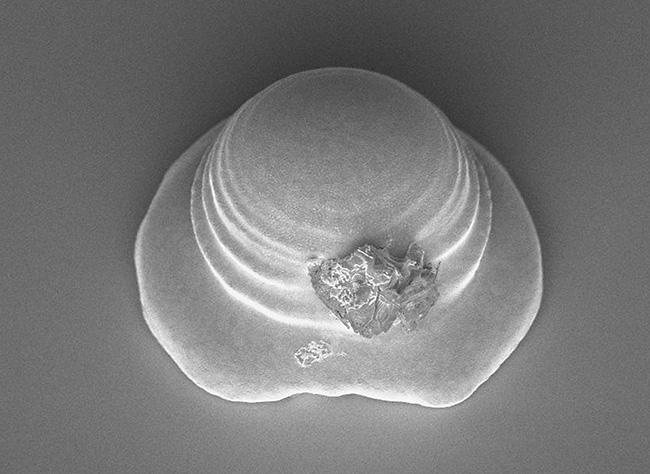
Faithful readers will no doubt remember Princeton's "Art of Science" contest, which I posted about back in July. Well, they're at it again; the 2nd annual Art of Science contest is over, and the winners and runner-ups are available for viewing. Easter Bonnet (pictured) is a particular standout; it's a laser etching with a speck of dust and has a diameter about half that of a human hair.

Interior Vacuum Vessel NSTX is also pretty cool, depicting a magnetic fusion device at the Princeton Plasma Physics Laboratory.

And Defense to Offense is a dazzling psychedelic vision of Venezuelan butterflies.
Interior Vacuum Vessel NSTX is also pretty cool, depicting a magnetic fusion device at the Princeton Plasma Physics Laboratory.

And Defense to Offense is a dazzling psychedelic vision of Venezuelan butterflies.

Amazing Castle Optical Illusion
Via BoingBoing (again), here's an amazingly trippy visual illusion I've never seen before. Stare at the negative image of the castle for twenty or thirty seconds then, while staring at the black dot in the middle, move the mouse over the pic. The photo appears to be in color until you move your eyes, when it becomes clear that it's actually a black and white photo.
This one feels like a magic trick; the color literally vanishes right before your eyes! But, to paraphrase Doug Henning, "it's only an illusion."
This one feels like a magic trick; the color literally vanishes right before your eyes! But, to paraphrase Doug Henning, "it's only an illusion."
Saturday, May 27, 2006
Juggling in an Eight-Foot Glass Cone
Fellow magic blogger Pagliacci linked to this lovely video of a juggler named Greg Kennedy juggling a boatload of balls inside an eight-foot glass cone. This reminds me of Michael Moshen's seminal work -- poetic, geometric, and very beautiful to contemplate.
Wednesday, May 24, 2006
Sunday, May 21, 2006
Dude, this carwash sucks!
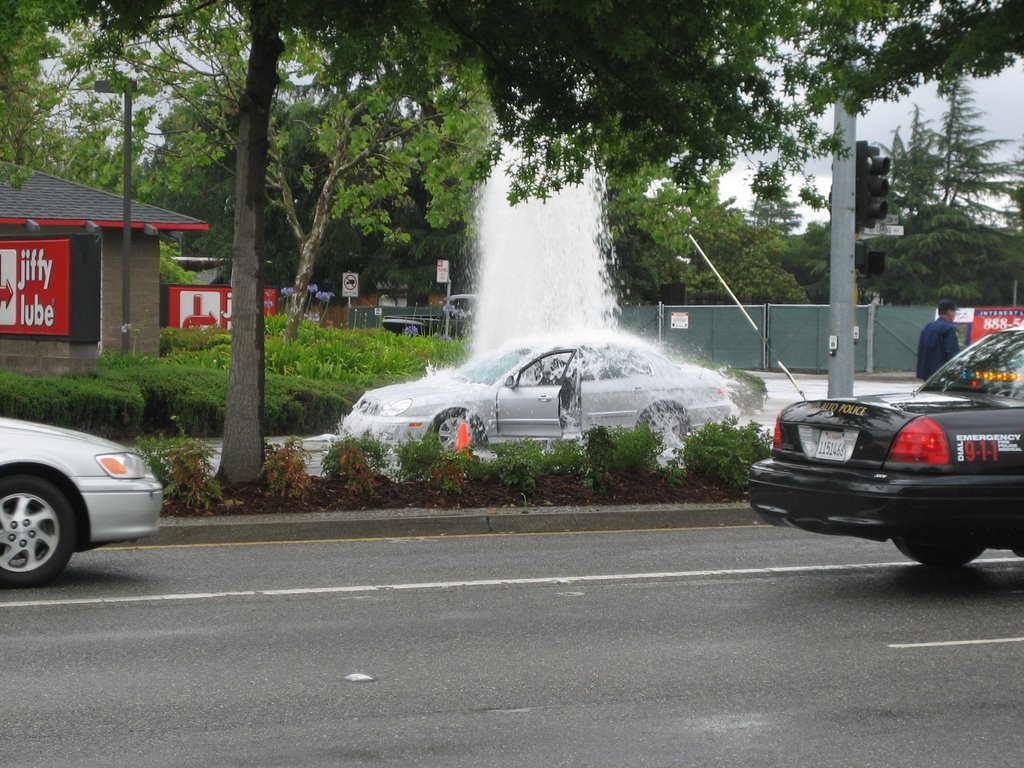
This happened across the street. A lady demolished a fire hydrant and produced a fountain.
The door is open for a reason, by the way. The side window is smashed (the airbags deployed, but the woman and her kids got out fine). So when they got her out and closed the door, the car immediately began filling up with water. Thus, the open door for drainage.
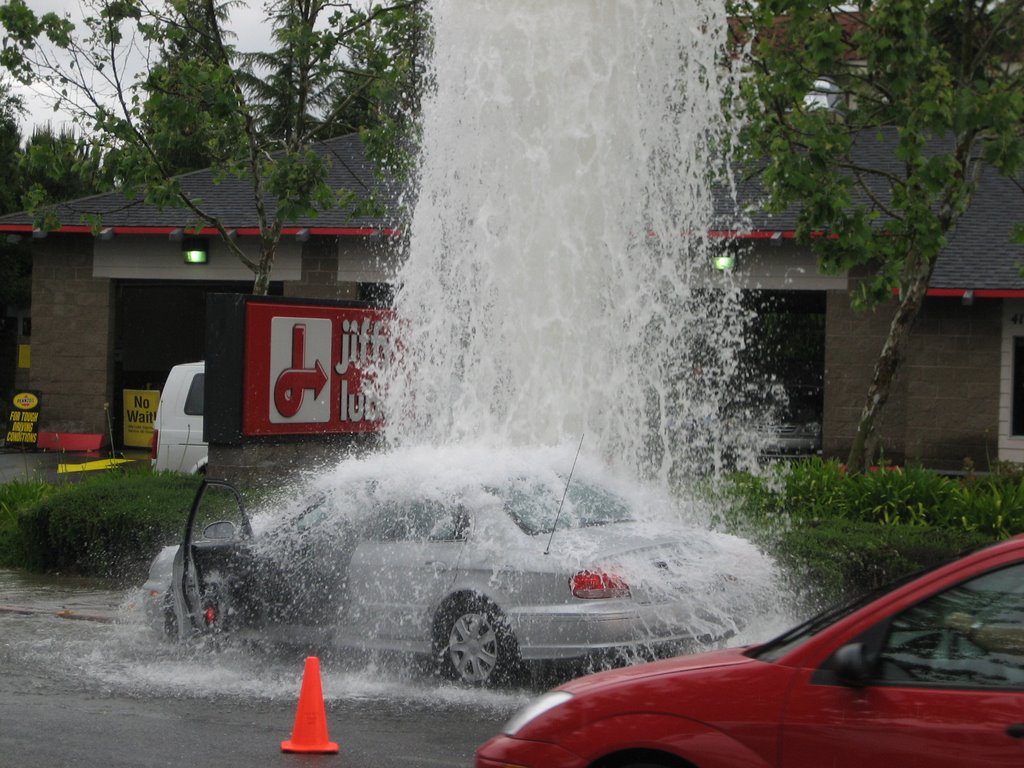
Anybody wanna' buy a very very very clean used car?
Wednesday, May 17, 2006
President Gore Addresses the Nation - UPDATED
Here's President Gore giving his State of the Union Address [Dead link. See update.] six years into his presidency.
Sigh.
--------------------------------
UPDATE: The video has been removed from YouTube "due to copyright infringement." In other words, NBC is too stupid to realize that the posting of a great video pulled from Saturday Night Live is the key to viral marketing and the major reason why SNL has become hip again (via sites like YouTube and the reposting of Lonely Island hits like "Lazy Sunday" -- which NBC also forced YouTube to remove -- and the hilarious "Natalie Portman Gangsta Rap").
Gore's self-sendup video is currently available on the Crooks and Liars site here.
Monday, May 15, 2006
Blaine and Me
In the comments to my last post, Anonymous says, I'd be right shocked if ever the words "I might have been mistaken" were ever to leave your keyboard.
Actually, I have no problem admitting when I'm wrong; in fact, I have a whole list of narrow beliefs I used to hold which have been replaced by broader, more nuanced views.
I was absolutely, unequivocally mistaken about Blaine for years (there, I said it). In the past I always felt a tremendous ambivalence about him. On the one hand, I could see that he blew people away and fostered a love of magic in every layperson he encountered. On the other hand, I was brainwashed by the typical magician line that he's an average talent, he uses stooges and trick photography, he's just lucky, etc. I reconciled those two views with the standard response to cognitive dissonance: I ignored them.
I now recognize that like many other magicians I, too, was blinded by jealousy. I resented that he was better looking than me, more successful, dated the beautiful women I'd like to date, got the reactions I'd love to get. And I resented that he did standard material and became rich and successful with it. My reaction had nothing to do with Blaine, of course, and everything to do with me. Blaine, as I stated in my very first post on the subject, is a mirror in which inferior magicians see their own inadequacies.
When Blaine first broke out onto the national stage, I had been a serious close-up magician for over twenty years. I had worked in restaurants, done street magic, worked in one of the top magic shops in the country, performed at the Magic Castle a bunch of times -- in short, I was an experienced and talented magician, pretty consistently well-liked by my audiences.
I'm ashamed to admit that while I never trash-talked Blaine to laypeople, I would often provide a typical magician response along the lines of, "He's pretty good. He does a lot of standard material that I've been doing for years, so it's funny to see him getting these TV shows..." In other words, damning with faint praise.It's only in the last few years that I lifted the veil off my eyes and recognized Blaine for the genius he is. Once I had this shift in consciousness, Blaine's overwhelming contribution to the world of magic became clear. His influence on every magician who came along after him is incalculable; it's hardly a stretch to define Street Magic as year zero of the new magic renaissance.
Actually, I have no problem admitting when I'm wrong; in fact, I have a whole list of narrow beliefs I used to hold which have been replaced by broader, more nuanced views.
I was absolutely, unequivocally mistaken about Blaine for years (there, I said it). In the past I always felt a tremendous ambivalence about him. On the one hand, I could see that he blew people away and fostered a love of magic in every layperson he encountered. On the other hand, I was brainwashed by the typical magician line that he's an average talent, he uses stooges and trick photography, he's just lucky, etc. I reconciled those two views with the standard response to cognitive dissonance: I ignored them.
I now recognize that like many other magicians I, too, was blinded by jealousy. I resented that he was better looking than me, more successful, dated the beautiful women I'd like to date, got the reactions I'd love to get. And I resented that he did standard material and became rich and successful with it. My reaction had nothing to do with Blaine, of course, and everything to do with me. Blaine, as I stated in my very first post on the subject, is a mirror in which inferior magicians see their own inadequacies.
When Blaine first broke out onto the national stage, I had been a serious close-up magician for over twenty years. I had worked in restaurants, done street magic, worked in one of the top magic shops in the country, performed at the Magic Castle a bunch of times -- in short, I was an experienced and talented magician, pretty consistently well-liked by my audiences.
I'm ashamed to admit that while I never trash-talked Blaine to laypeople, I would often provide a typical magician response along the lines of, "He's pretty good. He does a lot of standard material that I've been doing for years, so it's funny to see him getting these TV shows..." In other words, damning with faint praise.It's only in the last few years that I lifted the veil off my eyes and recognized Blaine for the genius he is. Once I had this shift in consciousness, Blaine's overwhelming contribution to the world of magic became clear. His influence on every magician who came along after him is incalculable; it's hardly a stretch to define Street Magic as year zero of the new magic renaissance.
Hatred and contempt directed at a performer who accomplishes magic for laypeople so well deserves to be examined. Too bad the magic community as a whole seems incapable of such introspection.
Burden to Ono to Blaine
In the comments to my recent MCJ on Blaine post, JB makes an important point about Blaine's willingness to sacrifice almost everything for his art. The magic boards are full of skeptics trying to convince themselves and others that the whole aquarium stunt was just a trick (maybe a seven-day 3D holographic projection while Blaine sat at home watching cable?), but it's quite obvious that he essentially did what he said he did. It also seemed pretty clear to me that his failure at the end was not planned, that he was geniunely moved by the love from the crowd (those tears were real), and that he really does undergo extraordinary mental, physical, and spiritual experiences while carrying out his performances. How could you spend 60 hours in a block of ice, 44 days fasting in a suspended glass box, or 7 days on public display underwater and NOT learn something?
Chris Burden
In a way, Blaine really belongs in the category of "conceptual artist," with an obvious influence being the artist Chris Burden. Burden is most famous for 1971's Shoot, in which he had a friend, yes, shoot him in the arm. Although it was ostensibly a commentary about Vietnam and our culture of violence, Burden's personal exploration of pain and death has resonances far beyond the merely political.
Fortunately, Blaine seems uninterested in physical mutilation as self-expression. Unlike, say, Criss Angel, Blaine never reveals the slightest trace of machismo, or even body centrism. He trains intensively to prepare for his stunt performances, but his goal is never to punish his body. It's no coincidence, of course, that he displays his body at every turn as a way to create aesthetic resonance in his work via the physical beauty of his body. Nevertheless, Blaine seems like the kind of guy who would willingly lose fifty pounds, or gain it, if it facilitated a performance.
Can you see Criss Angel deliberately losing fifty pounds off that sculpted body in order to survive a long, drawn-out performance? Angel is much more of a magician and stuntman than Blaine. Blaine is concerned mainly with head spaces and spiritual ideas...in short, with conceptual art.
Chris Burden's Five Day Locker Piece is a direct antecedent to Blaine:
Chris Burden
Five Day Locker Piece
University of California, Irvine:
April 26-30, 1971
I was locked in locker number 5 for five consecutive days and did not leave the locker during this time. The locker measured two feet high, two feet wide, and three feet deep. I stopped eating several days prior to entry. The locker directly above me contained five gallons of bottled water; the locker below me contained an empty five gallon bottle.
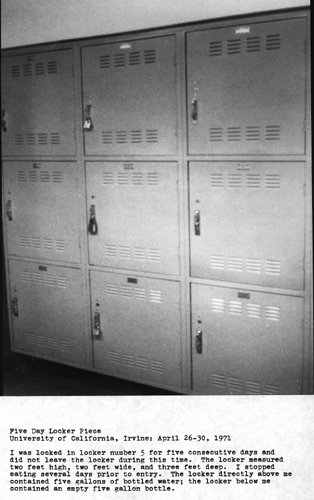
I don't know if Five Day Locker Piece is a work of conceptual art, performance art, or political theater, but there's something very beautiful about that description, about the symmetry of the bottles above and below, and about the way the whole work is constrained and contained. If Burden were performing that in my neck of the woods, I might be drawn to pay those lockers a visit, just to be in the presence of an ongoing work of Art.
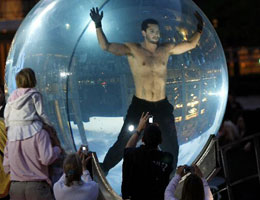
That same energy pervades Blaine's work. For Drowned Alive, Blaine added a powerful visual component. The sight of this extraordinary guy magnified by the curve of the tank was tremendously evocative. I wish I could have been in New York when Blaine was in that aquarium. I would have loved to visit him.
Yet Blaine has distinguished himself by accomplishing something none of the conceptual artists of the past managed; he figured out how to become famous and beloved before he began his stunts. He became a celebrity by making friends with the world, by bringing joy and wonder into peoples' lives. As a result, Blaine brings a tremendous amount of goodwill to the table, not just from the intelligensia and the art-academy elites, but from "regular" people as well.
Yoko Ono
Long before she met John Lennon, Yoko Ono was a fairly well-known member of the Fluxus art movement, a "famous for fifteen people" conceptual artist in the elite art world. I recently watched a moving short film of Yoko Ono's Cut Piece, a 1965 performance in which Ono sat on the stage at Carnegie Hall and invited audience members to come up and cut off pieces of her clothing. The piece encompasses many themes -- about gender, violence, sensuality and sexuality, among others. Its context, the rarified art world of New York, ensured that it would be analyzed and dissected, that viewers would attempt to extract meaning from the work. That it would be taken seriously.
The fact that Cut Piece has a frivolous, occasionally playful quality does not detract from its essential seriousness as a work of art. The pre-Lennon Ono is not playing games, and she's not wasting her time (and a perfectly good dress) for nothing. She has something to say, and this is her way of communicating it.
As soon as Ono hooked up with Lennon, and her fame grew exponentially outside of the intelligensia, the criticism began. The experimental works on which she had earned her reputation (and totally captivated the most cerebral, difficult of the Beatles) were exposed to a larger audience unschooled in the language of conceptual and performance art. The mainstream turned against Ono with astonishing viciousness (the fact that she was widely -- and incorrectly -- perceived as having caused the breakup of the Beatles didn't help). She was attacked as a no-talent hack, a shameless self-promoter who simply rode the coattails of her superstar husband.
David Blaine
Interestingly, Blaine is in a similar situation; his fame has exposed his conceptual art to a society unprepared to take it seriously.
David Blaine is in a no-win situation with critics. The moment he branches off into truly unique and daring territory, he is maligned as a shameless self-promoter. It's as if now that Blaine is famous he is no longer allowed to do conceptual art. I don't know if the New York art world embraces Blaine, but they certainly should. Of course, if they are as driven by jealousy as the magic world they probably hate him, too.
Andy of MCJ nailed it in the post I cited at the beginning; the vitriol directed at Blaine tells us more about the haters than about the Artist. Chris Burden was widely ridiculed for Shoot, since it's easier to dismiss and ignore than to wonder why an intelligent person would have himself shot as an artistic statement. Yoko Ono's screeching and wailing performances are similarly reviled as "bad music," a stance which so obviously misses the point that it hardly deserves to be considered as serious criticism.
David Blaine's every move is centered around presenting a vision of humanity that is generous and expansive, and his work encompasses some of the deepest, most personal exploration imaginable, presented in the most public possible manner. And yet he is presumptively dismissed by a large swath of the chattering class, including many people who would embrace Blaine as a genius -- if only he were an penniless conceptual artist submerged in an aquarium in an uptown gallery.
-----------------------------------------------------
There is an astonishing moment in the Drowned Alive special, in which Blaine is interviewing Aaron Ralston, the 27 year-old hiker who cut off his own arm in order to free himself from a boulder that had him trapped. Ralston recounts how he began to lose all hope of rescue. He considered cutting off his own arm, but he only had a cheap, lightweight knife that would never make it through his bone.
Then Ralston discovered that he could get the boulder under which he was trapped to move. The young hiker knew that he would not be able to get it off his arm, but he realized that he could use the boulder to crush his bones, which would facilitate cutting off his arm.
As he pulled the boulder over his arm, Ralston relates, the pain was so excruciating that his very definition of pain had to be recalibrated. And yet, he claims that it was also the most liberating moment of his life. He literally felt reborn in that moment, and empowered. Ralston knew in that moment that he would save himself and live.
This is the key moment in the Drowned Alive special, since it describes the transmutation of exteme situations into profound spiritual epiphanies. David Blaine is a spiritual seeker, a man who seeks the light at the end of his carefully constructed tunnels. And he invites his audience to watch his every move, to participate with their love and encouragement.
David Blaine did it all on his own. He is a famous, rich conceptual artist and he definitely has something to say. He uses magic as one of his expressive tools, but he also uses endurance "stunts," which are really a form of performance art.
Blaine doesn't talk about meaning very much, except in the most general terms. He says he likes to push himself, to explore the limits of his abilities. But he never engages in deep philosophical or aesthetic discussions about his themes and purpose, which leads shallow naysayers to conclude that he has none.
Utter foolishness. Blaine is way too smart to punish himself for nothing.
He is also regularly dismissed as a con man, or a shameless publicity hound; he tortures himself with these stunts, the saying goes, and laughs all the way to the bank.
David Blaine doesn't need to do such things anymore. He doesn't need the money and he doesn't need the grief.
His fame is entirely earned. He has performed some of the most extreme conceptual art ever, and done so with grand showmanship, and a beautiful and inspiring sense of theater. Best of all (and most annoying to the Blaine bashers), Blaine never tries to ascribe any huge meaning to his performance pieces. He just does them and lets the world react.
That, my friends, is High Art.
Sunday, May 14, 2006
Gnarls Barkley sings "Crazy" (live)

I hardly have a story here, except that I fell in love with Crazy the moment I first heard it. "Gnarls Barkley" consists of the vastly gifted rapper/R&B singer Cee-Lo and the equally formidable DJ Dangermouse, creator of the infamous Beatles/Jay Z mashup The Grey Album. Their Gnarls Barkley album St. Elsewhere just came out last month, although Crazy has been bouncing around for a while. Crazy has the historical distinction of becoming the first song in England to become a Number One hit based solely on digital sales.
This stupendous live version really shows off the soaring, angelic performance of Cee-Lo, anchored by the tight rythmic construction that Dangermouse brings to the table (and note how cool the Mouse looks behind the keyboards!).
Saturday, May 13, 2006
The Evolution of Dance Updated!
I guess I'm a little late to the game, since I see on the YouTube page that the six-minute The Evolution of Dance has been viewed just shy of five million times. That should tell you all you need to know; the collaborative nature of Web 2.0 means that genuine crowd pleasers rise to the top, voted on by five million clicks from all over the world.
I'm sure it's all over the Web by now, but I'll post it anyway, since it's a blast -- and "Inspirational Comedian" Judson Laipply is definitely a talented guy.
----------------------
Update: September 9, 2006. This clip has now been viewed 32 million times. Think about that.
----------------------
Hat Tip, BTW, to MySpace buddy Wisteria for the heads up.
I'm sure it's all over the Web by now, but I'll post it anyway, since it's a blast -- and "Inspirational Comedian" Judson Laipply is definitely a talented guy.
----------------------
Update: September 9, 2006. This clip has now been viewed 32 million times. Think about that.
----------------------
Hat Tip, BTW, to MySpace buddy Wisteria for the heads up.
Wednesday, May 10, 2006
MCJ on Blaine (from 2004)
Okay, I swear I'm not trying to be lazy here, posting the words of others. But some things are worth revisiting. Back in December, I wrote glowingly about the now-defunct "Magic Circle Jerk" blog (original post, and follow-up) and it's anonymous maestro Andy. Well, Andy sent me an email last night urging me to keep up the good fight with regards Blaine, and he included his very funny cut-through-the-bullshit post on Blaine from 2004. I had so much fun rereading it that I asked and received permission to post it here.
If anything, this post is even more relevant today than it was two+ years ago. The naysayers hatered of Blaine has deepened. Check the Cafe and the Genii Forum.
I still have no idea who Andy is, by the way. So don't ask.
When you're done reading this, I recommend you check out John LeBlanc's thoughtful Blaine posts on his excellent Escamoteurettes blog. It's nice to see I'm not alone...
-------------------------------------------------
Thursday, January 22, 2004
Andy's Take On Tired Topics: David Blaine
I like David Blaine.
Shhhhh. Don't talk to me. I'm a nerd.
Oh, yeah, that's right, I like David Blaine. I enjoy his specials, I have his DVD, I've read his book. What does this say about me? I don't think it says a whole hell of a lot. Maybe that I enjoy watching magic. I like to watch people freak out. I don't know.
Freud says that in order to find out about a person, we shouldn't ask them what they like, we should ask them what they dislike.
Comedian/writer Ali Farahnakian had a great show here in NYC called "Word of Mouth" and he talked about how when people are in traffic slamming on their horn, what we hear is-- HONK HONK "Hey fuck you, buddy" HONK HONK "C'mon. Move it, Asshole!" But what they're really saying is--HONK HONK "Somebody please pay attention to me!" HONK HONK "Somebody love me!"
So I always wonder what people are really saying when they constantly bitch about Blaine. I mean, I love music, but I hate shitty groups like Matchbox 20. I think they're lame and kind of worthless. But every time someone mentions Matchbox 20 or I hear a song by them I don't get all bothered by it. I just realize people have different tastes and some people like shitty, weak, pseudo-rock and roll.
In this thread on The Magic Cafe, "Macgyver" neatly lists the reasons why people dislike Blaine (He pretends he's listing other people's reasons, but they're clearly also his). They're almost all completely ridiculous. Let's take a look:
1. Constant use of plants and stooges-- Actually, he doesn't constantly use plants and stooges. Just because you don't understand how he accomplished a trick, that doesn't mean it utilized a plant or a stooge.
2. Camera tricks. -- Oh, come on. He used a camera trick to enhance the Balducci (levitation) for television. But ultimately he was trying to dramatically represent what the spectators were actually reacting to. Let's say you could make yourself disappear but it could only be performed for a couple of people at a particular angle. You're making your TV special and you realize that if you just film your disappearance it will be obvious to the television audience what is happening. But you don't want to lose the disappearance because the reaction to it was so fantastic. So you do a camera trick for the disappearance and intersperse it with the spectators reactions to the real disappearance. Is that so awful? Maybe. I can understand if you're completely anti-camera tricks. But somehow I don't think the vitriol reserved for Blaine stems from his performance of the Balducci.
3. Doing tricks that are store bought and require little skill, such as ID/Svengali/coin bite, ect. -- I have a theory. I don't think people were mad because Blaine was doing tricks that they could do. I think people got mad because Blaine was doing tricks that they could do, but they don't. In other words, many people bought an Invisible Deck when they first got into magic, but eventually stopped doing it and got into more complicated, convoluted tricks. Then they see Blaine on TV doing tricks that they disregarded years ago, and in their heads they're thinking "Why the hell am I spending all this time trying to do an invisible pass?" And that's a good question, why are you spending all that time trying to perfect an invisible pass? But that might be a difficult question to answer, so instead I think you should probably just piss on Blaine for taking bites out of quarters.
And honestly, this should have been a happy day for magicians. Here is someone getting national exposure and doing tricks that we can duplicate. If you weren't able to turn that into a positive for yourself without denigrating Blaine, then I'm afraid your creativity is rather sterile.
4. Having no story or patter, he keeps saying "look, look, look. Watch this, Watch here, look here, look, look, look." -- You know what I hate? Fucking stories and patter. Seriously, that stuff is way overrated. I don't need someone who's all like, "The last time I was India, I purchased this mysterious box." If I were a regular spectator I'd think, "Show me the trick, but don't patronize me, asshole." I think the longer you're involved in magic the more you believe you need some kind of story to accompany a trick. When you've seen twisting the aces a million times you begin to think, "Hey, this might be better if I wrapped it in a story about Paul Revere's midnight ride." But most times, it's not. It's really not. I agree that a trick benefits from context, but I don't think that a story or intricate patter is required. In David Blaine's case, the whole context of his performance is that he is someone who comes to you with no prelude, performs something impossible for you, then he leaves. The character is meant to be mysterious. About the best idea for fucking up the character he's trying to create would be for him to come up and say, "Good evening, my name is David Blaine and I'm here to show you some wondrous magical-merriment! Now, not long ago I was in the attic of a haunted house when a leprechaun gave me this coin..."
5. The Stunts... which have nothing to do with magic, only to get him more TV coverage and specials. --Oh, my god. Someone in the entertainment industry who does things to get himself more tv coverage and specials? For shame, Mr. Blaine. For shame. And what's wrong with the stunts? I like the notion that he's pushing himself to the limits of his endurance. I think that's interesting. Maybe it's not technically magical, but here's the way I look at it: Seeing a guy standing on a pole for 3 days when he could conceivably fall and smash his head on the pavement seems much more impossible than having someone accurately predict which one of four cards I would think of (i.e. B'wave). But that shows what I know, because the same people who think the stunts are lame think B'wave is genius.
6. He calls strolling magic, "street magic", which it isn't. Street magic is an art and Blaine alienated MANY street magicians by referring to what he does as street magic. --Jesus Christ, now you're just being silly. Really, that's what you have a problem with? The fact that he calls magic that he is performing on the street, Street Magic? You're beginning to betray your real motivations.
7. He comes across looking for the screaming spectator, and trying to be cool (which he is). Not for entertaining those specific people, but to make himself appear special and weird out their sense of reality. --I don't even really understand what this means, but if you're saying that he looks for people to get good reactions from. Well, asshole, you're right. HE'S TAPING A FUCKING TV SHOW!
8. He created many Blaine-wannabe's which do nothing but expose magic and go around showing friends BAD magic. --True. But don't blame him because there are a lot of unimaginative people out there.
Now, I'm not saying everyone has to like David Blaine, but the reason a lot of people come off as jealous when they complain about him is that their complaints seem to shift with Blaine's interests.
-When he first started out people complained that he was doing simple tricks right off the shelf that they could do themselves.
-When he stopped doing simple tricks off the shelf the same people complained that he was now doing tricks that they couldn't. "Oh yeah, well if I had a gimmicked store window, I could reach in there too."
-When he does his stunts people say, "That's not magic." But at the same time they say, "He's not really doing it."
In other words, no matter what this guy does people piss on him. So that's why their indignance seems somewhat hollow.
My favorite thing is when Blaine was hanging in the box in England and all these people would get on the message boards and say, "Nobody here even cares about Blaine. It's a bore quite frankly. All the people I talk to about him think that he's an idiot and that his stunt is stupid." Whenever someone goes out of their way to tell you how little they care about something, you can be pretty certain they're full of shit. You may say you don't care about Blaine, and that you find the whole thing boring, but the fact that you're talking to your friends about him and going onto message boards to read and write posts about him reveals a different truth.
If you don't like Blaine, that's great. Don't watch his shows. Don't read about him. But as with the other topics this week, letting everyone know how much you don't like Blaine is probably a waste of some precious resources. You come off not looking like the more talented, cool, unimpressed, person you believe you do. You come off as a person saying, "Somebody please pay attention to me! Somebody love me!"
Posted by: Andy / 5:59 PM
If anything, this post is even more relevant today than it was two+ years ago. The naysayers hatered of Blaine has deepened. Check the Cafe and the Genii Forum.
I still have no idea who Andy is, by the way. So don't ask.
When you're done reading this, I recommend you check out John LeBlanc's thoughtful Blaine posts on his excellent Escamoteurettes blog. It's nice to see I'm not alone...
-------------------------------------------------
Thursday, January 22, 2004
Andy's Take On Tired Topics: David Blaine
I like David Blaine.
Shhhhh. Don't talk to me. I'm a nerd.
Oh, yeah, that's right, I like David Blaine. I enjoy his specials, I have his DVD, I've read his book. What does this say about me? I don't think it says a whole hell of a lot. Maybe that I enjoy watching magic. I like to watch people freak out. I don't know.
Freud says that in order to find out about a person, we shouldn't ask them what they like, we should ask them what they dislike.
Comedian/writer Ali Farahnakian had a great show here in NYC called "Word of Mouth" and he talked about how when people are in traffic slamming on their horn, what we hear is-- HONK HONK "Hey fuck you, buddy" HONK HONK "C'mon. Move it, Asshole!" But what they're really saying is--HONK HONK "Somebody please pay attention to me!" HONK HONK "Somebody love me!"
So I always wonder what people are really saying when they constantly bitch about Blaine. I mean, I love music, but I hate shitty groups like Matchbox 20. I think they're lame and kind of worthless. But every time someone mentions Matchbox 20 or I hear a song by them I don't get all bothered by it. I just realize people have different tastes and some people like shitty, weak, pseudo-rock and roll.
In this thread on The Magic Cafe, "Macgyver" neatly lists the reasons why people dislike Blaine (He pretends he's listing other people's reasons, but they're clearly also his). They're almost all completely ridiculous. Let's take a look:
1. Constant use of plants and stooges-- Actually, he doesn't constantly use plants and stooges. Just because you don't understand how he accomplished a trick, that doesn't mean it utilized a plant or a stooge.
2. Camera tricks. -- Oh, come on. He used a camera trick to enhance the Balducci (levitation) for television. But ultimately he was trying to dramatically represent what the spectators were actually reacting to. Let's say you could make yourself disappear but it could only be performed for a couple of people at a particular angle. You're making your TV special and you realize that if you just film your disappearance it will be obvious to the television audience what is happening. But you don't want to lose the disappearance because the reaction to it was so fantastic. So you do a camera trick for the disappearance and intersperse it with the spectators reactions to the real disappearance. Is that so awful? Maybe. I can understand if you're completely anti-camera tricks. But somehow I don't think the vitriol reserved for Blaine stems from his performance of the Balducci.
3. Doing tricks that are store bought and require little skill, such as ID/Svengali/coin bite, ect. -- I have a theory. I don't think people were mad because Blaine was doing tricks that they could do. I think people got mad because Blaine was doing tricks that they could do, but they don't. In other words, many people bought an Invisible Deck when they first got into magic, but eventually stopped doing it and got into more complicated, convoluted tricks. Then they see Blaine on TV doing tricks that they disregarded years ago, and in their heads they're thinking "Why the hell am I spending all this time trying to do an invisible pass?" And that's a good question, why are you spending all that time trying to perfect an invisible pass? But that might be a difficult question to answer, so instead I think you should probably just piss on Blaine for taking bites out of quarters.
And honestly, this should have been a happy day for magicians. Here is someone getting national exposure and doing tricks that we can duplicate. If you weren't able to turn that into a positive for yourself without denigrating Blaine, then I'm afraid your creativity is rather sterile.
4. Having no story or patter, he keeps saying "look, look, look. Watch this, Watch here, look here, look, look, look." -- You know what I hate? Fucking stories and patter. Seriously, that stuff is way overrated. I don't need someone who's all like, "The last time I was India, I purchased this mysterious box." If I were a regular spectator I'd think, "Show me the trick, but don't patronize me, asshole." I think the longer you're involved in magic the more you believe you need some kind of story to accompany a trick. When you've seen twisting the aces a million times you begin to think, "Hey, this might be better if I wrapped it in a story about Paul Revere's midnight ride." But most times, it's not. It's really not. I agree that a trick benefits from context, but I don't think that a story or intricate patter is required. In David Blaine's case, the whole context of his performance is that he is someone who comes to you with no prelude, performs something impossible for you, then he leaves. The character is meant to be mysterious. About the best idea for fucking up the character he's trying to create would be for him to come up and say, "Good evening, my name is David Blaine and I'm here to show you some wondrous magical-merriment! Now, not long ago I was in the attic of a haunted house when a leprechaun gave me this coin..."
5. The Stunts... which have nothing to do with magic, only to get him more TV coverage and specials. --Oh, my god. Someone in the entertainment industry who does things to get himself more tv coverage and specials? For shame, Mr. Blaine. For shame. And what's wrong with the stunts? I like the notion that he's pushing himself to the limits of his endurance. I think that's interesting. Maybe it's not technically magical, but here's the way I look at it: Seeing a guy standing on a pole for 3 days when he could conceivably fall and smash his head on the pavement seems much more impossible than having someone accurately predict which one of four cards I would think of (i.e. B'wave). But that shows what I know, because the same people who think the stunts are lame think B'wave is genius.
6. He calls strolling magic, "street magic", which it isn't. Street magic is an art and Blaine alienated MANY street magicians by referring to what he does as street magic. --Jesus Christ, now you're just being silly. Really, that's what you have a problem with? The fact that he calls magic that he is performing on the street, Street Magic? You're beginning to betray your real motivations.
7. He comes across looking for the screaming spectator, and trying to be cool (which he is). Not for entertaining those specific people, but to make himself appear special and weird out their sense of reality. --I don't even really understand what this means, but if you're saying that he looks for people to get good reactions from. Well, asshole, you're right. HE'S TAPING A FUCKING TV SHOW!
8. He created many Blaine-wannabe's which do nothing but expose magic and go around showing friends BAD magic. --True. But don't blame him because there are a lot of unimaginative people out there.
Now, I'm not saying everyone has to like David Blaine, but the reason a lot of people come off as jealous when they complain about him is that their complaints seem to shift with Blaine's interests.
-When he first started out people complained that he was doing simple tricks right off the shelf that they could do themselves.
-When he stopped doing simple tricks off the shelf the same people complained that he was now doing tricks that they couldn't. "Oh yeah, well if I had a gimmicked store window, I could reach in there too."
-When he does his stunts people say, "That's not magic." But at the same time they say, "He's not really doing it."
In other words, no matter what this guy does people piss on him. So that's why their indignance seems somewhat hollow.
My favorite thing is when Blaine was hanging in the box in England and all these people would get on the message boards and say, "Nobody here even cares about Blaine. It's a bore quite frankly. All the people I talk to about him think that he's an idiot and that his stunt is stupid." Whenever someone goes out of their way to tell you how little they care about something, you can be pretty certain they're full of shit. You may say you don't care about Blaine, and that you find the whole thing boring, but the fact that you're talking to your friends about him and going onto message boards to read and write posts about him reveals a different truth.
If you don't like Blaine, that's great. Don't watch his shows. Don't read about him. But as with the other topics this week, letting everyone know how much you don't like Blaine is probably a waste of some precious resources. You come off not looking like the more talented, cool, unimpressed, person you believe you do. You come off as a person saying, "Somebody please pay attention to me! Somebody love me!"
Posted by: Andy / 5:59 PM
Tuesday, May 09, 2006
Blaine - Drowned Alive
The anti-Blaine contingent is having a field day with his failure to hold his breath for nine minutes (he managed "only" 7 minutes, 10 seconds) after staying submerged on public display in a tank of water for a week. The simple fact is this was a beautiful and ballsy stunt, a great work of performance art that few others would ever even attempt. As Racherbaumer pointed out in the previous post (reprinted from back in 2000!), can you think of any other genuine superstar with the courage and guts to risk not only his reputation, but also his physical health, for something like this?
David Blaine is without serious question the most important magician since Houdini, and he is redefining the boundaries of magic, stunts, and performance art. Many magicians are aparently too jealous and small-minded to understand why he's so great. Last night's special featured some of the most cutting-edge magic ever performed on television, capped by an extraordinarily brave and grueling feat of endurance.
Best of all, Blaine is a man of the people, a magician who brings dignity and grace and wonder to some of the most reviled and feared people in our society. He even took a page from Johnny Cash and brought his magic into a maximum security prison. Throughout his work, Blaine always maintains a stance of humility and generosity towards all people.
The imagery from last night's stunt will stay with us for years. The dense web of symbolism permeating Blaine's work -- Birth, Death, Rebirth - will become more obvious as the years go by.
The naysayers don't know what they're talking about...
David Blaine is without serious question the most important magician since Houdini, and he is redefining the boundaries of magic, stunts, and performance art. Many magicians are aparently too jealous and small-minded to understand why he's so great. Last night's special featured some of the most cutting-edge magic ever performed on television, capped by an extraordinarily brave and grueling feat of endurance.
Best of all, Blaine is a man of the people, a magician who brings dignity and grace and wonder to some of the most reviled and feared people in our society. He even took a page from Johnny Cash and brought his magic into a maximum security prison. Throughout his work, Blaine always maintains a stance of humility and generosity towards all people.
The imagery from last night's stunt will stay with us for years. The dense web of symbolism permeating Blaine's work -- Birth, Death, Rebirth - will become more obvious as the years go by.
The naysayers don't know what they're talking about...
Monday, May 08, 2006
Racherbaumer on Blaine (from 2000)
I discovered the post below on the Genii Forum last night. It's by Jon Racherbaumer, one of magic's leading creators and theorists. Although I found it on a thread from 2003, Racherbaumer says there that he wrote it in 2000, right after the "Frozen in Time" special in which Blaine was encased in a block of ice on Times Square for 61 hours.
I'm humbled by how much deeper this post is than my own Blaine manifesto. I think Racherbaumer understood earlier than most just how profoundly Blaine was affecting people. He also expresses beautifully how Blaine's style and vision are original and modern. I am posting it here in full (with my occasional background comments italicized, and a few explanatory links), with his kind permission.
-----------------------------------------------------
BLAINE GOT GAME? (from 2000)
by Jon Racherbaumer
“One who can only find his way by moonlight…”
- Oscar Wilde, commenting on the nature of a dreamer.
What more can be said about David Blaine that hasn’t been said before, ad nauseum? And of course press releases seldom reveal anything truly personal or revealing. From my obscured vantage point, I have little to add to what I wrote about David Blaine twice (in MAGIC magazine). My third, breezily brief excursus, by the way, will be in the January (2001) issue of MAGIC. My focus each time was about his approach, not his supposedly inherent skills as a sleight-of-hand artist.
I hate to keep hammering on the same points, but few magicians seem to get it. Blaine is primarily a creature created for and by television. From the cocoon of his New York street-performing period, he initially emerged as a hybrid television phenomenon, working as no one had done before and was savvy enough to know that performance is about the audience. He, until “Frozen in Time,” usually focused on spectators and human existence itself. What was filmed or televised occurred in the hot-damn here-and-now with all its glorious contingencies and grit. In fact, in many ways he prefigured so-called “reality television” and shows such as “Survivor” and “Big Brother.” However, Blaine transformed this “primal, see-it-right-now world” through post-production artifice. And whether anybody likes it not, television is an incredibly powerful and undeniably ubiquitous mass-cultural media form. It is a “window to the world” for most people —the one they depend on for transmissions of “reality”—live and direct, apparently unmediated, and relatively uncontrolled. And Blaine, using a magician’s prerogative to create illusions, has created a representative “world” where the street (usually grungy, “mean” ones) is his stage. The players are spectators who happen to be there when filming took place. Then Blaine plays a mischievous interloper in their reality...[snip]
Given this mise en scene, his most savvy ability, like the tricksters of myth, is to create and work with contingency. His sudden presence in the spectator’s environment seems random, almost accidental…He’s a mere, monosyllabic figure in their path, between situations, on the way to somewhere else…(God knows where?) He interrupts them and exploits this opportunity to demonstrate something novel, if not astonishing, with something as commonplace as a deck of cards. In short, he plays with their boundaries of expectancy and normality, momentarily trapping them only to set them free, making their minds discombobulated and perhaps transformed. At first he looks much like them, but then becomes something else. He’s “there” and “not there.” He moves on. He moves in and out of “frames,” in and out of “places,” a transient Lone Stranger dressed in black.
This may sound as hyperbolic as most of his press releases, but if you carefully study his first two television specials, you will see what I mean.
Wow, that was quite an analysis! I think Racherbaumer latched onto something important here, recognizing that Blaine is not really playing the role of "Street Magician," but of a wandering, nomadic "Mysterious Stranger" -- which later became the title of his book. It's an important distinction. A street magician makes his living doing magic on the streets for tips. A friend of mine who used to do quite well with this lamented that it's "one step up from begging." Blaine, on the other hand, performs miracles for people, brings them joy and amazement, and asks nothing in return.
In my first article in MAGIC, I wrote:
“David Blaine is a man of contrasts, coming out of nowhere. He is open and closed, forthcoming and mysterious; and has taken a path less traveled to big-time Prime Time…and in terms of conventional career-tracks—the kind magicians follow and expect—he is strictly an anomaly.”
Time has passed and most magicians still think that Blaine is an anomaly. Others make harsher assessments, calling him "a fluke, a no-talent, an overrated and overpaid opportunist of modest talents.”
I disagree.
Blaine’s talents are raw and not easily defined. Casual observers see vanilla performances. He seems (as Jerry Sadowitz mocks) like he should be named David Bland. And admittedly there is an inscrutable placidity about his appearance—which is a cross between Chancey Gardner (in the film, “Being There”) and the Man Without a Name (Clint Eastwood) from Sergio Leone’s spaghetti Westerns. His body language is “cool” and a calculated, confident, interior intelligence leaks out like time-lapse photography. He mumbles, “Let’s try something…maybe...ah…” and then there are all those sudden “spikes” of drama. His muted voice (like a junkie coming down) is monotone, sounding a bit like Steven Wright, the comic. This adds to his ambiguous, Rorschach-type persona.
But regardless of what anybody says pro or con, Blaine is on a roll.
However…
For him to stay on a roll, he must return to his roots. He must express his persona in different, more forceful ways. Another “Street Magic” special would slow his momentum. Déjà vu doesn’t cut it, although “one-shot wonders” often get three or four shots in television. Right now there is talk about a feature film. De Niro is interested and (the screenwriter of “Fight Club”) has apparently signed on. If this happens, it won’t be easy. The tricky part will be finding ways to successfully expand Blaine’s trickster-character so that it is a sustained, interesting, and compellingly dramatic presence for 106 minutes in a feature film. So far Blaine’s work is episodic, always captured in the hot-damn here-and-now with all its glorious contingencies and grit. In a feature film, he must do more than use a magician’s prerogative to create illusions. He must also be part of a character-driven, representative “world” above and beyond “the street.” He must interact with other characters (actors) rather than unsuspecting, ordinary street-people. But anything is possible.
Again, this was written six years ago, right after "Frozen in Time" but before Blaine had done the "Vertigo" (standing on a platform) stunt or the fast in the box over the Thames.
Now that the ice has melted, what remains to be remembered? Like other episodes of neo-television, very little reverberates beyond the day-to-day coverage. With hundreds of network and cable channels sending out signals, images, simulations, and “stories” 24-7, who remembers what happened yesterday? The public, for the most part, no longer talks about “Frozen in Time.”
But the always restless natives of magicdom were still abuzz. If Nethead gossip is any indication, many magicians thought that Blaine’s last show was a stinker, light on the magic, heavy on hype. (Hype-o-thermia, as one wag put it.) Their gossip doesn’t matter. ABC, the media, and loyal Blainiacs felt differently. The media rocked. Every newspaper except the Christian Science Monitor covered the Ice Skit, flushing out unlikely commentators from every quarter. Even a writer from the ultra-hip, liberal-chic Village Voice was moved to comment, calling Blaine’s stunt “X-treme Performance Art.” He wrote:
“Blaine is reviving an old vaudeville tradition: the death-defying act. His last piece, in which he lay six feet under in a Plexiglas coffin for a week, was supposedly a stunt Houdini wanted to do. Blaine's girlfriend told the Daily News that next ‘he may try to take a bullet.’ Of course, performance artist Chris Burden did that in 1971, as the death-defying urge moved into the art world.”
Notice the verbal difference? “Taking a bullet” is not the same as catching one.
To me, “Frozen in Time” had an unsatisfactory, disjunctive rhythm. Jumping back-and-forth from the melting ice to the trick-episodes broke the spells of both “scenes.” The frenetic energy of the actual site, except for Lynn Swan’s breathless, pre-game patter, was undifferentiated and undramatic. Compared to the X-treme coverage of the X-treme event, Blaine was almost catatonic before he was encased in the ice. When he laconically drawled that he was entering a frosty, see-through crypt to “challenge every human fear,” nobody thought he was climbing K2 or weathering “The Perfect Storm.” Yet if you listened to the clamorous coverage, you heard over and over the same litany of fearsome possibilities: muscle spasms, frostbite, blood clots, exhaustion, and hallucinations. And if that wasn’t enough, you had a deadpan-faced Blaine adding: “If I fall asleep and my face presses into the ice, they'll have to cut my face off.”
Nobody laughed…
….at least not right away.
Nevertheless, you must admit that when Blaine finally emerged from the ice, it was pretty tense. Even Bill Kalush (Blaine's close friend and collaborator) looked worried. Blaine slumped like he had survived a catastrophe he couldn’t remember. Unable to lucidly talk, he looked bewildered—as if he had indeed died yet was still conscious. If he was faking, De Niro take note; the guy can act.
Regardless, let’s give the guy some credit. He withstood a self-inflicted, brain-numbing, and body-punishing ordeal. Try imagining any celebrity-magicians putting themselves to a similar test. Blaine actually did something potentially dangerous. In the cosmic scheme of things, his endurance test is as silly as escaping from a straightjacket while hanging upside-down. But it was more believable than Penn Gillette catching a bullet between his teeth and his payday was bigger.
As mentioned earlier, the televised representation of the actual “test” site flattened out and diminished everything. Eyewitnesses had a different experience. Matt Fields, who visited the site, wrote:
“This time he's smack-dab in the middle of the ‘Crossroads of the World,’ New York's Times Square, in the street level atrium/lobby of the ABC "Good Morning America" studios at 44th Street and Broadway…If you've never seen this area at this time of year, it's only a little less busy than it is on New Year's Eve when they drop the ball. Thousands and thousands of people need to walk by Blaine just to get down the street. For a bit of a closer gawk you can wait on line and see David in his ice, obviously showing the strains of being enclosed and on his feet for two days, but smiling and waving to the crowds…the impact on the spectators is amazing. They wave, yell out things (‘Hey! Want me to get you a hot chocolate?’) and they talk about him, mentioning his name (not just ‘that magician’).”
Thomas Gaudette, another eyewitness, wrote:
“I visited the icy prison on the first day (Monday) and can confirm that it not only was a great publicity stunt, but that laymen were freaking out. I listened to their comments. He accomplished his mission. The New Yorkers I witnessed were very impressed.”
I initially thought that the Ice Stunt was not going to be an integral part of it; that Blaine would “break out” during the last five minutes, triumphantly liberated from the ice with ice-chipping fanfare, spotlights, and a cheering rabble. As it turned out, the third show focused on Blaine and the endurance stunt, not the trick-episodes. This, to me, was a blunder. The first two television specials focused on the audience. Viewers saw a filmed “representation” of what actually happened in the streets and saw dramatic, human responses. This is what made him celebrated in the first place: in-your-face tricks, in mean streets, with ordinary people. Shifting focus away from the “magic” to the Times Square hubbub was a disappointing strategy from an artistic standpoint. From a ratings-boosting standpoint, it was brilliant.
Blaine first endurance stunt (“Buried Alive”) was not a significant part of the subsequent television show. It was a “prequel,” a back-story, a publicity-generating device. Its staging area was in the world, but off-camera, and the media coverage was huge. It was also a bit like a soap opera with no beginning, middle, and end; it was episodic and continuous. It was, as Umberto Eco calls such things, neo-television. That is, it is remarkable and newsworthy for being televised; for being on television as a televised phenomenon. Its coverage is another event to be covered. Over and over fed on itself. There were stories about the stories and coverage of coverage. “Live” endurance stunts, like the publicity feats of Houdini, have such saturated reality that it is best experienced through “a kind of filter of preconceptions and expectations fabricated in advance by a culture swamped in images.”
So…
The episodic trick-part of the third installment of the Blaine Game was marginal. How many do you remember? There was the trick where he borrowed a woman’s ring, accidentally dropped it down a grate, and then rediscovered it inside a small liquor bottle found several feet away. He upped the ante and instead of resuscitating a dead fly, he brought a dead bird back to life in Central Park. He borrowed somebody’s baseball hat and produced a live snake from it—a sure way to evoke screams. Still upping the ante and thumbing his nose at Too-Perfect Theorists, he asked a scruffy guy to think of his girl friend. Then Blaine used a cigarette lighter to burn a hole in his tee shirt, which he then presses against his fleshy midsection to “frame” a tattoo of the guy’s girl friend’s face! That’s the sum-and-substance of the “magic show.” Otherwise there were some brief travelogue shots of Blaine walking alone in an arid, desolate place and through an immense field of what looked like sunflowers, looking nomadic, mysterious, and…perhaps, lost! What was conspicuously missing (as I stated in an early assessment) was Blaine “tapping into the primal roots of magic by breaking through people’s personal spaces, by penetrating the defensive threshold of what ordinary folks are willing to believe and unprepared to contemplate.” That was the trickster everybody loves to watch and that is probably the magician others magicians tuned in to see. Compare this “magic show” with the last special. For the record, here is a quantitative breakdown by the numbers of that second special:
I think this is hilarious. Racherbaumer breaks down the whole special, as if the whole can be derived from the sum of the parts. This seems, to me, a very subtle slap to all the naysayer magicians who dismiss Blaine as a no-talent simpleton.
BY THE NUMBERS
Actual running time (without commercials): 44 minutes and 50 seconds
Number of individual performances or scenes: 45
Cited Locations: New York City (Times Square), Atlantic City, New Jersey, Dallas, Texas, Compton, California, San Francisco (Haight-Asbury), Mojave Desert.
Number of on-site spectators, added together: 106
Number of females: 35
Number of males: 71
Number of stray dogs: 2
Number of different tricks performed: 26
Number of tricks repeated: 8
List of repeated tricks and the number of times they were performed: Impromptu Levitation (7), Biting and Restoring Half-Dollar (3), Wrist-Watch Steal (3), Meir Yedid’s Arm-Twister (2), The Raven Coin Vanish (2), Ambitious Card (2), Fechter Transposition Trick (2), Think Of A Card (2), and Double-Card Change In Spectator’s Hand (2).
Number of card tricks: 17
Number of coin tricks: 4
Number of other kinds of tricks: 5
Number of gaffs used: 6
Number of dealer tricks performed: 7
Specifics: Devano Deck, Invisible Deck, Folding Coin, Cigarette-Through-Half-dollar, Super Neck-Cracker Gimmick, the Raven, Arm-Twister (mss.)
Number of flourishes: 6
Specifics: Coin Roll, Fingertip Fan, One-Hand Fan-Close, Hot-Shot Cut and Card Spin (Daryl), Card Toss, Instant Replay (Paul Harris).
Easiest trick: Biting and Restoring a Half-Dollar
Most technically difficult trick: Daryl’s “Snow-Shoe Sandwich”
Most impressive card trick: Hummer’s Selection-Against-and-Behind-Window
Most impressive coin trick: Cigarette Through Half-Dollar
Most impressive trick in the entire show: One-Man Impromptu Levitation
Second most impressive trick: Think-Of-A-Card Divination
Best geek trick: Yedid’s Arm-Twister
Type of decks used: Bicycle - Tally-Ho (Diamond-Circle Back)
Number of times a blue deck was used: 4
Number of times a red deck was used: 14
Most recognizable lay person: (tie) Deion Sanders and Emmit Smith of the Dallas Cowboys football team.
Weirdest name of lay person: Fruit Loops
Number of basic card sleights used: 11
Specifics: Tilt, Bluff Pass, Double Lift, Top Change, Jog-Fan Control, Classic Force, Riffle (Mental) Force, Snap Change, Flip Change, Coin Switch, Mercury Card Fold
Technical Advisers: Michael Weber, Paul Harris, Harvey Cohen, Ray Cuomo
Most frequently uttered expletive: “Wow!”
Number of rejections: 2
Notable utterances by lay persons:
“I don’t care if he makes a million or starves to death…It’s mind-boggling!”
“You is stupid!” (to another lay person)
“You don’t have any tools?”
“I think he is not natural.”
“This man is not right!”
“I’m kinda broke. Can you make money?”
“Are you a guru of some kind? I just moved from Los Angles. Am I going to have success?”
(Deion Sanders) “I’m going. I gotta go home and take a nap!”
(David Blaine) “I don’t know if I’ll be able to get off?” (prior to levitating)]
This next section is a scream. Racherbaumer is directly addressing the vast multitude of magicians who see a trick and decide they want to do it exactly as seen -- in other words, copycats without a shred of original creativity -- by simply telling them where to find the tricks Blaine did.
Ready Reference Guide to Select Tricks That May Catch Your Fancy:
(1) “Impromptu Levitation” (Ed Balducci) - Pallbearers Review (July-1974), p. 755. Although it is credited to Balducci, the originator is unknown, but it was shown to him by one of the original Harmonicats: Erwin Levine. Finn Jon is also a great exponent of this impressive levitation.
(2) Wrist Watch Steal: Stars of Magic - Francis Caryle
“Snow-Shoe Sandwich and Hot-Shot Cut” by Daryl - For Your Entertainment Pleasure!
(4) “Convincing Tilt” by Daryl - The Last Hierophant (June-1980), p. 39.
(5) “The Snap Change” - Marlo’s Magazine #2 (1977), p. 158. This is based on the “Visible Color Change” by Joseph Cottone. Popularized by Marlo and J.C. Wagner.
(6) Marc DeSouza’s Color Change, The Trapdoor (originally invented by Oscar Muniz)
In the end and despite its comparative lack of magic, “Frozen in Time” his show helped ABC win the Sweeps. It finished 20th and almost 16 million people watched the show. Only “Law & Order” outdrew the “ice man.” I’m also told that the only “news story” of 2000 that exceeded the amount of saturated and extensive international coverage given Blaine was the Columbine Shootings; and that, my friends, is an impressive factoid.
But what does it mean?
Maybe it's simply this?
Blaine understands what Houdini understood and what Uri Geller understands. It's not what you actually do, but what they think you do and have done. The rest then ferments in the massive, global spin-machine until it becomes potentially mythic.
So…
Blaine’s First and Second Acts have come and gone. He is now able to use real money and his celebrity-capital to parlay his next dream-scheme. You can expect him to do something different, something outrageous. He is a risk-taker who puts everything that he is (whatever that may be) on the line. He goes for broke and that’s what I like about him. California journalist, Marnelle Jameson calls Blaine “The Houdini of the Hoi Polloi” and quotes him:
“For me it's more about the people than the effect,” says Blaine, who calls his brand of magic “intimate,” because he usually works one-on-one. “My favorite part is when I connect. If there's no connection, there's no magic.”
The media, meanwhile, stands by. Investors keep investing. The money keeps rolling in…and David, finding his way by moonlight, keeps looking for those connections that produce the magic that feeds his dreams, vexes his critics, and delights his fans. Blaine’s got game.
His mother would have been proud.
--------------------------------------------
Thanks, Jon, for the great and prescient essay. I look forward to seeing what you write about "Drowned Alive," tonight's two-hour special.
I'm humbled by how much deeper this post is than my own Blaine manifesto. I think Racherbaumer understood earlier than most just how profoundly Blaine was affecting people. He also expresses beautifully how Blaine's style and vision are original and modern. I am posting it here in full (with my occasional background comments italicized, and a few explanatory links), with his kind permission.
-----------------------------------------------------
BLAINE GOT GAME? (from 2000)
by Jon Racherbaumer
“One who can only find his way by moonlight…”
- Oscar Wilde, commenting on the nature of a dreamer.
What more can be said about David Blaine that hasn’t been said before, ad nauseum? And of course press releases seldom reveal anything truly personal or revealing. From my obscured vantage point, I have little to add to what I wrote about David Blaine twice (in MAGIC magazine). My third, breezily brief excursus, by the way, will be in the January (2001) issue of MAGIC. My focus each time was about his approach, not his supposedly inherent skills as a sleight-of-hand artist.
I hate to keep hammering on the same points, but few magicians seem to get it. Blaine is primarily a creature created for and by television. From the cocoon of his New York street-performing period, he initially emerged as a hybrid television phenomenon, working as no one had done before and was savvy enough to know that performance is about the audience. He, until “Frozen in Time,” usually focused on spectators and human existence itself. What was filmed or televised occurred in the hot-damn here-and-now with all its glorious contingencies and grit. In fact, in many ways he prefigured so-called “reality television” and shows such as “Survivor” and “Big Brother.” However, Blaine transformed this “primal, see-it-right-now world” through post-production artifice. And whether anybody likes it not, television is an incredibly powerful and undeniably ubiquitous mass-cultural media form. It is a “window to the world” for most people —the one they depend on for transmissions of “reality”—live and direct, apparently unmediated, and relatively uncontrolled. And Blaine, using a magician’s prerogative to create illusions, has created a representative “world” where the street (usually grungy, “mean” ones) is his stage. The players are spectators who happen to be there when filming took place. Then Blaine plays a mischievous interloper in their reality...[snip]
Given this mise en scene, his most savvy ability, like the tricksters of myth, is to create and work with contingency. His sudden presence in the spectator’s environment seems random, almost accidental…He’s a mere, monosyllabic figure in their path, between situations, on the way to somewhere else…(God knows where?) He interrupts them and exploits this opportunity to demonstrate something novel, if not astonishing, with something as commonplace as a deck of cards. In short, he plays with their boundaries of expectancy and normality, momentarily trapping them only to set them free, making their minds discombobulated and perhaps transformed. At first he looks much like them, but then becomes something else. He’s “there” and “not there.” He moves on. He moves in and out of “frames,” in and out of “places,” a transient Lone Stranger dressed in black.
This may sound as hyperbolic as most of his press releases, but if you carefully study his first two television specials, you will see what I mean.
Wow, that was quite an analysis! I think Racherbaumer latched onto something important here, recognizing that Blaine is not really playing the role of "Street Magician," but of a wandering, nomadic "Mysterious Stranger" -- which later became the title of his book. It's an important distinction. A street magician makes his living doing magic on the streets for tips. A friend of mine who used to do quite well with this lamented that it's "one step up from begging." Blaine, on the other hand, performs miracles for people, brings them joy and amazement, and asks nothing in return.
In my first article in MAGIC, I wrote:
“David Blaine is a man of contrasts, coming out of nowhere. He is open and closed, forthcoming and mysterious; and has taken a path less traveled to big-time Prime Time…and in terms of conventional career-tracks—the kind magicians follow and expect—he is strictly an anomaly.”
Time has passed and most magicians still think that Blaine is an anomaly. Others make harsher assessments, calling him "a fluke, a no-talent, an overrated and overpaid opportunist of modest talents.”
I disagree.
Blaine’s talents are raw and not easily defined. Casual observers see vanilla performances. He seems (as Jerry Sadowitz mocks) like he should be named David Bland. And admittedly there is an inscrutable placidity about his appearance—which is a cross between Chancey Gardner (in the film, “Being There”) and the Man Without a Name (Clint Eastwood) from Sergio Leone’s spaghetti Westerns. His body language is “cool” and a calculated, confident, interior intelligence leaks out like time-lapse photography. He mumbles, “Let’s try something…maybe...ah…” and then there are all those sudden “spikes” of drama. His muted voice (like a junkie coming down) is monotone, sounding a bit like Steven Wright, the comic. This adds to his ambiguous, Rorschach-type persona.
But regardless of what anybody says pro or con, Blaine is on a roll.
However…
For him to stay on a roll, he must return to his roots. He must express his persona in different, more forceful ways. Another “Street Magic” special would slow his momentum. Déjà vu doesn’t cut it, although “one-shot wonders” often get three or four shots in television. Right now there is talk about a feature film. De Niro is interested and (the screenwriter of “Fight Club”) has apparently signed on. If this happens, it won’t be easy. The tricky part will be finding ways to successfully expand Blaine’s trickster-character so that it is a sustained, interesting, and compellingly dramatic presence for 106 minutes in a feature film. So far Blaine’s work is episodic, always captured in the hot-damn here-and-now with all its glorious contingencies and grit. In a feature film, he must do more than use a magician’s prerogative to create illusions. He must also be part of a character-driven, representative “world” above and beyond “the street.” He must interact with other characters (actors) rather than unsuspecting, ordinary street-people. But anything is possible.
Again, this was written six years ago, right after "Frozen in Time" but before Blaine had done the "Vertigo" (standing on a platform) stunt or the fast in the box over the Thames.
Now that the ice has melted, what remains to be remembered? Like other episodes of neo-television, very little reverberates beyond the day-to-day coverage. With hundreds of network and cable channels sending out signals, images, simulations, and “stories” 24-7, who remembers what happened yesterday? The public, for the most part, no longer talks about “Frozen in Time.”
But the always restless natives of magicdom were still abuzz. If Nethead gossip is any indication, many magicians thought that Blaine’s last show was a stinker, light on the magic, heavy on hype. (Hype-o-thermia, as one wag put it.) Their gossip doesn’t matter. ABC, the media, and loyal Blainiacs felt differently. The media rocked. Every newspaper except the Christian Science Monitor covered the Ice Skit, flushing out unlikely commentators from every quarter. Even a writer from the ultra-hip, liberal-chic Village Voice was moved to comment, calling Blaine’s stunt “X-treme Performance Art.” He wrote:
“Blaine is reviving an old vaudeville tradition: the death-defying act. His last piece, in which he lay six feet under in a Plexiglas coffin for a week, was supposedly a stunt Houdini wanted to do. Blaine's girlfriend told the Daily News that next ‘he may try to take a bullet.’ Of course, performance artist Chris Burden did that in 1971, as the death-defying urge moved into the art world.”
Notice the verbal difference? “Taking a bullet” is not the same as catching one.
To me, “Frozen in Time” had an unsatisfactory, disjunctive rhythm. Jumping back-and-forth from the melting ice to the trick-episodes broke the spells of both “scenes.” The frenetic energy of the actual site, except for Lynn Swan’s breathless, pre-game patter, was undifferentiated and undramatic. Compared to the X-treme coverage of the X-treme event, Blaine was almost catatonic before he was encased in the ice. When he laconically drawled that he was entering a frosty, see-through crypt to “challenge every human fear,” nobody thought he was climbing K2 or weathering “The Perfect Storm.” Yet if you listened to the clamorous coverage, you heard over and over the same litany of fearsome possibilities: muscle spasms, frostbite, blood clots, exhaustion, and hallucinations. And if that wasn’t enough, you had a deadpan-faced Blaine adding: “If I fall asleep and my face presses into the ice, they'll have to cut my face off.”
Nobody laughed…
….at least not right away.
Nevertheless, you must admit that when Blaine finally emerged from the ice, it was pretty tense. Even Bill Kalush (Blaine's close friend and collaborator) looked worried. Blaine slumped like he had survived a catastrophe he couldn’t remember. Unable to lucidly talk, he looked bewildered—as if he had indeed died yet was still conscious. If he was faking, De Niro take note; the guy can act.
Regardless, let’s give the guy some credit. He withstood a self-inflicted, brain-numbing, and body-punishing ordeal. Try imagining any celebrity-magicians putting themselves to a similar test. Blaine actually did something potentially dangerous. In the cosmic scheme of things, his endurance test is as silly as escaping from a straightjacket while hanging upside-down. But it was more believable than Penn Gillette catching a bullet between his teeth and his payday was bigger.
As mentioned earlier, the televised representation of the actual “test” site flattened out and diminished everything. Eyewitnesses had a different experience. Matt Fields, who visited the site, wrote:
“This time he's smack-dab in the middle of the ‘Crossroads of the World,’ New York's Times Square, in the street level atrium/lobby of the ABC "Good Morning America" studios at 44th Street and Broadway…If you've never seen this area at this time of year, it's only a little less busy than it is on New Year's Eve when they drop the ball. Thousands and thousands of people need to walk by Blaine just to get down the street. For a bit of a closer gawk you can wait on line and see David in his ice, obviously showing the strains of being enclosed and on his feet for two days, but smiling and waving to the crowds…the impact on the spectators is amazing. They wave, yell out things (‘Hey! Want me to get you a hot chocolate?’) and they talk about him, mentioning his name (not just ‘that magician’).”
Thomas Gaudette, another eyewitness, wrote:
“I visited the icy prison on the first day (Monday) and can confirm that it not only was a great publicity stunt, but that laymen were freaking out. I listened to their comments. He accomplished his mission. The New Yorkers I witnessed were very impressed.”
I initially thought that the Ice Stunt was not going to be an integral part of it; that Blaine would “break out” during the last five minutes, triumphantly liberated from the ice with ice-chipping fanfare, spotlights, and a cheering rabble. As it turned out, the third show focused on Blaine and the endurance stunt, not the trick-episodes. This, to me, was a blunder. The first two television specials focused on the audience. Viewers saw a filmed “representation” of what actually happened in the streets and saw dramatic, human responses. This is what made him celebrated in the first place: in-your-face tricks, in mean streets, with ordinary people. Shifting focus away from the “magic” to the Times Square hubbub was a disappointing strategy from an artistic standpoint. From a ratings-boosting standpoint, it was brilliant.
Blaine first endurance stunt (“Buried Alive”) was not a significant part of the subsequent television show. It was a “prequel,” a back-story, a publicity-generating device. Its staging area was in the world, but off-camera, and the media coverage was huge. It was also a bit like a soap opera with no beginning, middle, and end; it was episodic and continuous. It was, as Umberto Eco calls such things, neo-television. That is, it is remarkable and newsworthy for being televised; for being on television as a televised phenomenon. Its coverage is another event to be covered. Over and over fed on itself. There were stories about the stories and coverage of coverage. “Live” endurance stunts, like the publicity feats of Houdini, have such saturated reality that it is best experienced through “a kind of filter of preconceptions and expectations fabricated in advance by a culture swamped in images.”
So…
The episodic trick-part of the third installment of the Blaine Game was marginal. How many do you remember? There was the trick where he borrowed a woman’s ring, accidentally dropped it down a grate, and then rediscovered it inside a small liquor bottle found several feet away. He upped the ante and instead of resuscitating a dead fly, he brought a dead bird back to life in Central Park. He borrowed somebody’s baseball hat and produced a live snake from it—a sure way to evoke screams. Still upping the ante and thumbing his nose at Too-Perfect Theorists, he asked a scruffy guy to think of his girl friend. Then Blaine used a cigarette lighter to burn a hole in his tee shirt, which he then presses against his fleshy midsection to “frame” a tattoo of the guy’s girl friend’s face! That’s the sum-and-substance of the “magic show.” Otherwise there were some brief travelogue shots of Blaine walking alone in an arid, desolate place and through an immense field of what looked like sunflowers, looking nomadic, mysterious, and…perhaps, lost! What was conspicuously missing (as I stated in an early assessment) was Blaine “tapping into the primal roots of magic by breaking through people’s personal spaces, by penetrating the defensive threshold of what ordinary folks are willing to believe and unprepared to contemplate.” That was the trickster everybody loves to watch and that is probably the magician others magicians tuned in to see. Compare this “magic show” with the last special. For the record, here is a quantitative breakdown by the numbers of that second special:
I think this is hilarious. Racherbaumer breaks down the whole special, as if the whole can be derived from the sum of the parts. This seems, to me, a very subtle slap to all the naysayer magicians who dismiss Blaine as a no-talent simpleton.
BY THE NUMBERS
Actual running time (without commercials): 44 minutes and 50 seconds
Number of individual performances or scenes: 45
Cited Locations: New York City (Times Square), Atlantic City, New Jersey, Dallas, Texas, Compton, California, San Francisco (Haight-Asbury), Mojave Desert.
Number of on-site spectators, added together: 106
Number of females: 35
Number of males: 71
Number of stray dogs: 2
Number of different tricks performed: 26
Number of tricks repeated: 8
List of repeated tricks and the number of times they were performed: Impromptu Levitation (7), Biting and Restoring Half-Dollar (3), Wrist-Watch Steal (3), Meir Yedid’s Arm-Twister (2), The Raven Coin Vanish (2), Ambitious Card (2), Fechter Transposition Trick (2), Think Of A Card (2), and Double-Card Change In Spectator’s Hand (2).
Number of card tricks: 17
Number of coin tricks: 4
Number of other kinds of tricks: 5
Number of gaffs used: 6
Number of dealer tricks performed: 7
Specifics: Devano Deck, Invisible Deck, Folding Coin, Cigarette-Through-Half-dollar, Super Neck-Cracker Gimmick, the Raven, Arm-Twister (mss.)
Number of flourishes: 6
Specifics: Coin Roll, Fingertip Fan, One-Hand Fan-Close, Hot-Shot Cut and Card Spin (Daryl), Card Toss, Instant Replay (Paul Harris).
Easiest trick: Biting and Restoring a Half-Dollar
Most technically difficult trick: Daryl’s “Snow-Shoe Sandwich”
Most impressive card trick: Hummer’s Selection-Against-and-Behind-Window
Most impressive coin trick: Cigarette Through Half-Dollar
Most impressive trick in the entire show: One-Man Impromptu Levitation
Second most impressive trick: Think-Of-A-Card Divination
Best geek trick: Yedid’s Arm-Twister
Type of decks used: Bicycle - Tally-Ho (Diamond-Circle Back)
Number of times a blue deck was used: 4
Number of times a red deck was used: 14
Most recognizable lay person: (tie) Deion Sanders and Emmit Smith of the Dallas Cowboys football team.
Weirdest name of lay person: Fruit Loops
Number of basic card sleights used: 11
Specifics: Tilt, Bluff Pass, Double Lift, Top Change, Jog-Fan Control, Classic Force, Riffle (Mental) Force, Snap Change, Flip Change, Coin Switch, Mercury Card Fold
Technical Advisers: Michael Weber, Paul Harris, Harvey Cohen, Ray Cuomo
Most frequently uttered expletive: “Wow!”
Number of rejections: 2
Notable utterances by lay persons:
“I don’t care if he makes a million or starves to death…It’s mind-boggling!”
“You is stupid!” (to another lay person)
“You don’t have any tools?”
“I think he is not natural.”
“This man is not right!”
“I’m kinda broke. Can you make money?”
“Are you a guru of some kind? I just moved from Los Angles. Am I going to have success?”
(Deion Sanders) “I’m going. I gotta go home and take a nap!”
(David Blaine) “I don’t know if I’ll be able to get off?” (prior to levitating)]
This next section is a scream. Racherbaumer is directly addressing the vast multitude of magicians who see a trick and decide they want to do it exactly as seen -- in other words, copycats without a shred of original creativity -- by simply telling them where to find the tricks Blaine did.
Ready Reference Guide to Select Tricks That May Catch Your Fancy:
(1) “Impromptu Levitation” (Ed Balducci) - Pallbearers Review (July-1974), p. 755. Although it is credited to Balducci, the originator is unknown, but it was shown to him by one of the original Harmonicats: Erwin Levine. Finn Jon is also a great exponent of this impressive levitation.
(2) Wrist Watch Steal: Stars of Magic - Francis Caryle
“Snow-Shoe Sandwich and Hot-Shot Cut” by Daryl - For Your Entertainment Pleasure!
(4) “Convincing Tilt” by Daryl - The Last Hierophant (June-1980), p. 39.
(5) “The Snap Change” - Marlo’s Magazine #2 (1977), p. 158. This is based on the “Visible Color Change” by Joseph Cottone. Popularized by Marlo and J.C. Wagner.
(6) Marc DeSouza’s Color Change, The Trapdoor (originally invented by Oscar Muniz)
In the end and despite its comparative lack of magic, “Frozen in Time” his show helped ABC win the Sweeps. It finished 20th and almost 16 million people watched the show. Only “Law & Order” outdrew the “ice man.” I’m also told that the only “news story” of 2000 that exceeded the amount of saturated and extensive international coverage given Blaine was the Columbine Shootings; and that, my friends, is an impressive factoid.
But what does it mean?
Maybe it's simply this?
Blaine understands what Houdini understood and what Uri Geller understands. It's not what you actually do, but what they think you do and have done. The rest then ferments in the massive, global spin-machine until it becomes potentially mythic.
So…
Blaine’s First and Second Acts have come and gone. He is now able to use real money and his celebrity-capital to parlay his next dream-scheme. You can expect him to do something different, something outrageous. He is a risk-taker who puts everything that he is (whatever that may be) on the line. He goes for broke and that’s what I like about him. California journalist, Marnelle Jameson calls Blaine “The Houdini of the Hoi Polloi” and quotes him:
“For me it's more about the people than the effect,” says Blaine, who calls his brand of magic “intimate,” because he usually works one-on-one. “My favorite part is when I connect. If there's no connection, there's no magic.”
The media, meanwhile, stands by. Investors keep investing. The money keeps rolling in…and David, finding his way by moonlight, keeps looking for those connections that produce the magic that feeds his dreams, vexes his critics, and delights his fans. Blaine’s got game.
His mother would have been proud.
--------------------------------------------
Thanks, Jon, for the great and prescient essay. I look forward to seeing what you write about "Drowned Alive," tonight's two-hour special.
Thursday, May 04, 2006
Two Great French PSAs
Check out these two wonderful three-minute animated safe sex PSAs from France. They're directed by commercial and music video director Wilfred Brimo. The first, from 2005, is called Femme, and it's a young woman's life story and sexual history set to The Vibrators' 1976 classic Baby Baby. The second, the newly released Sugar Baby Love is the similar journey of a young gay man, set to The Rubettes' 1974 song of the same name. [Update: The original links are dead and the new ones are a bit grainy but still watchable.]
Both shorts are raucous, sweet, sexy, and lushly romantic. A big shout out to Salon's Video Dog for the heads up. As they rightly point out, American safe sex PSAs tend toward the somber and anti-sexual, the "one mistake can kill you" message rather than a message like "sex can be a blast, it can be a bummer, it can accompany love -- just be safe about it."
It's just too bad they'll never find their way onto American TV screens.
------------------------
Bonus: Love Game
Love Game is Brimo's eBoy-style video for the Shakedown song. Brimo gets a lot of resonance out of pixel art, with its linear motion and "love" meter; it's a moving lifecycle of romance.
Both shorts are raucous, sweet, sexy, and lushly romantic. A big shout out to Salon's Video Dog for the heads up. As they rightly point out, American safe sex PSAs tend toward the somber and anti-sexual, the "one mistake can kill you" message rather than a message like "sex can be a blast, it can be a bummer, it can accompany love -- just be safe about it."
It's just too bad they'll never find their way onto American TV screens.
------------------------
Bonus: Love Game
Love Game is Brimo's eBoy-style video for the Shakedown song. Brimo gets a lot of resonance out of pixel art, with its linear motion and "love" meter; it's a moving lifecycle of romance.
Wednesday, May 03, 2006
Copperfield Parody

Funny stuff.
---------------------------------------------
The hilarious caricature above, which is only loosely related to the link, is by the fabulously talented Mark Poutenis.
Tuesday, May 02, 2006
Achtung, Baby!
Confirmed, via my parents:
The University of Chicago Alumni of Washington are offering a Pentagon tour in August. Along with the usual information about security ("two forms of picture ID") is the following:
"English is the only language permitted inside the Pentagon. Please do not converse or otherwise communicate in any other language while on tour or you will be escorted out of the building."
Ay Caramba! This is un-American.

Where's Stephen Colbert when you need him?
The University of Chicago Alumni of Washington are offering a Pentagon tour in August. Along with the usual information about security ("two forms of picture ID") is the following:
"English is the only language permitted inside the Pentagon. Please do not converse or otherwise communicate in any other language while on tour or you will be escorted out of the building."
Ay Caramba! This is un-American.

Where's Stephen Colbert when you need him?
Monday, May 01, 2006
Stephen Colbert: Courageous American Patriot

Just in case you missed it, here's Stephen Colbert's astonishing performance at the Annual White House Correspondents' Dinner.
Colbert is a national treasure. He got his big break on The Daily Show, but his spinoff, The Colbert Report (pretentiously pronounced The Colbear Repore) skewers the right-wing spin machine with the sharpest blades on television. Invited to speak at the Correspondents' Dinner (presumably for comic relief), Colbert teamed up with press corps doyenne Helen Thomas to deliver a shockingly ferocious ironic attack on not only the President (who had to sit there with his wife and take it), but also on the obsequious press corps sycophants trying to honor themselves for a job well done.
Here's a snip from Colbert's monologue, in which he addresses President Bush -- who as noted, was sitting right there: I stand by this man. I stand by this man because he stands for things. Not only for things, he stands on things. Things like aircraft carriers and rubble and recently flooded city squares. And that sends a strong message, that no matter what happens to America, she will always rebound -- with the most powerfully staged photo ops in the world.
Following the monologue, Colbert reveals that he tried out for the White House Press Secretary job recently vacated by Scott McClellan. He then rolls the tape of the audition, in which a Terminator-like Helen Thomas pursues him out to the parking lot trying to get an answer for why we actually invaded Iraq. Thomas seems to be having a ball aiming a big "fuck you" at an administration that has disrespected her so thoroughly.
The Daily Kos has a full transcript. CSPAN has played it in its entirety at least once, but the rest of the American media has virtually ignored it or played only small snippets. I recommend you check it out online if at all possible. The Crooks and Liars link at the top is only a portion of Colbert's talk. Here's the complete performance: Part One and Part Two.
It's easy to underestimate or ignore the courage it takes to stand in front of the President in a public forum and essentially accuse him of criminal incompetence. We live in creepy times, and this administration has shown itself more than capable of violent personal attacks against those who oppose it. Colbert himself looks pretty uncomfortable at the end, as the President and his wife sweep past him with tight-lipped half-grins.
But he never wavered when delivering the goods, he never broke irony with any sort of "just kidding" wink wink, nudge nudge expression. Colbert drew blood and took no prisoners. I doubt he'll be invited back next year.
---------------------------------
UPDATE: Thank Colbert yourself here.
Friday, April 28, 2006
Blaine - Ten Years Later

I'm going to draw a line in the sand on the issue of David Blaine, right here and now. I believe that David Blaine is the most important magician since Houdini and that he single-handedly saved the great art of magic. Those of us in magic right now are blessed to be able to witness the most extraordinary renaissance the art has seen for a century -- and we have David Blaine to thank for it.
I have long commented to anyone who would listen that the biggest problem with magic is that it's very difficult to make it resonate as a great art. Take a top pro and let him work a cocktail party. He'll blow people away and get them laughing. But I maintain that if one of the guests breaks out a guitar and starts singing some reasonably good songs, the magic will be quickly forgotten as the music transports everyone in the room. In other words, a competent but unexceptional singer will trump even a gifted magician in almost every case.
There have been many talented magical performers over the years, some of them even quite brilliant, but no one before Blaine figured out how to make magic so astonishing that people watching it on television actually got excited, wanted to see more, and concluded that the magician performing it was the hippest guy in the room.
No one before Blaine figured out how to become a superstar doing magic. Not a famous punch line, but a genuine superstar. When David Copperfield was engaged to Claudia Schiffer, the rumor mill churned that he was gay and that their relationship was a business arrangement (he denied it). Here's a guy who's handsome and graceful, who has made $100 million doing magic -- and his girlfriend has to worry that dating him might be a bad career move!
Blaine never had that problem. He's the first famous magician who's an equal to any possible model or actress he dates. Fiona Apple, Josie Maran, even Madonna -- none of them needed to worry about how it looked for them to be sleeping with this magician.
------------------------------------------
Street Magic: Of the People, By the People, For the People
I just watched Street Magic, the very first Blaine special from back in 1997, on TLC. Just happened to be on, and I watched it.
Good lordy oh lordy. This kid's a fuckin' genius. I mean, really. Today, nearly a decade later, every magician under twenty-five of any note is doing David Blaine. That super soft-sell, totally straightforward and clear, the absolute committment to the effect, the nearly-laconic pace which ramps up the intensity...this is all Blaine.
And those eyes! That hypnotic gaze, staring intently into the eyes of his spectator. Blaine not only stares deeply into the eyes of beautiful women (an excellent technique for seduction as well as deception), but also into the eyes of men -- strapping football players, gangbangers in Compton, an elderly Chinese man. He's the first TV magician secure enough with his sexuality to risk looking gay by connecting with male spectators on a very visceral level.
Watch Street Magic again and it's clear that it's not about magic at all. It's about people. Blaine travels the world bringing magic, wonder and joy to people of all colors, cultures, and socioeconomic backgrounds. He makes everyone wonder-ful, filled with wonder, and the viewer at home feels the connnection, too.
--------------------------------------------------------
In a way, this is the project started by the late Doug Henning. Henning strove to bring the experience of magic to everyone, the sense of wonder. Henning gave magic back to the people, and the people loved him for it. I owe my own passion for magic in large part to seeing Henning perform in The Magic Show on Broadway twice in it's initial run.
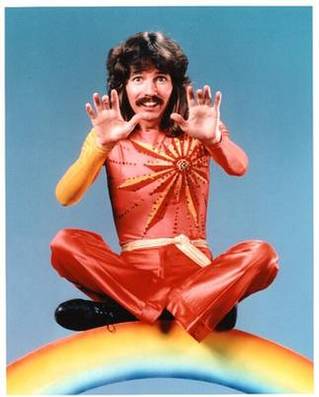
But Henning was never hip. Henning was a hippie kid, loveable but outsider. Henning gave up magic to study Transcendental Meditation, which only made him seem like an oddball to the mainstream population. I remember seeing Henning on the Merv Griffin Show in the late Seventies, talking about how advanced TM meditators could float up off the ground. A skeptical Burt Reynolds, who was also a guest, had a field day with Henning.
-------------------------------------
Evaluating Blaine
Blaine, different story altogether. Blaine, in his scruffy tee-shirt and slouchy pants, looks like every other young American. Except that he seems to possess extraordinary powers.
I know they picked the best reaction shots, the spectators whose world was turned upside-down, the occasional person who seriously questioned whether he was a conjurer or something supernatural. But all of these choices add up to something more than just promoting the cult of David Blaine. Through the vehicle of Street Magic, Blaine is a peacemaker, a uniter, a lover of humanity. Blaine uses magic to drop walls, to humanize people, to snap them out of their familiar patterns and see the world as magical, beautiful.
Genius performer. Genius.
And the guy's absolutely brilliant with a deck of cards. I know about all the magicians who like to bash him: he's not original, he does stuff I can do, he does stuff I've been doing for years, his doubles aren't clean, blah blah blah. Well, let me tell you, on that special Blaine performs a bunch of fairly sophisticated effects, not super-dooper, knuckle-busting tough, but far from easy.
His card work is graceful, smooth, and brilliantly well-covered. His use of direction and misdirection is superlative; in fact, I think most magicians are totally incapable of understanding just how well Blaine covers his work and so they underestimate his genius. This kid was only twenty-three years old at the time this special was shot. But he kills like a master.
If you're a magician and you can follow what he's doing, try watching his audience management skills. Blaine is always absolutely in control of the spectator. He knows when to give the spectator room to breath, laugh, and react and he knows exactly how to reel him or her back in for the kill. You can tell watching this special that Blaine has serious performing chops.
There's an effect he does where a little girl's selected card disappears from the deck and appears in the girl's back pocket. Blaine's pacing on this one is astonishing; the girl (who looks to be about eight or nine) and her mother are totally blown away. In fifty years, this little girl will be a middle-aged woman who loves magic and remembers -- vividly -- the time that amazing guy made her card jump into her pocket. As a viewer, it really feels like you're watching over the girl's shoulder. I have no doubt most non-magician viewers were as blown away as the girl.
When Street Magic first aired, people literally went out of their way to tell me how much they enjoyed it. Kids, teenagers, old people, absolutely every non-magician I talked to who watched the special thought it was truly, well, special. They fell in love with magic, since Blaine communicated a sense of wonder not seen for years.

---------------------------------------
The Blaine Backlash
Okay, it's time I addressed the whole issue of TV magic, selective editing, and all those ridiculous hot-button issues launched into the magical stratosphere by the explosive popularity of Blaine's special. The job of the magician is not to be honest. It is, as Darwin Ortiz says in Strong Magic, "to create the illusion of impossibility." If you can use television to help create the illusion of impossibility, by all means do so. You'll be doing your job properly.
There's a lot of sniping directed his way regarding Street Magic's promiscuous use of reaction shots. Give ME the chance to film myself doing an effect fifty times and let ME pick the two or three best reactions out of fifty, and I'll seem like a genius, too, seems to be a common analysis. Well, guess what?
You're absolutely right. And if you ever get your own TV special, I'd certainly recommend that you pick out the best reactions to show, too. Why wouldn't you? Do you really think it would have been a better TV show, a better magic show, if Blaine had shown those times when people had been less blown away? Do you really think it would have honored magic to show the guy who said, "That's pretty cool. I used to do that stuff, too. Here, let me show you the trick with the three rows of seven cards..." blah blah blah?
Blaine (with rumored help from an uncredited Spike Lee) figured out a way to translate the very best experience of magic onto television: show people being blown away, floored, absolutely balls-out astonished. They become the eyes and ears of the people watching at home. Over the last ten years, probably the most common thing people tell me when they find out I'm a magician is that they love David Blaine (or, "that kid who does street magic") and still marvel at things they saw him do years ago.
------------------------------------------
Blaine's Influence
Blaine triggered a complete paradigm shift in the magical community.
No, scratch that, I'll come back to that paradigm shift in a moment. The existing magical community didn't change at all; in fact, it predictably responded with a vast reservoir of hostility. People absolutely hated that Blaine became a superstar doing what in many cases were tricks they had sitting in their magic drawers at home. They said, "I could have done that! I've had an Invisible Deck for years! I've used the Coin in Bottle for that gag for years! He's nothing special."
There it is, that moment of denial. Magicians everywhere should have been saying, "Holy smokes, look at all the powerful material I have available to me right now!
"Thanks, David Blaine, for showing me how to use it!"
Magicians the world over should have seen the success of Street Magic and concluded, "Oh, now I understand. People don't want lame patter about little sponge bunnies breeding, about Gypsies and fairy dust, about card elevators. They just want to be shown something impossible. They want to see their signed card put in the middle and suddenly -- magically -- be on the top."
And let's not get past the fact that Blaine's an extremely handsome and sexy guy. Right there, a lot of jealous magicians (who don't tend to fit the above description) were ready to write him off. Blaine uses his charisma and sex appeal on everyone, male and female, young and old. And -- bless my heart! -- he doesn't dress up all fancy, either! No tuxedos for Blaine; he performs on the streets in jeans and a tee-shirt. Another crime in the stuffy magic world circa 1997!
But here's the number one reason why a lot of magicians hated Blaine. Blaine was a mirror held up to other magicians which reflected back their own lameness. By 1997, magic had been in a decades-long slide into absolute mediocrity. After Street Magic, anyone who wasn't as good as Blaine suddenly found himself facing an educated audience no longer interested in sitting still for crappy magic tricks.

A boatload of terrible magicians had quietly poisoned the reputation of magic as an art for years. Even worse, they had gotten a free pass from the magic community.
Then Blaine came along and ruined it for all of them.
-----------------------------------------------
Saving Magic: The New Generation
Although the mainstream of magic failed to embrace Blaine, an entire generation of young magicians has grown up in his sphere of influence. Indeed, a most amazing thing has happened as a direct result of that first Street Magic special: magic has become hip. The "street magic" style popularized by Blaine is now all over the Web, in the spawn of Penguin and Ellusionist, and in clever young performers like Daniel Garcia, Wayne Houchin, and Morgan Strebler.
TV shows like T.H.E.M.(Totally Hidden Extreme Magic) and Mondo Magic brought cutting-edge magic to a whole new audience. T.H.E.M. featured the performance group Magic X, which includes PeaceLove's Musings fave Cyril Takayama. Probably the most high-profile magician of the moment is Criss Angel, star of A&E's Mindfreak. Angel is a major talent in his own right, but his show is undeniably an offspring of Blaine, combining as it does roving street magic with Blaine's other great breakthrough: endurance stunts.
--------------------------------------
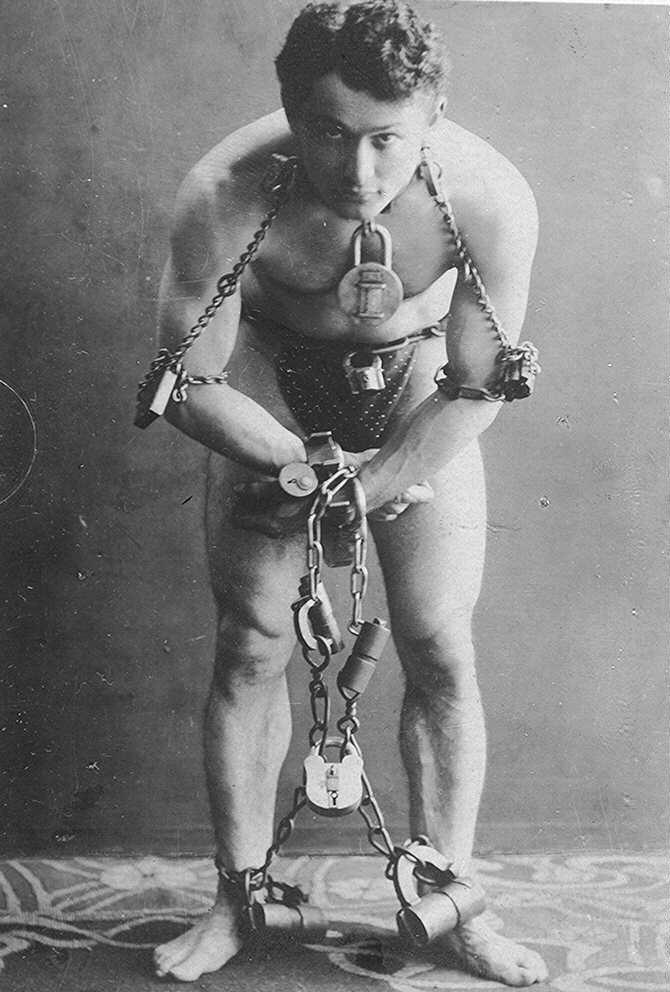
Blaine has spoken at length about his admiration for Houdini, a Hungarian-born Jew who grew up dirt poor and rose to become one of the most famous and idolized entertainers in the world. Although Houdini began and ended his career as a magician, his greatest fame came through his extraordinary ability to convince the world he could escape from any type of restraint. As part of his mythos, Houdini presented himself as almost a superman, a man more physically gifted than others. To this end, he trained himself as a contortionist, learned to hold his breath for minutes at a time, and made sure to have himself photographed frequently in little more than a loincloth -- the better to show off his impressive physique.
Blaine was smart enough to realize early on that he had taken "street magic" about as far as it could go. By the time his later specials aired, the Web was full of sites explaining many of the basic effects Blaine made famous, including the Balducci levitation. Blaine must have understood that in order to build his fame and reputation he would have to move on to bigger and better things. So he began to formulate the endurance stunts that now dominate his specials -- sixty-one hours encased in a block of ice on Times Square, thirty-five hours atop a small platform a hundred feet in the air, ending with a jump down onto a pile of boxes, and, most famously, forty-four days fasting in a glass box suspended over the River Thames in London.

Blaine isn't the first magician to attempt far-out endurance stunts, but he is the first geniune superstar since Houdini to do so. He has been able to present his endurance feats as spiritual trials, a quest to further the bounds of his personal abilities -- and, by extension, to demonstrate to his audience that humans are capable of truly extraordinary levels of survival and endurance. Blaine always maintains a stance of absolute humility; he continually expresses that he is grateful for the opportunity to explore his own limits. (In this, he has distinguished himself from his idol Houdini, by all accounts one of the least humble performers in history.)

This stance, this framing of the endurance trials as some sort of higher calling, a quest to find and exceed the outer limits of the physically possible -- this is yet another area where Criss Angel owes a huge and largely unacknowledged debt to Blaine.
Drowned Alive
On May 1st, Blaine will begin his latest performance. He plans to spend seven days on public display submerged in a tank of water (with food and oxygen lines), at the end of which he will attempt to hold his breath for almost nine minutes. It's a bold, brilliant step in a provocative career, and I for one will be watching ABC on May 8th when it all comes down to the wire.
-----------------------
This post has been corrected since it first went up. Please see the comments for my embarrassing mistakes.
UPDATE: 12/12/10
Below are some follow-up posts on Blaine:
Racherbaumer on Blaine
Baine - Drowned Alive
MCJ on Blaine (from 2004)
Burden to Ono to Blaine
Blaine and Me
MCJ on Blaine (from 2004)
Subscribe to:
Posts (Atom)