As expected, the "morally corrupt" Governator vetoed the gay marriage bill.
From Reuters: Schwarzenegger's press secretary, Margita Thompson, said the governor "believes that gay couples are entitled to full protection under the law and should not be discriminated against based upon their relationship."
But since California voters approved a ballot measure five years ago defining marriage as between a man and a woman, the question of gay marriage should be put to voters again in a referendum or decided by courts, she said.
All together now: Civil liberties are not a popularity contest. They are a fundamental human right.
The Fourteenth Ammendment says:
No State shall make or enforce any law which shall abridge the privileges or immunities of citizens of the United States; nor shall any State deprive any person of life, liberty, or property, without due process of law; nor deny to any person within its jurisdiction the equal protection of the laws.
And the Supreme Court, in the landmark 1967 Loving v. Virginia decision, which declared a Virginia statute banning interracial marriage unconstitutional, said:
Marriage is one of the "basic civil rights of man," fundamental to our very existence and survival.
I understand the distinction put forth by Arnold's mouthpiece above; it would be nice if the courts would settle this issue once and for all. But in the meantime, is it too much to ask of our elected leaders that they actually lead? Do they have to hide behind technicalities rather than simply doing the right thing?
Gavin Newsom for President!
Thursday, September 08, 2005


Friday, September 02, 2005
Disaster Rankings, circa 2001
The conservative Free Republic site reprints a December 1, 2001 Houston Chronicle article about a rather eerily prescient mid-2001 Federal Emergency Management Agency (FEMA) report. In the report, FEMA scientists concluded that the three most likely catastrophic disasters to occur in the U.S. in the near future are: 1. A terrorist attack on New York City (which happened); 2. a massive earthquake in San Francisco; and 3. (drumroll, please) a hurricane and flood in New Orleans. Of the last scenario (the main subject of the article), the Chronicle says:
In the face of an approaching storm, scientists say, the city's less-than-adequate evacuation routes would strand 250,000 people or more, and probably kill one of 10 left behind as the city drowned under 20 feet of water. Thousands of refugees could land in Houston....
A big storm, scientists said, would likely block four of five evacuation routes long before it hit. Those left behind would have no power or transportation, and little food or medicine, and no prospects for a return to normal any time soon.
Wow. FEMA is taking a lot of abuse these days for being unprepared and slow to respond to the catastrophe in New Orleans and surrounding areas. It's nice to see that their scientists, at least, knew long ago what they faced.
In the face of an approaching storm, scientists say, the city's less-than-adequate evacuation routes would strand 250,000 people or more, and probably kill one of 10 left behind as the city drowned under 20 feet of water. Thousands of refugees could land in Houston....
A big storm, scientists said, would likely block four of five evacuation routes long before it hit. Those left behind would have no power or transportation, and little food or medicine, and no prospects for a return to normal any time soon.
Wow. FEMA is taking a lot of abuse these days for being unprepared and slow to respond to the catastrophe in New Orleans and surrounding areas. It's nice to see that their scientists, at least, knew long ago what they faced.
Sacred Geometry - Plugs

I was hooking up the electronic hub in my new place (that's my fancy way of saying I was setting up the stereo) when I noticed the beautiful geometric shape formed by the intersection of plugs. Specifically, the angles got really interesting when I added a 1-3 plug going into the extension cord to fit the iPod power supply and the iBook plug. The black plug is for my power amp. Preamp and CD player (which I seldom use anymore) are going into a separate outlet on the other side of the stereo.
Anyway, I was struck very strongly -- for the umpteenth time -- just how extraordinary all this technology is. I now have about 300 CDs on my tiny iPod, and it's amazing to be able to play any one of them on demand through my stereo but then to also simply grab the thing and have the entire vast library available in my car and at the gym, too.
Even more astoundingly, my laptop has a wireless connection so I'm able to wander the house, sit around in my pjs (metaphorically speaking), and participate in a global conversation and database. Wired "Senior Maverick" Kevin Kelly has a stunning article in last month's issue about how mind-boggling the web's ten years has been. I can't resist these excerpts:
The scope of the Web today is hard to fathom. The total number of Web pages, including those that are dynamically created upon request and document files available through links, exceeds 600 billion. That's 100 pages per person alive.
How could we create so much, so fast, so well? In fewer than 4,000 days, we have encoded half a trillion versions of our collective story and put them in front of 1 billion people, or one-sixth of the world's population. That remarkable achievement was not in anyone's 10-year plan.
I noticed this with bemusement years ago. I used to read a highly influential cyberpunk magazine called Mondo 2000 back around 1990 or so. This San Francisco-based mind-bender of a magazine covered everything from artificial intelligence to virtual reality to psychedelic drugs to new theories of consciousness and reality. They were early adapters of email and other embryonic electronic networks, such as bulletin boards.
And yet, these tripped-out visionaries didn't see the World Wide Web coming. They totally missed it. (As Kelly points out, so did everyone else). There's nothing in any of those jaw-dropping early issues that describes a future even remotely as connected as the present we live in today. And this is still only the beginning.
Kelly again: The accretion of tiny marvels can numb us to the arrival of the stupendous. Today, at any Net terminal, you can get: an amazing variety of music and video, an evolving encyclopedia, weather forecasts, help wanted ads, satellite images of anyplace on Earth, up-to-the-minute news from around the globe, tax forms, TV guides, road maps with driving directions, real-time stock quotes, telephone numbers, real estate listings with virtual walk-throughs, pictures of just about anything, sports scores, places to buy almost anything, records of political contributions, library catalogs, appliance manuals, live traffic reports, archives to major newspapers - all wrapped up in an interactive index that really works....
This view is spookily godlike....
Why aren't we more amazed by this fullness? Kings of old would have gone to war to win such abilities. Only small children would have dreamed such a magic window could be real. I have reviewed the expectations of waking adults and wise experts, and I can affirm that this comprehensive wealth of material, available on demand and free of charge, was not in anyone's scenario. Ten years ago, anyone silly enough to trumpet the above list as a vision of the near future would have been confronted by the evidence: There wasn't enough money in all the investment firms in the entire world to fund such a cornucopia. The success of the Web at this scale was impossible.
But if we have learned anything in the past decade, it is the plausibility of the impossible.
Later in the article, he states:
There is only one time in the history of each planet when its inhabitants first wire up its innumerable parts to make one large Machine. Later that Machine may run faster, but there is only one time when it is born.
You and I are alive at this moment. [snip]This will be recognized as the largest, most complex, and most surprising event on the planet.
Well, that about sums up how I feel, too. I consider the Internet to be the most important invention in the history of life on earth, and it amazes me that more people don't appreciate just how profoundly it is transforming and benefitting humanity. We are fortunate beyond imagining to be living in such times.
Monday, August 29, 2005
English Language Usage Errors
Researching Web sites about grammar I came across Common Errors in English Usage site. It contains a huge list of commonly misused or misspelled words, organized in alphabetical order. The list is a blast to peruse; although I was already familiar with most of the examples, Brians clarifies subtle points I might not have thought of or known about (e.g. the discussion of e.g. and i.e. was helpful to me).
While you're there, check out the Non-Errors page as well.
While you're there, check out the Non-Errors page as well.
Sunday, August 21, 2005
The Houdini That Didn't Escape
I was all inspired to write about the painting in the last post, the one that didn't get away. But then, somehow, I lost the urge. So here's the story in a nutshell: 1. My soon-to-be-ex and I bought the painting together in Prague last year. 2. The painter is a quite famous Czech artist and it's an exceptional piece, in my opinion. 3. Now that my wife and I are separated, we both want the piece.
So maybe this one should have gotten away. Ba dum bum.
--------------------------------------------------------------
I have another, more interesting story to tell you, however, this one from fellow magi Jeff. In a comment to my Hofzinser post, Jeff mentioned his own great find, a signed copy of Houdini's 1906 The Unmasking of Robert Houdin, for which he paid $7.50 back in 1982.
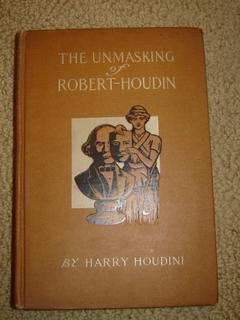 I'll tell you more about the book in a moment. But first, here's Jeff's story in his own words:
I got it when I was in college; I won a book-collecting contest sponsored by the campus library, and one of the privileges of winning was being able to purchase some of the duplicates in their special collection. They kept another copy of the book...which was not only signed, but had some kind of message from Houdini to whoever he gave it to.
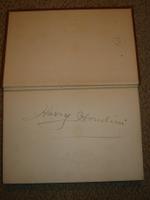

Compare the autograph with the printed signature on the frontispiece. Looks like a pretty good match!
These days, with the inflation in anything Houdini-related, I'd guess it's worth about $1000.00 - $2000.00, maybe more depending on the auction. But I'm keeping it.
About the Book
The Unmasking of Robert Houdin was a smear book written by Houdini against his former idol, French "Father of Modern Magic" Robert Houdin (from whom Houdini had taken his name). By all accounts it's a grossly unfair book filled with scurrilous arguments. Noted magic writer Jean Hugard even went so far as to publish a series of articles refuting the book in his magazine, Hugard's Magic Monthly.
Here's a great account of the whole silly affair that Houdini's friend, famed magician, magic dealer, and writer Will Goldston wrote in his book Sensational Tales of Mystery Men (1929). Goldston chalks up the whole embarrasing episode to Houdini's obdurate pig-headedness; Houdin's family had refused to meet with him in France and Houdini was not one to take any perceived insult lightly.
If you want to see what all the fuss was about, you can do so thanks to Chris Wasshuber's fabulous Lybrary.com, which offers PDFs of classic magic books at very reasonable prices. They have a downloadable version of The Unmasking of Robert Houdin here. There's even a link to Hugard's 1957 response, Houdini's Unmasking.
---------------------------------------------------------------------
Thanks for sharing the story and the pictures, Jeff. Since Houdini remains the most famous (and collectible) magician who ever lived, I think you win the "great magic find" award! Any other nominees?
So maybe this one should have gotten away. Ba dum bum.
--------------------------------------------------------------
I have another, more interesting story to tell you, however, this one from fellow magi Jeff. In a comment to my Hofzinser post, Jeff mentioned his own great find, a signed copy of Houdini's 1906 The Unmasking of Robert Houdin, for which he paid $7.50 back in 1982.
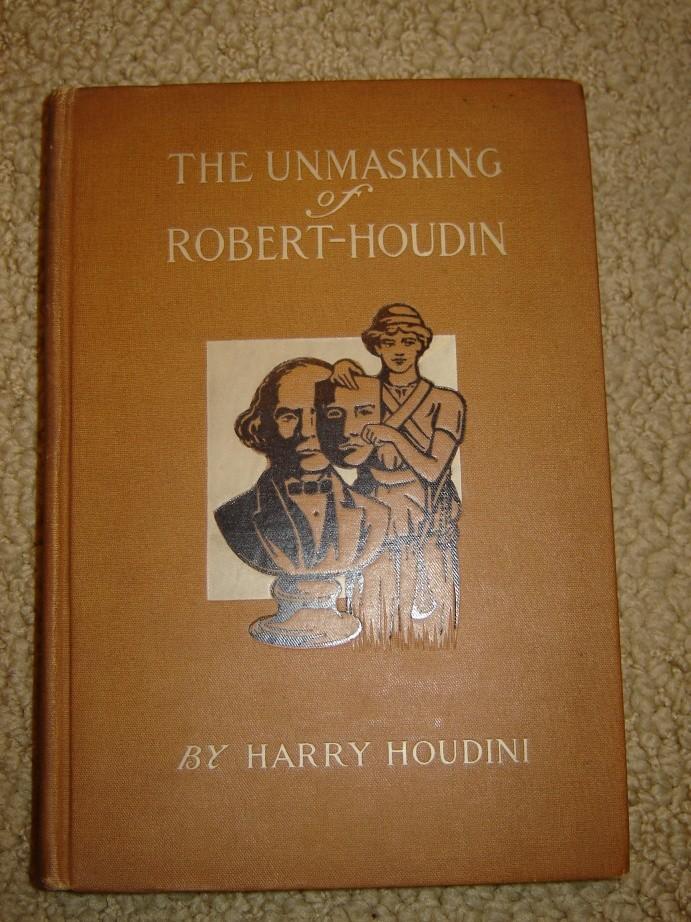 I'll tell you more about the book in a moment. But first, here's Jeff's story in his own words:
I got it when I was in college; I won a book-collecting contest sponsored by the campus library, and one of the privileges of winning was being able to purchase some of the duplicates in their special collection. They kept another copy of the book...which was not only signed, but had some kind of message from Houdini to whoever he gave it to.
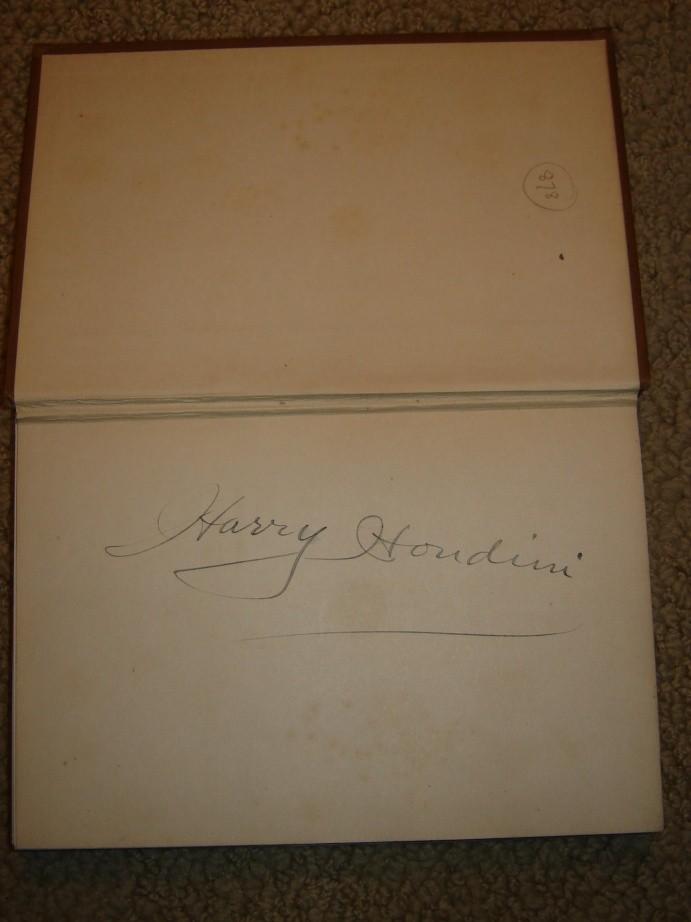
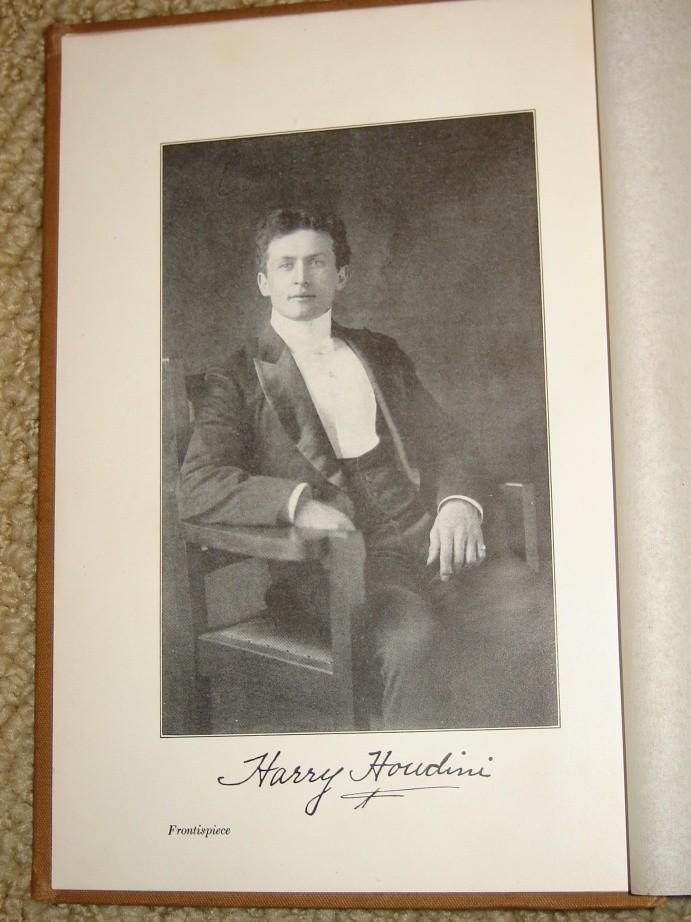
Compare the autograph with the printed signature on the frontispiece. Looks like a pretty good match!
These days, with the inflation in anything Houdini-related, I'd guess it's worth about $1000.00 - $2000.00, maybe more depending on the auction. But I'm keeping it.
About the Book
The Unmasking of Robert Houdin was a smear book written by Houdini against his former idol, French "Father of Modern Magic" Robert Houdin (from whom Houdini had taken his name). By all accounts it's a grossly unfair book filled with scurrilous arguments. Noted magic writer Jean Hugard even went so far as to publish a series of articles refuting the book in his magazine, Hugard's Magic Monthly.
Here's a great account of the whole silly affair that Houdini's friend, famed magician, magic dealer, and writer Will Goldston wrote in his book Sensational Tales of Mystery Men (1929). Goldston chalks up the whole embarrasing episode to Houdini's obdurate pig-headedness; Houdin's family had refused to meet with him in France and Houdini was not one to take any perceived insult lightly.
If you want to see what all the fuss was about, you can do so thanks to Chris Wasshuber's fabulous Lybrary.com, which offers PDFs of classic magic books at very reasonable prices. They have a downloadable version of The Unmasking of Robert Houdin here. There's even a link to Hugard's 1957 response, Houdini's Unmasking.
---------------------------------------------------------------------
Thanks for sharing the story and the pictures, Jeff. Since Houdini remains the most famous (and collectible) magician who ever lived, I think you win the "great magic find" award! Any other nominees?
Wednesday, August 17, 2005

Tuesday, August 16, 2005
The One That Didn't, Part 2 -- The Castle
So I got this amazing book for twelve dollars, the copy of Hofzinser given by Faucett Ross to Dai Vernon back in 1932. And I actually KNOW Vernon, not well, but I see him all the time at the Castle and I've hung out with him on a few occasions. He's even seen my act in the Close-Up Room; he said, "Very nice!" on the way out and I have to believe it was more than courtesy that he said it.
It's 1990, Vernon's 96 years old, and here's this book he signed in 1932, when he was already 38, and I realize, "Jesus, he's been around for a helluva' long time!"
So when I get back to L.A. I call up my buddy T.A. Waters, the brilliant mentalist who wrote "Mind, Myth, and Magic," one of the, oh, ten best books ever written on mentalism. T.A.'s one of those remarkable people who know quite a bit about a wide range of subjects, with a specialty in the subterrenean side of things, the occult, the strange, the magical, and the dark. But he's not a dark guy; he's a lot of fun to hang out with. And I'm pretty sure he likes me, because I'm smart.
He taught me a lot, particularly that you could be very smart and very knowledgeable (about magic and other things) and believe, based on the evidence you have seen and the people you know, that the world is stranger than any of us really think. Yes, T.A. was definitely one of the more influential people in my life.
So I tell T.A. about this amazing find, this book given to the Professor (as Vernon was known to the magical community) back in 1932. And I tell him it must be worth a pretty penny. And he says, "Well it would have been worth more a few years ago, but the book's been reissued so it's not as rare anymore." I remember being surprised at how non-savvy he was about collectibles. It seemed obvious to me that the main value in the book was in its extraordinary provenance, not the rarity of the book itself.
But my question to T.A. was, "Should I return it to him? I only paid twelve bucks for it and I think it might be cool for him to get it back."
T.A.'s answer was classic. "Well, he gave away everything he ever owned so I doubt he'd want it back. But if you do give it to him, you should definitely wait until Larry Jennings and Bruce Cervon [well-known "inner circle" close-up magicians who frequented the Castle for years in order to hang around and learn from Vernon] and a few others are there with him and see you do it. You don't need to be excessively honorable."
The truth was, I didn't really want to give it back to Vernon, since I knew it was valuable, both dollarwise and as a fascinating, unique collectible. But I thought it would be noble to try. So I went to the Professor the next time I was at the Castle and told him about the book. "Do you want it back, Professor?"
"No, I don't want that back!" he said dismissively and without further interest. So I had it free and clear.
The next time I went to the Castle, which was a few days later, I brought the book. I showed it to John Carney, who had studied with Faucett Ross while growing up in Iowa (Carney had the best line ever about Iowa: "When I tell people I'm from Iowa they always say, 'Oh Iowa! I've been to Columbus...[pause]...and I love potatoes!'")
So I showed it to Carney and he took one look and said, "That's Faucett's handwriting," which really made it more "real," somehow.
And on that night, Larry Jennings offered me $500 for it, and Jim Patton (the Magical Bartender) sighed when he saw it and then snorted when I told him what I'd paid for it. And up in the library (it was still "up" in those days, before it moved to the basement), I showed it to some guy I didn't really know who said he was a collector. He offered me $500 for it, too.
That was fifteen years ago. Vernon is long gone, Jennings is gone, T.A. is gone, Bill Larsen, the magical owner of the Magic Castle, is long gone...
But I've still got my book.
It's 1990, Vernon's 96 years old, and here's this book he signed in 1932, when he was already 38, and I realize, "Jesus, he's been around for a helluva' long time!"
So when I get back to L.A. I call up my buddy T.A. Waters, the brilliant mentalist who wrote "Mind, Myth, and Magic," one of the, oh, ten best books ever written on mentalism. T.A.'s one of those remarkable people who know quite a bit about a wide range of subjects, with a specialty in the subterrenean side of things, the occult, the strange, the magical, and the dark. But he's not a dark guy; he's a lot of fun to hang out with. And I'm pretty sure he likes me, because I'm smart.
He taught me a lot, particularly that you could be very smart and very knowledgeable (about magic and other things) and believe, based on the evidence you have seen and the people you know, that the world is stranger than any of us really think. Yes, T.A. was definitely one of the more influential people in my life.
So I tell T.A. about this amazing find, this book given to the Professor (as Vernon was known to the magical community) back in 1932. And I tell him it must be worth a pretty penny. And he says, "Well it would have been worth more a few years ago, but the book's been reissued so it's not as rare anymore." I remember being surprised at how non-savvy he was about collectibles. It seemed obvious to me that the main value in the book was in its extraordinary provenance, not the rarity of the book itself.
But my question to T.A. was, "Should I return it to him? I only paid twelve bucks for it and I think it might be cool for him to get it back."
T.A.'s answer was classic. "Well, he gave away everything he ever owned so I doubt he'd want it back. But if you do give it to him, you should definitely wait until Larry Jennings and Bruce Cervon [well-known "inner circle" close-up magicians who frequented the Castle for years in order to hang around and learn from Vernon] and a few others are there with him and see you do it. You don't need to be excessively honorable."
The truth was, I didn't really want to give it back to Vernon, since I knew it was valuable, both dollarwise and as a fascinating, unique collectible. But I thought it would be noble to try. So I went to the Professor the next time I was at the Castle and told him about the book. "Do you want it back, Professor?"
"No, I don't want that back!" he said dismissively and without further interest. So I had it free and clear.
The next time I went to the Castle, which was a few days later, I brought the book. I showed it to John Carney, who had studied with Faucett Ross while growing up in Iowa (Carney had the best line ever about Iowa: "When I tell people I'm from Iowa they always say, 'Oh Iowa! I've been to Columbus...[pause]...and I love potatoes!'")
So I showed it to Carney and he took one look and said, "That's Faucett's handwriting," which really made it more "real," somehow.
And on that night, Larry Jennings offered me $500 for it, and Jim Patton (the Magical Bartender) sighed when he saw it and then snorted when I told him what I'd paid for it. And up in the library (it was still "up" in those days, before it moved to the basement), I showed it to some guy I didn't really know who said he was a collector. He offered me $500 for it, too.
That was fifteen years ago. Vernon is long gone, Jennings is gone, T.A. is gone, Bill Larsen, the magical owner of the Magic Castle, is long gone...
But I've still got my book.
Sunday, August 14, 2005
The One That Didn't - Part One
What an interesting experience, this blog! On my last post, the great item that "didn't get away" is a magic book I found for a super bargain price (more on that in a moment). However, rereading the post I suddenly realized it's NOT about the book, which I got for a song (hence no heady deliberation and choice of options to buy or not to buy), but about a particular painting my soon-to-be-ex-wife and I aquired in Prague for our tenth anniversary. So I've decided to split this into two separate stories, both interesting in their own way.
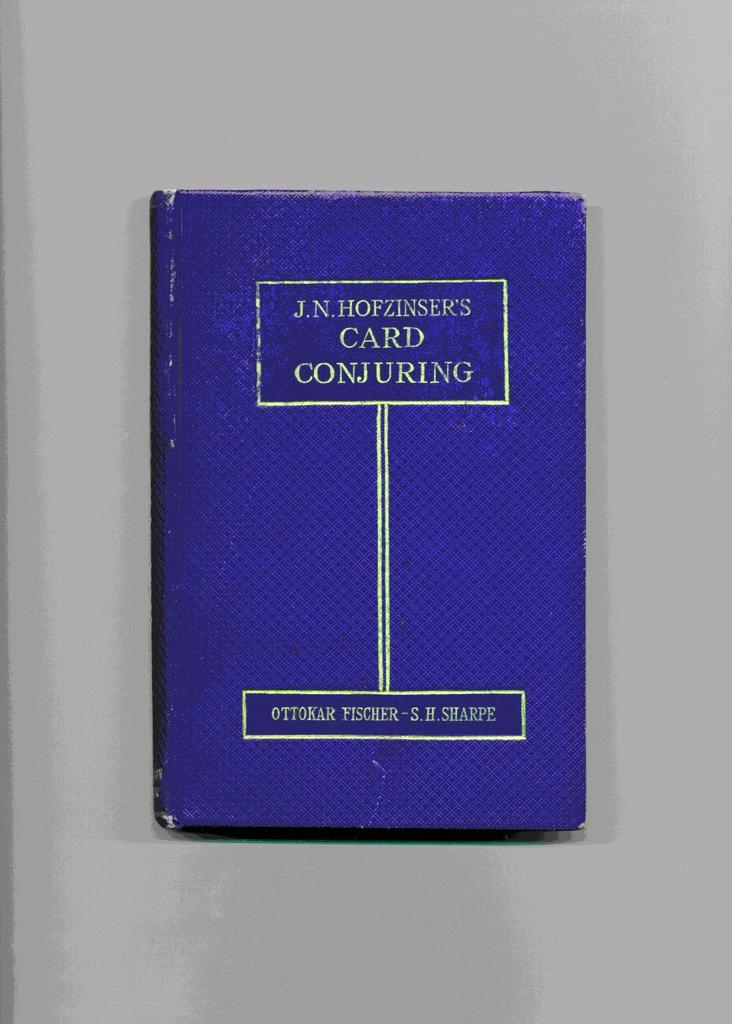
It's August 10th, 1990 (I still have the receipt), and I'm visiting a friend in Chicago, on the campus of my old alma mater, the University of Chicago. I pop into Powell's Bookstore, a famous used book store on 57th, right in the neighborhood. I'm perusing the used magic books (in the "Games" section -- shows you the respect with which magicians are held), and out of the corner of my eye I see an old blue spine with gold lettering, "Hofzinser."
 Hofzinser, for my non-magician friends, was a stupendous "drawing room" conjuror in nineteenth-century Vienna. He invented a number of standard moves and, more importantly, plots, in use by card magicians to this day. Ricky Jay included a tribute to Hofzinzer in his Obie Award Winning Ricky Jay and His 52 Assistants, closing the first section of his show by performing one of the master's elegantly structured tricks.
So my hand shot out and grabbed the book, hoping against hope that it wouldn't be fifty dollars or so, since I knew I'd be tempted but didn't really know what the book was worth.
The book turned out to be the first English language edition (by S.H. Sharpe in 1931) of Ottokar Fischer's classic work, Hofzinser's Card Conjuring (1910), a book that was to have an enormous impact on the whole generation of close-up artists who "set the ground" for modern close-up, all the way up to Dai Vernon, who famously attributed his advice to "be natural" directly to Hofzinser.
As I checked the inside cover I was delighted to see a price of $12 on the inside cover, a bargain for this book, even fifteen years ago. But I was even more delighted to see the inscription, "To D.W. Vernon, with proper reverence, Faucett W. Rossio."
In other words, this is a copy of Hofzinser that Faucett Ross (as he's better known to magicians), friend and confidante of Vernon's (and later mentor to noted close-up performer and teacher John Carney) gave to his buddy Dai Vernon. And, Holy Shit! Vernon himself signed and dated it "1932!"
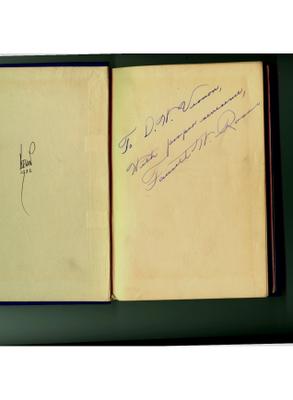
Twelve bucks. THIS one I got! And since I'm tired, you'll have to wait until the next post for the story of what happened when I went back to L.A. with the book and showed up at the Magic Castle with it.
And then after that, the real One That Didn't Get Away -- and why maybe it should have.
It's August 10th, 1990 (I still have the receipt), and I'm visiting a friend in Chicago, on the campus of my old alma mater, the University of Chicago. I pop into Powell's Bookstore, a famous used book store on 57th, right in the neighborhood. I'm perusing the used magic books (in the "Games" section -- shows you the respect with which magicians are held), and out of the corner of my eye I see an old blue spine with gold lettering, "Hofzinser."
 Hofzinser, for my non-magician friends, was a stupendous "drawing room" conjuror in nineteenth-century Vienna. He invented a number of standard moves and, more importantly, plots, in use by card magicians to this day. Ricky Jay included a tribute to Hofzinzer in his Obie Award Winning Ricky Jay and His 52 Assistants, closing the first section of his show by performing one of the master's elegantly structured tricks.
So my hand shot out and grabbed the book, hoping against hope that it wouldn't be fifty dollars or so, since I knew I'd be tempted but didn't really know what the book was worth.
The book turned out to be the first English language edition (by S.H. Sharpe in 1931) of Ottokar Fischer's classic work, Hofzinser's Card Conjuring (1910), a book that was to have an enormous impact on the whole generation of close-up artists who "set the ground" for modern close-up, all the way up to Dai Vernon, who famously attributed his advice to "be natural" directly to Hofzinser.
As I checked the inside cover I was delighted to see a price of $12 on the inside cover, a bargain for this book, even fifteen years ago. But I was even more delighted to see the inscription, "To D.W. Vernon, with proper reverence, Faucett W. Rossio."
In other words, this is a copy of Hofzinser that Faucett Ross (as he's better known to magicians), friend and confidante of Vernon's (and later mentor to noted close-up performer and teacher John Carney) gave to his buddy Dai Vernon. And, Holy Shit! Vernon himself signed and dated it "1932!"
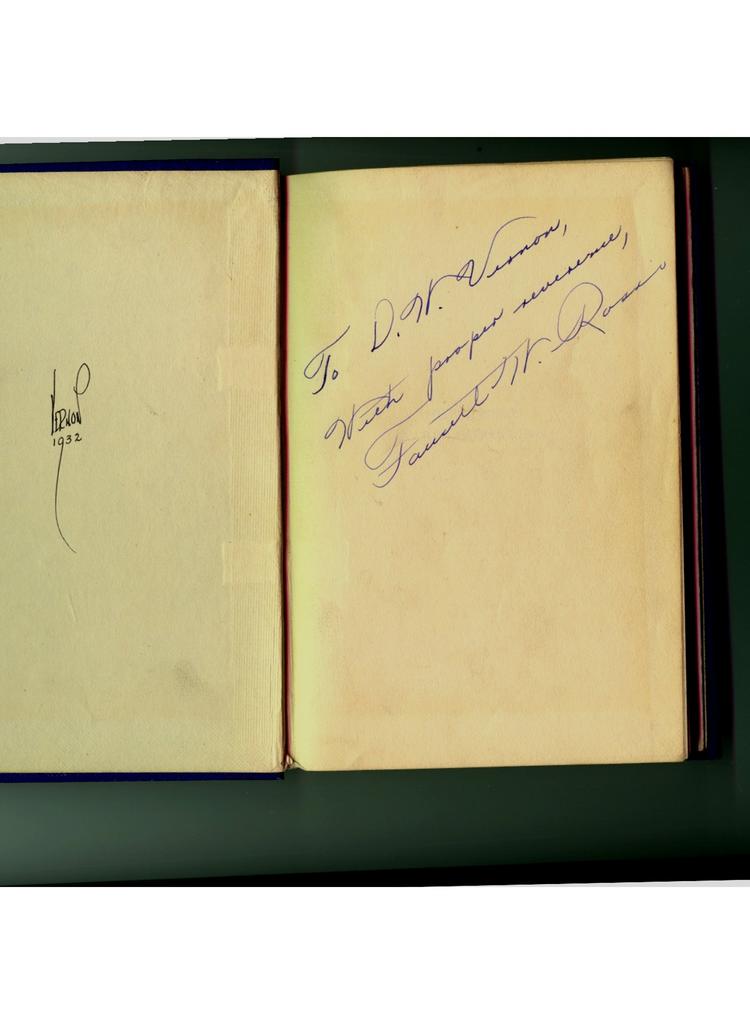
Twelve bucks. THIS one I got! And since I'm tired, you'll have to wait until the next post for the story of what happened when I went back to L.A. with the book and showed up at the Magic Castle with it.
And then after that, the real One That Didn't Get Away -- and why maybe it should have.
Friday, August 12, 2005
Ones that Got Away (and One that Didn't)
Everyone has a story like this. Back in 1963, my aunt and uncle in New York went to the fiftieth anniversary exhibit commemorating the legendary 1913 Armory Show, in which America got its first major public glimpse of such future modern luminaries as Picasso, Braque, Matisse, Brancusi, and Duchamp (whose Nude Descending a Staircase #2 was a scandalous cause celebre).
So my aunt and uncle were checking out the show, perusing these now-legendary paintings, some of which were for sale (priced in the six-figure range, which was a lot of money back then). There were also paintings by well-known "second wave" Moderns for sale, too. The one they fell in love with, the one that tempted them, was an early painting by Stuart Davis, which was selling for the eminently-reasonable-but-too-much-for-young-teachers price of $12,000.
They came, they saw, they were very tempted...but in the end they decided that what must have been a year's salary (I'm guessing here, actually I have no idea) was a bit too dear to spend on a piece of art, lovely or not.
I have no idea what a Stuart Davis sells for these days, but I'm sure you could add a couple of extra zeros to the 1963 price and probably still fall quite short...
My own experience like this happened about fifteen years ago in L.A. I was wandering through a very nice art gallery in Santa Monica and I happened upon an extraordinary piece of art glass unlike anything I had ever seen before. It was dark electric violet with a a rather striking yellow accent, about two feet tall and shaped like a willowy flowing sea creature. The price was $6000, which was too much money for me to seriously consider-- but low enough for me to seriously consider (IF you know what I mean).
The artist was, it turned out, a pretty famous glass artist with his own glass school in Seattle; I looked through a book of his work and vowed to remember his name.
My more art-centric readers will no doubt have guessed that the piece was by Dale Chihuly, now an internationally famous artist (not just "glass" artist) and an artist for whom smaller, inferior works fetch $25-50,000. The piece I passed on looked somewhat like the one below, but much much nicer: a bit taller and darker (dark electric purple with a psychedelic yellow accent) and more vaselike, and more flowing. And backlit, like the one in the photo.

I'll swear to this day that I've yet to see another Chihuly piece as nice as the one I passed up. Damn. If only...
Chihuly's forms have been heavily imitated over the past fifteen years, but back then this was a stunning and unexpected piece. Chihuly almost single-handedly transformed the field of blowing glass into an accepted, legitimate Art. I consider him to be as important an artist as Frank Lloyd Wright, and would be honored to have his work in my home.
Truly, the increase in value of the piece would be immaterial to me; If I had it I'd never sell it.
Next up: The extremely nice magic-related collectible that didn't get away, or My very very very good day at the used bookstore.
So my aunt and uncle were checking out the show, perusing these now-legendary paintings, some of which were for sale (priced in the six-figure range, which was a lot of money back then). There were also paintings by well-known "second wave" Moderns for sale, too. The one they fell in love with, the one that tempted them, was an early painting by Stuart Davis, which was selling for the eminently-reasonable-but-too-much-for-young-teachers price of $12,000.
They came, they saw, they were very tempted...but in the end they decided that what must have been a year's salary (I'm guessing here, actually I have no idea) was a bit too dear to spend on a piece of art, lovely or not.
I have no idea what a Stuart Davis sells for these days, but I'm sure you could add a couple of extra zeros to the 1963 price and probably still fall quite short...
My own experience like this happened about fifteen years ago in L.A. I was wandering through a very nice art gallery in Santa Monica and I happened upon an extraordinary piece of art glass unlike anything I had ever seen before. It was dark electric violet with a a rather striking yellow accent, about two feet tall and shaped like a willowy flowing sea creature. The price was $6000, which was too much money for me to seriously consider-- but low enough for me to seriously consider (IF you know what I mean).
The artist was, it turned out, a pretty famous glass artist with his own glass school in Seattle; I looked through a book of his work and vowed to remember his name.
My more art-centric readers will no doubt have guessed that the piece was by Dale Chihuly, now an internationally famous artist (not just "glass" artist) and an artist for whom smaller, inferior works fetch $25-50,000. The piece I passed on looked somewhat like the one below, but much much nicer: a bit taller and darker (dark electric purple with a psychedelic yellow accent) and more vaselike, and more flowing. And backlit, like the one in the photo.

I'll swear to this day that I've yet to see another Chihuly piece as nice as the one I passed up. Damn. If only...
Chihuly's forms have been heavily imitated over the past fifteen years, but back then this was a stunning and unexpected piece. Chihuly almost single-handedly transformed the field of blowing glass into an accepted, legitimate Art. I consider him to be as important an artist as Frank Lloyd Wright, and would be honored to have his work in my home.
Truly, the increase in value of the piece would be immaterial to me; If I had it I'd never sell it.
Next up: The extremely nice magic-related collectible that didn't get away, or My very very very good day at the used bookstore.
Thursday, August 11, 2005
UPDATED: Hip-Hop and the Mainstream - Growing Pains
It seems that whenever I post about hip-hop my darling readers become inflamed, but in this case I can't resist. The SF Chronicle has an article in the Datebook section today titled Who would have thought it? Rap legend RZA hangs out, chats at Commonwealth Club gig.
It's a pleasant enough article, but the premise -- that it's somehow newsworthy when a hip hop artist gets taken seriously by the straightlaced Commonwealth Club -- demonstrates clearly just how out of touch the mainstream press really is, even in left-leaning San Francisco. After all, as a founding member of the seminal hip-hop collective Wu-Tang Clan and a successful film composer to boot, the 39-year-old RZA is a major modern artist by almost any standard. The fact that he's (presumably) virtually unknown to a large percentage of the Chronicle's readership is as much a commentary on their ongoing failure to adequately cover an important artist than on the supposed "clash of cultures" being covered.
My fur ruffled a bit at the opening paragraph:
What becomes a legend most? When the legend in question is the man behind one of the most influential hip-hop crews in history, the answer is not a public affairs forum such as the Commonwealth Club. But then, most musical artists don't philosophize about chess and martial arts and Islam and the mythology of organized crime.
Notice the patronizing tone and assumption of that last sentence, that "musical artists" (a clever shorthand for "hip-hop artists") are not cultured, educated about their work and the world around them, or diverse in their interests. If you doubt my take on this, try to imagine that a pop writer like, oh, Stephen King was the subject of the article instead. But then, most writers don't philosophize about chess.... Or how about if the article was about a different kind of "musical artist?" But then, most opera singers don't philosophize about chess....
In any of the above examples, readers would immediately smell something foul. "What do you mean, 'Most writers don't philosophize about chess...?' Writers are an intelligent, worldly lot!" Apparently, this kind of inherent respect doesn't extend to hip-hop artists, at least in the SF Chronicle.
Somewhat later in the article (on the back page), writer Neva Chonin asserts: It shouldn't have worked, this collision of disparate worlds of a stodgy public affairs forum and a profane street poet.... This would seem to score one for hip-hop, but is it necessary to refer to one of the most successful and influential recording artists of the last decade as a "profane street poet?"
Just calling out for a little respect, that's all. The day hip-hop is truly accepted as another valid art form will be the day a visit to the Commonwealth Club by a hip-hop artist ceases to be news.
UPDATE - August 31, 2005
Today's Chronicle has a letter to the editor (scroll down a bit) from one Max Woodworth in Taipei, Taiwan (I guess the mail from Taiwan travels really slowly). Woodworth essentially covers the same ground I did (though much more eloquently) in six paragraphs. I like his closing section:
...The forum could not have been a testament to hip-hop's "new place in the cultural canon" for the simple reason that hip-hop is not new, neither as an art form nor as part of our cultural canon. Practically every facet of our popular culture bears the marks of hip-hop, and this has been the case for about 20 years.
From speech to clothing to mannerism, hip-hop is everywhere and has been for a long time. The real shock should be that RZA hadn't been invited a decade ago to the Commonwealth Club. But I'm grateful, at least, that the forum was covered. It's a start.
As an update to my update, I Googled "Max Woodworth Taipei Taiwan" and discovered that he is a correspondant for the Taipei Times. At least, I assume he's the same Max Woodworth; I'll let you know if anything else turns up.
It's a pleasant enough article, but the premise -- that it's somehow newsworthy when a hip hop artist gets taken seriously by the straightlaced Commonwealth Club -- demonstrates clearly just how out of touch the mainstream press really is, even in left-leaning San Francisco. After all, as a founding member of the seminal hip-hop collective Wu-Tang Clan and a successful film composer to boot, the 39-year-old RZA is a major modern artist by almost any standard. The fact that he's (presumably) virtually unknown to a large percentage of the Chronicle's readership is as much a commentary on their ongoing failure to adequately cover an important artist than on the supposed "clash of cultures" being covered.
My fur ruffled a bit at the opening paragraph:
What becomes a legend most? When the legend in question is the man behind one of the most influential hip-hop crews in history, the answer is not a public affairs forum such as the Commonwealth Club. But then, most musical artists don't philosophize about chess and martial arts and Islam and the mythology of organized crime.
Notice the patronizing tone and assumption of that last sentence, that "musical artists" (a clever shorthand for "hip-hop artists") are not cultured, educated about their work and the world around them, or diverse in their interests. If you doubt my take on this, try to imagine that a pop writer like, oh, Stephen King was the subject of the article instead. But then, most writers don't philosophize about chess.... Or how about if the article was about a different kind of "musical artist?" But then, most opera singers don't philosophize about chess....
In any of the above examples, readers would immediately smell something foul. "What do you mean, 'Most writers don't philosophize about chess...?' Writers are an intelligent, worldly lot!" Apparently, this kind of inherent respect doesn't extend to hip-hop artists, at least in the SF Chronicle.
Somewhat later in the article (on the back page), writer Neva Chonin asserts: It shouldn't have worked, this collision of disparate worlds of a stodgy public affairs forum and a profane street poet.... This would seem to score one for hip-hop, but is it necessary to refer to one of the most successful and influential recording artists of the last decade as a "profane street poet?"
Just calling out for a little respect, that's all. The day hip-hop is truly accepted as another valid art form will be the day a visit to the Commonwealth Club by a hip-hop artist ceases to be news.
UPDATE - August 31, 2005
Today's Chronicle has a letter to the editor (scroll down a bit) from one Max Woodworth in Taipei, Taiwan (I guess the mail from Taiwan travels really slowly). Woodworth essentially covers the same ground I did (though much more eloquently) in six paragraphs. I like his closing section:
...The forum could not have been a testament to hip-hop's "new place in the cultural canon" for the simple reason that hip-hop is not new, neither as an art form nor as part of our cultural canon. Practically every facet of our popular culture bears the marks of hip-hop, and this has been the case for about 20 years.
From speech to clothing to mannerism, hip-hop is everywhere and has been for a long time. The real shock should be that RZA hadn't been invited a decade ago to the Commonwealth Club. But I'm grateful, at least, that the forum was covered. It's a start.
As an update to my update, I Googled "Max Woodworth Taipei Taiwan" and discovered that he is a correspondant for the Taipei Times. At least, I assume he's the same Max Woodworth; I'll let you know if anything else turns up.
Monday, August 08, 2005
LSD and Schizophrenia
In a comment last week, JB asked: Have you ever thought that perhaps schizophrenics are in a permanent state of delusion, much like someone on LSD or some other hallucinogen?
This very view dominated psychedelic research in it's first ten years, this notion that LSD mimicked psychosis or schizophrenia. It wasn't until the 1960s that a different paradigm emerged to describe the effects of psychedelics, when people who weren't researchers started to use them recreationally and, echoing their use throughout history, sacramentally.
In fact, I disagree with the inherent premise of the question, that LSD and other psychedelics create delusional thinking. People seldom become delusional on LSD; certainly it can happen and certainly this aspect of LSD seems to be very similar to what many people believe the experience of schizophrenia to be like. But overwhelmingly it's the wrong metaphor -- for both psychedelics and schizophrenia.
The most interesting work with psychedelics arises from their use in illuminating aspects of the physical, emotional, spiritual, or metaphysical world we live in. Schizophrenia, on the other hand, is pretty much defined by the inability to accurately perceive one of more of these aspects and the concomitant inability to function in the real world. Psychedelics like LSD can be extremely useful in sensitizing therapists to the "real feel" of schizophrenia by illuminating the kind of extreme shifts in consciousness experienced by those suffering from the disease. But therapists should never forget that their ability to distinguish psychedelic effects from "normal" consensual reality sets them apart from true schizophrenics.
Interestingly, in the early years of LSD research (1950s and early 1960s) LSD was explored as a treatment for schizophrenia. Check here for an overview of some early, extremely promising research with schizophrenic children. Can you imagine the brave soul who would ask to try out such research today?
Unfortunately, all research was abruptly halted in 1966 when politics overrode science and LSD was outlawed. The extraordinary potential of these substances remains tragically underexplored, although groups like the Multi-Disciplinary Association of Psychedelic Studies (MAPS) are doing yeoman's work in fighting for funding and approval for research into these substances. A brief perusal of their site gives hope that we are entering a new age of psychedelic exploration.
This very view dominated psychedelic research in it's first ten years, this notion that LSD mimicked psychosis or schizophrenia. It wasn't until the 1960s that a different paradigm emerged to describe the effects of psychedelics, when people who weren't researchers started to use them recreationally and, echoing their use throughout history, sacramentally.
In fact, I disagree with the inherent premise of the question, that LSD and other psychedelics create delusional thinking. People seldom become delusional on LSD; certainly it can happen and certainly this aspect of LSD seems to be very similar to what many people believe the experience of schizophrenia to be like. But overwhelmingly it's the wrong metaphor -- for both psychedelics and schizophrenia.
The most interesting work with psychedelics arises from their use in illuminating aspects of the physical, emotional, spiritual, or metaphysical world we live in. Schizophrenia, on the other hand, is pretty much defined by the inability to accurately perceive one of more of these aspects and the concomitant inability to function in the real world. Psychedelics like LSD can be extremely useful in sensitizing therapists to the "real feel" of schizophrenia by illuminating the kind of extreme shifts in consciousness experienced by those suffering from the disease. But therapists should never forget that their ability to distinguish psychedelic effects from "normal" consensual reality sets them apart from true schizophrenics.
Interestingly, in the early years of LSD research (1950s and early 1960s) LSD was explored as a treatment for schizophrenia. Check here for an overview of some early, extremely promising research with schizophrenic children. Can you imagine the brave soul who would ask to try out such research today?
Unfortunately, all research was abruptly halted in 1966 when politics overrode science and LSD was outlawed. The extraordinary potential of these substances remains tragically underexplored, although groups like the Multi-Disciplinary Association of Psychedelic Studies (MAPS) are doing yeoman's work in fighting for funding and approval for research into these substances. A brief perusal of their site gives hope that we are entering a new age of psychedelic exploration.
God, I love this blog!
Not much to add, except it's one more miracle brought to me by the Internet! Lemme' hear a "Hallelujah!"
Seriously, man, I just love that I have place to throw out ideas as I see fit, to try to pour the most interesting parts of myself out there into the world. Obviously, there are areas I don't go into, but by and large my passions are on the screen for all to see. I've been without evening Internet access these last couple of weeks so my posting has tended to be of a less personal nature. (I can't compose a personal entry at work, that just doesn't...work, for me.)
Perhaps as aspects of my personal life become clearer I'll be more inclined to post about them. Perhaps.
I'm also thinking seriously of starting a spinoff blog for my film reviews. That way, others who love film as I do will have a place to go see my (hopefully interesting) take on various films without having to dig through this blog to find them. I think I have excellent taste and a unique background, having studied film extensively (with the late Gerald Mast, author of numerous standard texts on film history) and having also worked in the film industry in the late Eighties/early Nineties, in L.A., New York, and Prague.
At any rate, even if absolutely no one wants to read them, at least I'll have a place to put all my reviews and an extra, public motivation to keep doing them...
Seriously, man, I just love that I have place to throw out ideas as I see fit, to try to pour the most interesting parts of myself out there into the world. Obviously, there are areas I don't go into, but by and large my passions are on the screen for all to see. I've been without evening Internet access these last couple of weeks so my posting has tended to be of a less personal nature. (I can't compose a personal entry at work, that just doesn't...work, for me.)
Perhaps as aspects of my personal life become clearer I'll be more inclined to post about them. Perhaps.
I'm also thinking seriously of starting a spinoff blog for my film reviews. That way, others who love film as I do will have a place to go see my (hopefully interesting) take on various films without having to dig through this blog to find them. I think I have excellent taste and a unique background, having studied film extensively (with the late Gerald Mast, author of numerous standard texts on film history) and having also worked in the film industry in the late Eighties/early Nineties, in L.A., New York, and Prague.
At any rate, even if absolutely no one wants to read them, at least I'll have a place to put all my reviews and an extra, public motivation to keep doing them...
Saturday, August 06, 2005
The Iraq War Fatalities Project
I have added a link at right to the elegant and elegaic Iraq War Fatalities Project. I note that Iraqi casualties are not listed, which makes the war, terrible though it looks, seem signifantly less obscene. With civilian casualty estimates ranging from 25,000 to 100,000 or more, it is important to remember Robert Fisk's comment that, "War is about human suffering and death."
Is this being done in my name?
Is this being done in my name?
Wednesday, August 03, 2005
R.I.P. Mark Chorvinsky
Mark Chorvinsky, founder of Strange Magazine has died of cancer at 51. I knew Mark somewhat when I worked at Dream Wizards, his legendary gaming store in Rockville, Maryland way back in the (gasp!) late Seventies. I was never into gaming; I worked the magic counter (at one point, I demoed magic at Dream Wizards and the late great Al's Magic Shop at the same time).
One of the fellow magi I used to hang out with was a talented kid named Alain Nu, who now has his own TV show. On the Magic Cafe Forum a couple of weeks ago, Alain said, "I really mean it when I say that [Chorvinsky] was my greatest influence in mentalism. He was the man who showed me the 'real world' of strange phenomena!"
Unfortunately, at the time I was working for Mark I was a diehard CSICOP skeptic. I knew nothing and cared nothing about the serious investigation of strange scientific anomolies; as far as I was concerned, it was all bunk and those who took such subjects seriously were deluded cranks. Not the best attitude to take if I wanted to be friends with Mark!
Mark was definitely ahead of his time in both the world of gaming and that of borderland scientific research. I wish I could have had the chance to meet him again as an open-minded adult.
One of the fellow magi I used to hang out with was a talented kid named Alain Nu, who now has his own TV show. On the Magic Cafe Forum a couple of weeks ago, Alain said, "I really mean it when I say that [Chorvinsky] was my greatest influence in mentalism. He was the man who showed me the 'real world' of strange phenomena!"
Unfortunately, at the time I was working for Mark I was a diehard CSICOP skeptic. I knew nothing and cared nothing about the serious investigation of strange scientific anomolies; as far as I was concerned, it was all bunk and those who took such subjects seriously were deluded cranks. Not the best attitude to take if I wanted to be friends with Mark!
Mark was definitely ahead of his time in both the world of gaming and that of borderland scientific research. I wish I could have had the chance to meet him again as an open-minded adult.
Tuesday, July 26, 2005
Funny Bitter Bush Jokes
McSweeneys has a fabulous article by Matt Alexander called, ALTHOUGH I LIKE A GOOD GEORGE W. BUSH JOKE AS MUCH AS THE NEXT GUY, SOME OF THEM SEEM GRATUITOUS AND MEAN-SPIRITED. Some of the highlights:
A doctor, a lawyer, and an accountant all die and go to heaven on the same day. When they get to the Pearly Gates, they are greeted by St. Peter. St. Peter says, "Scott McClellan is a lying sack of shit and I'd tell him so myself if he weren't going straight to hell when he dies."
Did you hear that Bill Clinton hired a new intern? It turns out that his old intern had to go home and spend time with her family after her brother was killed in Iraq.
Ouch!
A doctor, a lawyer, and an accountant all die and go to heaven on the same day. When they get to the Pearly Gates, they are greeted by St. Peter. St. Peter says, "Scott McClellan is a lying sack of shit and I'd tell him so myself if he weren't going straight to hell when he dies."
Did you hear that Bill Clinton hired a new intern? It turns out that his old intern had to go home and spend time with her family after her brother was killed in Iraq.
Ouch!
1. Drop Acid 2. Jump Out the Window
The title refers to a famous urban legend suggesting that many hippie kids took LSD and jumped out of windows, thinking they could fly. In fact, psychedelic historians are forever pointing out that there's only one documented case in which LSD and window-jumping are linked, that of U.S. Army/CIA germ warfare researcher Frank Olsen, who was famously dosed by the evil Sidney Gottlieb in 1953, went psychotic, and jumped out of a hotel window to his death a few weeks later.
Now it turns out even this story might have been a cover for a more ominous truth underneath. In his new book A Voice for the Dead: A Forensic Investigator's Pursuit of the Truth in the Grave, George Washington University Law and Forensic Science Professor James Starrs (who's best known for his new autopsy on Jesse James) devotes an eye-opening chapter to the Olsen case. Working with Olsen's son Eric, Starrs and a distinguished team of forensic specialists exhumed Olsen's body, conducted a fresh autopsy, and concluded that Olsen received a blow to the head before he "jumped" out the window. Based on this and other new research, Starrs suggests the CIA had Olsen murdered when they discovered he was about to resign (and possibly go public with his dirty knowledge) following a suddden flowering of conscience.
The full text of Starr's chapter on the Olsen investigation is available here, as part of the Olsen family's Frank Olsen Legacy Project, a website devoted to the circumstances and investigation surrounding Olsen's life and death. Starr's conclusion merits repeating:
From my view and that of the clear majority of my team members, with all the other investigative details, as well as what we found scientifically, Dr. Olson's death was not a suicide. The probabilities, taken together, strongly and relentlessly suggest that it was a homicide.
-----------------------------------------------------
I'm sure it's a bit boring to read my constant hat-tipping to BoingBoing, but they keep delivering the goods. They first covered the venal Sidney Gottlieb here in an excerpt from editor Mark Frauenfelder's new book THE WORLD'S WORST: A Guide to the Most Disgusting, Hideous, Inept and Dangerous, People, Places and Things on Earth (Gottlieb took the "Maddest Mad Scientist" nod). After several reader comments (featuring more good links), Frauenfelder followed up with this story from another reader, plus comments with even more links.
An intriguing ancillary thread for magicians is the weaving in and out presence of John Mullholland, New York magi and eventual accumulator of the astoundingly large Mullholland Collection of magic books and memorabilia (formerly curated by Ricky Jay, now owned -- at a cost of $2.2 million -- by David Copperfield). Apparently, Mullholland worked for the CIA, training them in secret methods of delivering coded messages and surreptitious poisons, as well as other black arts. He was contracted by the CIA to write a book on the subject, though it's not clear whether he actually ever wrote the book. If he did, it remains classified to this day.
Now it turns out even this story might have been a cover for a more ominous truth underneath. In his new book A Voice for the Dead: A Forensic Investigator's Pursuit of the Truth in the Grave, George Washington University Law and Forensic Science Professor James Starrs (who's best known for his new autopsy on Jesse James) devotes an eye-opening chapter to the Olsen case. Working with Olsen's son Eric, Starrs and a distinguished team of forensic specialists exhumed Olsen's body, conducted a fresh autopsy, and concluded that Olsen received a blow to the head before he "jumped" out the window. Based on this and other new research, Starrs suggests the CIA had Olsen murdered when they discovered he was about to resign (and possibly go public with his dirty knowledge) following a suddden flowering of conscience.
The full text of Starr's chapter on the Olsen investigation is available here, as part of the Olsen family's Frank Olsen Legacy Project, a website devoted to the circumstances and investigation surrounding Olsen's life and death. Starr's conclusion merits repeating:
From my view and that of the clear majority of my team members, with all the other investigative details, as well as what we found scientifically, Dr. Olson's death was not a suicide. The probabilities, taken together, strongly and relentlessly suggest that it was a homicide.
-----------------------------------------------------
I'm sure it's a bit boring to read my constant hat-tipping to BoingBoing, but they keep delivering the goods. They first covered the venal Sidney Gottlieb here in an excerpt from editor Mark Frauenfelder's new book THE WORLD'S WORST: A Guide to the Most Disgusting, Hideous, Inept and Dangerous, People, Places and Things on Earth (Gottlieb took the "Maddest Mad Scientist" nod). After several reader comments (featuring more good links), Frauenfelder followed up with this story from another reader, plus comments with even more links.
An intriguing ancillary thread for magicians is the weaving in and out presence of John Mullholland, New York magi and eventual accumulator of the astoundingly large Mullholland Collection of magic books and memorabilia (formerly curated by Ricky Jay, now owned -- at a cost of $2.2 million -- by David Copperfield). Apparently, Mullholland worked for the CIA, training them in secret methods of delivering coded messages and surreptitious poisons, as well as other black arts. He was contracted by the CIA to write a book on the subject, though it's not clear whether he actually ever wrote the book. If he did, it remains classified to this day.
Monday, July 25, 2005
Wow, a mention in Slate!
I just discovered (by accident) that Bidisha Banerjee mentioned my recent post on the Pear research in his June 20th blog roundup in Slate. I did a Google "I'm Feeling Lucky" search for PeaceLove's Musings and Banerjee's column came up. Scroll down past the Judicial appointments discussion for the brief mention.
Slate is owned by Microsoft and is one of the best-known news sites on the web. How exciting -- for me, at least!
Slate is owned by Microsoft and is one of the best-known news sites on the web. How exciting -- for me, at least!
Thursday, July 21, 2005
Art of Science
Princeton has announced the winners of the First Annual* Art of Science Competition. From the site:
This spring we asked the Princeton University community to submit imagery produced in the course of research or incorporating tools and concepts from science....
The resulting assembly of images presents a fascinating and beautiful cross section of the arts and sciences at Princeton. It celebrates the aesthetics of research and the ways in which science and art inform each other.

The image above didn't win, but it's my personal favorite (probably due to my longstanding love of Kandinsky and the Constructivists). It's called Dynamic Asset Allocation in Freight Transportation, and it's modeled from a PhD dissertation relating to "stochastic, integer multicommodity flow problems" (there'll be a quiz on this later). Fallopian (below), which depicts its namesake as seen from a uterus, is also quite stunning.

Check out the whole gallery here.
---------------
* I had an English teacher in high school who hated the term "First Annual." "How can the first of anything be 'annual?'" she would ask. You can PLAN for it to be annual, but it won't be 'annual' until at least the second time it happens." Well, I guess Princeton disagrees with her.
Was I misinformed, all those years ago?
(Thanks to BoingBoing for the link.)
This spring we asked the Princeton University community to submit imagery produced in the course of research or incorporating tools and concepts from science....
The resulting assembly of images presents a fascinating and beautiful cross section of the arts and sciences at Princeton. It celebrates the aesthetics of research and the ways in which science and art inform each other.
The image above didn't win, but it's my personal favorite (probably due to my longstanding love of Kandinsky and the Constructivists). It's called Dynamic Asset Allocation in Freight Transportation, and it's modeled from a PhD dissertation relating to "stochastic, integer multicommodity flow problems" (there'll be a quiz on this later). Fallopian (below), which depicts its namesake as seen from a uterus, is also quite stunning.
Check out the whole gallery here.
---------------
* I had an English teacher in high school who hated the term "First Annual." "How can the first of anything be 'annual?'" she would ask. You can PLAN for it to be annual, but it won't be 'annual' until at least the second time it happens." Well, I guess Princeton disagrees with her.
Was I misinformed, all those years ago?
(Thanks to BoingBoing for the link.)
Wednesday, July 20, 2005
Fleep
 Fleep is an amazing existential journey in 42 panels. Creator Jason Shiga says:
[Fleep] is about a man who wakes up in a telephone booth which has been mysteriously selaed in an envelope of concrete. Using only the contents of his pockets (two pens, a paperback novel, three coins and 20 ft of unwaxed dental floss) our hero must fashion and execute an escape plan before he runs out of oxygen.
The results are spare and gripping. Unfortunately, Shiga seems to have dropped off the map; the most recent news I could find on him is on his website from September, 2003.
------------------------------
Tip O' the Hat to Magic Circle Jerk for the pointer.
Tuesday, July 19, 2005
From Wired News: Mind May Affect Machines
Well, it sure is nice to see coverage of parapsychology (psi) research showing up in a fairly mainstream source like Wired News!
 This article reports on research at the Princeton Engineering Anomalies Research program (Pear) purporting to show that our state of mind can have subtle but significant effects on machines. Longtime readers (over two months!) will recall that early on I posted a back and forth debate on the merits of parapsychology research (see here, and then, if you're still interested, here, here, here, here, and here). The gist of the argument against psi research seems to be that 1. it does not follow the standard rule of being replicable in a variety of settings and conditions, and 2. the results make no sense according to current scientific knowledge and therefore must be wrong.
The Wired article pretty much avoids addressing the second point, but it does a good job illustrating the controversy at the heart of the first, quoting skeptics who tried and failed to replicate the experiments as well as discussing meta-analyses done over the years that have found the effects to be real, significant, and replicable. And they quote Dean Radin, who I cited in my previous posts:
Radin, who is not affiliated with Pear, dismisses critics who say the group isn't practicing solid science.
"This field has received far more scrutiny and criticism than many other ordinary fields," Radin said. "The people who do this kind of research are well aware that their research has to be done better. The Pear lab has taken the best principles of rigorous science and applied it to extremely difficult questions and come up with some pretty interesting answers."
No new ground is covered here, but it's nice to see a balanced view showing up someplace where intelligent, informed people can actually have a chance to consider both sides of the issue and draw their own conclusions. Even if your own conclusion is that there's not enough information to draw a definitive conclusion, this is a big improvement over the credulous paranormal coverage found in tabloid television or the biased anti-psi slant that generally permeates the mainstream media.
I predict that a revolution in how we perceive the interaction of consciousness and the "material world" will happen within our lifetimes. Stay tuned.
This article reports on research at the Princeton Engineering Anomalies Research program (Pear) purporting to show that our state of mind can have subtle but significant effects on machines. Longtime readers (over two months!) will recall that early on I posted a back and forth debate on the merits of parapsychology research (see here, and then, if you're still interested, here, here, here, here, and here). The gist of the argument against psi research seems to be that 1. it does not follow the standard rule of being replicable in a variety of settings and conditions, and 2. the results make no sense according to current scientific knowledge and therefore must be wrong.The Wired article pretty much avoids addressing the second point, but it does a good job illustrating the controversy at the heart of the first, quoting skeptics who tried and failed to replicate the experiments as well as discussing meta-analyses done over the years that have found the effects to be real, significant, and replicable. And they quote Dean Radin, who I cited in my previous posts:
Radin, who is not affiliated with Pear, dismisses critics who say the group isn't practicing solid science.
"This field has received far more scrutiny and criticism than many other ordinary fields," Radin said. "The people who do this kind of research are well aware that their research has to be done better. The Pear lab has taken the best principles of rigorous science and applied it to extremely difficult questions and come up with some pretty interesting answers."
No new ground is covered here, but it's nice to see a balanced view showing up someplace where intelligent, informed people can actually have a chance to consider both sides of the issue and draw their own conclusions. Even if your own conclusion is that there's not enough information to draw a definitive conclusion, this is a big improvement over the credulous paranormal coverage found in tabloid television or the biased anti-psi slant that generally permeates the mainstream media.
I predict that a revolution in how we perceive the interaction of consciousness and the "material world" will happen within our lifetimes. Stay tuned.
Monday, July 18, 2005
Houdini Speaks! - UPDATED
Courtesy of the massive Internet Archives ("Universal Access to Human Knowledge"), here's a 1914 Edison Wax Cylinder of Houdini pitching his Water Torture Cell. It's a rather stilted delivery, but at least you get to hear his voice.
While we're on the subject, if you have an extra $50,000+ you might want to consider putting in a bid for the Milk Can poster below. The sellers claim it's one of only three extant original copies of the 1908 classic. Drool!
UPDATE: I was outbid. My high bid was $29.95 and the poster sold for $68,404. Damn. So close...
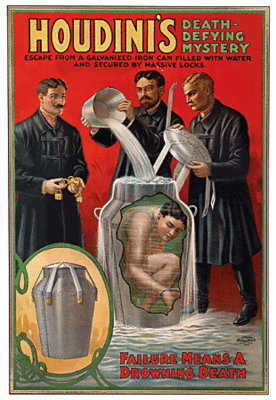
While we're on the subject, if you have an extra $50,000+ you might want to consider putting in a bid for the Milk Can poster below. The sellers claim it's one of only three extant original copies of the 1908 classic. Drool!
UPDATE: I was outbid. My high bid was $29.95 and the poster sold for $68,404. Damn. So close...
Monday, July 11, 2005
Incredible Optical Illusions - UPDATED

Check out the incredible optical illusion at left. It's one of those checkerboards in which two different squares, in this case A and B, turn out to be exactly the same shade of grey. (For a full explanation and proof, check here.) Normally, when I see these types of illusions I can kind of squint and see that they're actually the same. Not so with this one; I actually had to put Post-It's on my computer to convince myself! (see below)

Incidentally, if you're into optical illusions, the mother of all optical illusion pages is Akiyoshi's Illusion Pages. Akiyoshi Kitaoka is an Associate Professor of Psychology at Ritsumeikan University in Kyoto, Japan, and he specializes in the study and design of trippy "visual illusions" like the one below. Some of these are absolutely mind-blowing; you gotta' love a page with this serious warning at the outset:
Caution: This page contains some works of "anomalous motion illusion", which might make sensitive observers dizzy or sick. Should you feel dizzy, you had better leave this page immediately.

Tip O' the Hat (TOTH) to blogger.com for adding image capability right into their package. The Checkerboard Illusion has been around for a while, but I was recently reminded of it and called to really examine it by a report on Rocketboom, a fantastic daily 3-minute news roundup featuring the adorable Amanda Congdon. Rocketboom is pretty much what we all wish the daily news shows could be: incisive, sharp, and witty.
UPDATE: I forgot to also mention Caltech Professor Al Seckel's homepage, which contains much info about optical illusions including a whole section on his extraordinary book, Masters of Deception: Escher, Dalí & the Artists of Optical Illusion. Also check out the vast gallery at eyetricks. Lots to peruse here!
Saturday, July 09, 2005
Brief Film Review - Code 46
Code 46 is a pretty spectacular film by Michael Winterbottom starring Tim Robbins as an investigator in the near-future (or alternative present) who uses "empathy" (essentially a form of high-tech mindreading) to figure out who has been smuggling forged identity chips out to the lower classes in a desert city called "Shanghai." He meets and falls for Samantha Morton (genius star of Morvern Callar and Minority Report), and finds himself covering for her when he determines that she's the culprit.
Code 46 manages on a very low budget the extraordinary task of creating a desolate futuristic world out of the present. It's most obvious stylistic antecedent is Goddard's Alphaville, in which modern Paris stands in for the city of the future. It's a weird, sad film about lonely alienated people, blending a kind of THX 1138 sterility with a postmodern glass and steel iciness in an ozone-hole world.
I used the term "spectacular" because it's the word that came to me most strongly when the film was over. The film isn't spectacular in the "spectacle" sense; in fact it's a rather low-key and detatched work. What's spectacular, to me, is Winterbottom and screenwriter Frank Cottrell Boyce's extraordinary control over tone and rhythm. Code 46 is spectacular in the manner of a Bresson film or a De Chirico painting.
Director Winterbottom is on my hero list for the ascerbically jaunty 24 Hour Party People, a free-wheeling film about the rise of Manchester's legendary Factory Records which, in it's heyday, produced killer acts like Joy Division and Happy Mondays. 24 Hour Party People was also written by Boyce, and it's astonishing to see two such 180-degree opposite works come from the same creative minds. I'd definitely put Winterbottom on my list of directors to watch, and I look forward to checking out some of his earlier collaborations with Boyce, like Welcome to Sarajevo and The Claim.
Code 46 manages on a very low budget the extraordinary task of creating a desolate futuristic world out of the present. It's most obvious stylistic antecedent is Goddard's Alphaville, in which modern Paris stands in for the city of the future. It's a weird, sad film about lonely alienated people, blending a kind of THX 1138 sterility with a postmodern glass and steel iciness in an ozone-hole world.
I used the term "spectacular" because it's the word that came to me most strongly when the film was over. The film isn't spectacular in the "spectacle" sense; in fact it's a rather low-key and detatched work. What's spectacular, to me, is Winterbottom and screenwriter Frank Cottrell Boyce's extraordinary control over tone and rhythm. Code 46 is spectacular in the manner of a Bresson film or a De Chirico painting.
Director Winterbottom is on my hero list for the ascerbically jaunty 24 Hour Party People, a free-wheeling film about the rise of Manchester's legendary Factory Records which, in it's heyday, produced killer acts like Joy Division and Happy Mondays. 24 Hour Party People was also written by Boyce, and it's astonishing to see two such 180-degree opposite works come from the same creative minds. I'd definitely put Winterbottom on my list of directors to watch, and I look forward to checking out some of his earlier collaborations with Boyce, like Welcome to Sarajevo and The Claim.
Cool Hamburger Trick
Here's a really neat video of Japanese magician Cyril Takayama Blaine-ing a bunch of spectators on the street. Now, if only he can turn hamburgers into veggie burgers...
Shout out to Pagliacci for the link and further info. If you're a magic fan, this is a good one to add to your Bloglines feeds.
Shout out to Pagliacci for the link and further info. If you're a magic fan, this is a good one to add to your Bloglines feeds.
Thursday, July 07, 2005
Cultured Meat?
I'm an ethical vegetarian, so I was intrigued by this story at We Make Money Not Art about the potential to produce meat in the lab.
Two new techniques of tissue engineering may one day lead to large scale production of lab grown meat that tastes like beef, poultry, pork, lamb or fish and has the texture of meat...
I'm not a fan of bioengineered food; the potential for unknown ramifications from both the use of these new "frankenfoods" and the elimination of Mother Nature's own natural whole foods is incalculable -- and scary as hell. On the other hand, I'm even less fond of the barbaric meat industry, with its pollution, waste, and lifelong torture and summary execution of billions of cows, sheep, chickens, and pigs. (KFC alone slaughters over 850 million chickens per year.)
Frankly, I'd prefer if the whole world went vegetarian, but this at least offers hope to reduce the total cruelty in the world. Manufacturing meat would also end the rampant overuse of antibiotics (over 70% of the antibiotics in use go to farm animals).
All in all, since I'm not going to eat it anyway, I'd opt for the Frankenmeats.
Two new techniques of tissue engineering may one day lead to large scale production of lab grown meat that tastes like beef, poultry, pork, lamb or fish and has the texture of meat...
I'm not a fan of bioengineered food; the potential for unknown ramifications from both the use of these new "frankenfoods" and the elimination of Mother Nature's own natural whole foods is incalculable -- and scary as hell. On the other hand, I'm even less fond of the barbaric meat industry, with its pollution, waste, and lifelong torture and summary execution of billions of cows, sheep, chickens, and pigs. (KFC alone slaughters over 850 million chickens per year.)
Frankly, I'd prefer if the whole world went vegetarian, but this at least offers hope to reduce the total cruelty in the world. Manufacturing meat would also end the rampant overuse of antibiotics (over 70% of the antibiotics in use go to farm animals).
All in all, since I'm not going to eat it anyway, I'd opt for the Frankenmeats.
Thursday, June 30, 2005
Brief Film Review - "The Life Aquatic with Steve Zissou"
I haven't been 100% thrilled with Wes Anderson's work. I rather liked Rushmore, but The Royal Tenenbaums left me more annoyed than thrilled. Despite some excellent performances and clever ideas (it's basically a surreal, Salingeresque romp among an eccentric New York family), Tenenbaums felt self-indulgently cutesy rather than deep or purposeful. The Life Aquatic received very mixed reviews on its initial release, and I was prepared for more "too cute to care" filmmaking.
I am delighted to report that The Life Aquatic is a surprisingly generous film anchored (no pun intended) by Bill Murray's beautifully understated performance as a fading, Cousteau-like oceanographer and documentarian. Murray has an extraordinary gift for playing aging stars (he single-handedly saved Lost In Translation from dissolving into its own self-pleasure), and here he manages the difficult task of portraying a very famous man who is by turns acerbic and charming, self-effacing and self-indulgent, pompous and pigheaded and childish and wise - often in the same scene. You can see and feel the ravages of time in both his eyes and the way he steps back and observes the dramas unfolding around him. He's grieving the loss of both his best friend (eaten by an unknown sea creature he refers to as a "Jaguar Shark,") and his wife (Anjelica Huston), who has left him (possibly to return to her ex, a wealthy and sleazy oceanographic rival played with smarmy enthusiasm by Jeff Goldblum).
Much has been made of the surreal, candy-colored world of The Life Aquatic, and the film is a joy to behold. Anderson makes no attempt to depict anything like a real undersea film; this is a production designer's wet dream, a phantasmic, crazy-quilt world of childhood dreams and adult disillusion. Yet through it all Anderson manages to maintain a warm edge to the procedings; even at it's most outrageous (a violent pirate attack and a deadpan Special Ops-style rescue) you never lose your attachment to the characters.
The Life Aquatic is too bizarre and quirky for me to recommend it without qualification, and I can already predict which of my friends would like it and which ones wouldn't (and no, I won't say). The film has some very funny lines and situations; let's not forget that Murray is a deadpan comic genius. If you have a high tolerance for the oddball, this one is definitely worth your time and energy.
I am delighted to report that The Life Aquatic is a surprisingly generous film anchored (no pun intended) by Bill Murray's beautifully understated performance as a fading, Cousteau-like oceanographer and documentarian. Murray has an extraordinary gift for playing aging stars (he single-handedly saved Lost In Translation from dissolving into its own self-pleasure), and here he manages the difficult task of portraying a very famous man who is by turns acerbic and charming, self-effacing and self-indulgent, pompous and pigheaded and childish and wise - often in the same scene. You can see and feel the ravages of time in both his eyes and the way he steps back and observes the dramas unfolding around him. He's grieving the loss of both his best friend (eaten by an unknown sea creature he refers to as a "Jaguar Shark,") and his wife (Anjelica Huston), who has left him (possibly to return to her ex, a wealthy and sleazy oceanographic rival played with smarmy enthusiasm by Jeff Goldblum).
Much has been made of the surreal, candy-colored world of The Life Aquatic, and the film is a joy to behold. Anderson makes no attempt to depict anything like a real undersea film; this is a production designer's wet dream, a phantasmic, crazy-quilt world of childhood dreams and adult disillusion. Yet through it all Anderson manages to maintain a warm edge to the procedings; even at it's most outrageous (a violent pirate attack and a deadpan Special Ops-style rescue) you never lose your attachment to the characters.
The Life Aquatic is too bizarre and quirky for me to recommend it without qualification, and I can already predict which of my friends would like it and which ones wouldn't (and no, I won't say). The film has some very funny lines and situations; let's not forget that Murray is a deadpan comic genius. If you have a high tolerance for the oddball, this one is definitely worth your time and energy.
Brief Film Review - "Holes"
Okay, time to start living up to an earlier promise to at least attempt to say something useful about every film I see. These will almost always be films I've checked out on DVD, since I never seem to get around to seeing films in the theater anymore (and there's very little out that I care about that much).
Holes (2003) was adapted for the screen by Louis Sachar from his own prizewinning (and very popular among the pre-teen set) 1998 novel of the same name. This one got great reviews when it came out, even among discriminating, intelligent critics like those at Salon, The New York Times, The Village Voice, and the Chicago Reader. So I felt pretty confident I was in for a treat.
Well, I can happily report it is indeed terrific, and far stranger and more resonant than I expected. Holes is the story of one Stanley Yelnats, a young teenager mistakenly convicted of stealing a pair of shoes belonging to a famous basketball player. Stanley is sent to a prison camp in the desert where he and the other young inmates are forced to work in the blazing sun digging 5' deep and 5' across holes in the hard desert floor as a way to "build character."
Holes is also a story about a family curse dating back to Latvia, a famous Old West Bandit named "Kissing Kate," buried treasure, "God's Thumb," and an inventor (Stanley's father) trying haplessly to develop an antidote to foot odor. If this all sounds a bit wacky, I assure you it's really not; Holes is, at its heart, both a serious story of friendship triumphing over adversity and a sly commentary on the way the criminal justice system breeds abuse.
That's not to say the film isn't both entertaining and funny. Holes unfolds deliberately, spending a lot of its time observing the way the other juvenile inmates interact with each other and their "caretakers" (Jon Voight, wonderfully cracked, simpering Tim Blake Nelson, and a deliciously venal Sigourney Weaver as the warden). Best of all, Holes avoids both the treacly sentimentality and the ironic, "hipper-than-thou" detachment so endemic in children's films, especially Disney product. The film plays for real and it plays like it matters -- and it works beautifully. Highly recommended.
Addendum: On watching this with my 9-year-old son.
My son hasn't seen many films not geared to very young kids, and this one gave him quite a ride! He spent some of the film watching intently, other parts leaping up and down, and still other parts (scary parts include a racially-motivated lynching and a death-by-lizard) hiding behind the couch. At one point, he said, "I don't know if this is a good film for me. It's kind of weird." (I LOVE that he's sensitive and aware enough to be able to make these judgements out loud.)
I paused it and asked him if he wanted to turn it off. He thought about it for a moment and decided, "We can just watch a little bit more and see what happens." Needles to say, we watched the rest of the film and he liked it a lot -- although I think if he watches it again in a few years he'll understand it better. But it IS quite a ride!
Holes (2003) was adapted for the screen by Louis Sachar from his own prizewinning (and very popular among the pre-teen set) 1998 novel of the same name. This one got great reviews when it came out, even among discriminating, intelligent critics like those at Salon, The New York Times, The Village Voice, and the Chicago Reader. So I felt pretty confident I was in for a treat.
Well, I can happily report it is indeed terrific, and far stranger and more resonant than I expected. Holes is the story of one Stanley Yelnats, a young teenager mistakenly convicted of stealing a pair of shoes belonging to a famous basketball player. Stanley is sent to a prison camp in the desert where he and the other young inmates are forced to work in the blazing sun digging 5' deep and 5' across holes in the hard desert floor as a way to "build character."
Holes is also a story about a family curse dating back to Latvia, a famous Old West Bandit named "Kissing Kate," buried treasure, "God's Thumb," and an inventor (Stanley's father) trying haplessly to develop an antidote to foot odor. If this all sounds a bit wacky, I assure you it's really not; Holes is, at its heart, both a serious story of friendship triumphing over adversity and a sly commentary on the way the criminal justice system breeds abuse.
That's not to say the film isn't both entertaining and funny. Holes unfolds deliberately, spending a lot of its time observing the way the other juvenile inmates interact with each other and their "caretakers" (Jon Voight, wonderfully cracked, simpering Tim Blake Nelson, and a deliciously venal Sigourney Weaver as the warden). Best of all, Holes avoids both the treacly sentimentality and the ironic, "hipper-than-thou" detachment so endemic in children's films, especially Disney product. The film plays for real and it plays like it matters -- and it works beautifully. Highly recommended.
Addendum: On watching this with my 9-year-old son.
My son hasn't seen many films not geared to very young kids, and this one gave him quite a ride! He spent some of the film watching intently, other parts leaping up and down, and still other parts (scary parts include a racially-motivated lynching and a death-by-lizard) hiding behind the couch. At one point, he said, "I don't know if this is a good film for me. It's kind of weird." (I LOVE that he's sensitive and aware enough to be able to make these judgements out loud.)
I paused it and asked him if he wanted to turn it off. He thought about it for a moment and decided, "We can just watch a little bit more and see what happens." Needles to say, we watched the rest of the film and he liked it a lot -- although I think if he watches it again in a few years he'll understand it better. But it IS quite a ride!
Screenhead
I've been spending a bit of time at Screenhead recently, and sharp-eyed readers will note that I have added it to my Blogroll. They call themselves "an online review of funny shit," but they're broader than that and they often feature extraordinary art, online films, and flash animations you're unlikely to find elsewhere. They tend towards the dark and twisted (which works for me), and what's most impressive to me is the scope and range of talent on display in cyberspace.
Some particular standouts:
Kid Koala's Basin Street Blues is a beautiful song and a melancholy animated video -- a very controlled and haunting work. Polite Winter is a creepy but beautiful online art project, as well. And definitely check out Le Building, which is kind of a compressed Triplets of Belleville on acid.
Some particular standouts:
Kid Koala's Basin Street Blues is a beautiful song and a melancholy animated video -- a very controlled and haunting work. Polite Winter is a creepy but beautiful online art project, as well. And definitely check out Le Building, which is kind of a compressed Triplets of Belleville on acid.
Tuesday, June 28, 2005
Sarah Suicide - UPDATED
October 25, 2015 -- Her 3 amazing performances can be viewed here: http://www.aliveness.co.uk
Sumeray is now an actress/comedian in the UK. Her website is here: http://www.sarahsumerayonline.com/home/4588510535
November 8, 2005 -- The magician's name is Sarah Sumeray, and unfortunately the links on her site have been down for months. [Dead links removed].
I'm not the first to note the tendency of magicians and their tricks to be lame and pointless [dead Magic Circle Jerk links removed]. Here's an amazing antidote: Sarah Suicide (Click on the "Suicide" link). This is absolutely the most convincing presentation of an old classic I've ever seen. I have no idea who Sarah is (the site is UK-based) but I count myself a huge fan just on the basis of this one effect.
If you have a weak stomach, you may not like this.
This is one of the most visceral effects I've seen since David Blaine freaked out Carson Daly, which you can check out here (Click on the appropriate link, and while you're there be sure to also check out the footage of the legendary Cardini). [Dead link. Here's Cardini's amazing performance.]
* Thanks to Steve Pellegrino, who shut down Magic Rants and repoened his doors with the all new MagiCentric, for the incredible Sarah Suicide link. Steve also has a good link to magician and self-proclaimed "psychic" Uri Geller's humiliating 1973 appearance on "The Tonight Show." Unbeknowst to Geller, Carson consulted with magician and "skeptic" James Randi, who made sure that Geller couldn't cheat. The result? No psi on display that night.
Sumeray is now an actress/comedian in the UK. Her website is here: http://www.sarahsumerayonline.com/home/4588510535
November 8, 2005 -- The magician's name is Sarah Sumeray, and unfortunately the links on her site have been down for months. [Dead links removed].
I'm not the first to note the tendency of magicians and their tricks to be lame and pointless [dead Magic Circle Jerk links removed]. Here's an amazing antidote: Sarah Suicide (Click on the "Suicide" link). This is absolutely the most convincing presentation of an old classic I've ever seen. I have no idea who Sarah is (the site is UK-based) but I count myself a huge fan just on the basis of this one effect.
If you have a weak stomach, you may not like this.
This is one of the most visceral effects I've seen since David Blaine freaked out Carson Daly, which you can check out here (Click on the appropriate link, and while you're there be sure to also check out the footage of the legendary Cardini). [Dead link. Here's Cardini's amazing performance.]
* Thanks to Steve Pellegrino, who shut down Magic Rants and repoened his doors with the all new MagiCentric, for the incredible Sarah Suicide link. Steve also has a good link to magician and self-proclaimed "psychic" Uri Geller's humiliating 1973 appearance on "The Tonight Show." Unbeknowst to Geller, Carson consulted with magician and "skeptic" James Randi, who made sure that Geller couldn't cheat. The result? No psi on display that night.
Monday, June 27, 2005
Petals Around the Rose
Petals Around the Rose is a tricksy little puzzle that has apparently been around for years, but I just heard about it so I'm passing it along. It's devilishly clever, or devilishly simple, depending on your point of view. It only took me a minute or so to crack, once I realized that the name of the game matters.
Once you solve it, head over to the Fraternity of Petals Around the Rose to register yourself as an uber-geek. While there, check out the story of how Bill Gates tackled the problem back in 1977.
Pull quote from the September/October, 1977 issue of Personal Computing:
The rotten kid [Gates] must have had two dozen rolls, with answers, committed to memory by the time this discussion came up. ("Kid," because he ordered a Shirley Temple at lunch one day just a few months ago, and drank it before the awestricken eyes of his tablemates, some of whom realised that they were at least twice Bill's age. He had taken leave of his undergraduate courses at Harvard to lead this little company, Microsoft, which is creating BASIC and FORTRAN, etc... interpreters and compilers for various microcomputers. No applications software in their product line yet, just system packages that are already making them famous and may at length make them rich. *Sigh.*)
* Thanks to Rick Carruth's Magic Bullets blog for the link. Carruth's blog covers "Magic and The Marketing of Magic," although he shares my tendency to stray over whatever interests him. Carruth also runs the Street Magic Bullets site, which includes the complete archives to the Magic Roadshow Journal of Magic. These are filled with great advice and ideas; well worth checking out if you're interested in working professionally as a magician.
Once you solve it, head over to the Fraternity of Petals Around the Rose to register yourself as an uber-geek. While there, check out the story of how Bill Gates tackled the problem back in 1977.
Pull quote from the September/October, 1977 issue of Personal Computing:
The rotten kid [Gates] must have had two dozen rolls, with answers, committed to memory by the time this discussion came up. ("Kid," because he ordered a Shirley Temple at lunch one day just a few months ago, and drank it before the awestricken eyes of his tablemates, some of whom realised that they were at least twice Bill's age. He had taken leave of his undergraduate courses at Harvard to lead this little company, Microsoft, which is creating BASIC and FORTRAN, etc... interpreters and compilers for various microcomputers. No applications software in their product line yet, just system packages that are already making them famous and may at length make them rich. *Sigh.*)
* Thanks to Rick Carruth's Magic Bullets blog for the link. Carruth's blog covers "Magic and The Marketing of Magic," although he shares my tendency to stray over whatever interests him. Carruth also runs the Street Magic Bullets site, which includes the complete archives to the Magic Roadshow Journal of Magic. These are filled with great advice and ideas; well worth checking out if you're interested in working professionally as a magician.
Saturday, June 25, 2005
"The Aristocrats"
Have you heard about The Aristrocrats? This documentary, produced by Penn Jillette (of Penn and Teller), features over 100 famous comics (including Robin Williams, Bob Saget, Chris Rock, and George Carlin) telling a single legendary -- and very very filthy -- joke. The film's tagline: "No nudity. No violence. Unspeakable obscenity."
Here's a clip of the South Park version. Warning: Very very filthy. Definitely NSFW!
And a SFW New York Times review of the film.
I first heard this joke about fifteen years ago when my very funny friend Joe Monti, a magician and comedian, told it to me at the Magic Castle. His delivery was exceptional; I literally haven't ever laughed so hard at any other joke, ever. I'm talking incapacitating laughter, continuing for a good five minutes.
If you have a high tolerance level, the potential is extraordinary. I'm DYING to see this...
Here's a clip of the South Park version. Warning: Very very filthy. Definitely NSFW!
And a SFW New York Times review of the film.
I first heard this joke about fifteen years ago when my very funny friend Joe Monti, a magician and comedian, told it to me at the Magic Castle. His delivery was exceptional; I literally haven't ever laughed so hard at any other joke, ever. I'm talking incapacitating laughter, continuing for a good five minutes.
If you have a high tolerance level, the potential is extraordinary. I'm DYING to see this...
Thursday, June 23, 2005
Classic Psychedelic Story
There's a famous (in psychedelic circles) story about how pitcher Dock Ellis pitched a no-hitter while tripping on LSD back in 1970. I always heard that Ellis later recanted the story, but now apparently he's owning up to the whole thing, and there's a lovely article in the Dallas Observer all about Ellis, his colorful career, and his subsequent reinvention as a prison drug counselor and all-around nice guy. Nice to see at least one story confirmed at the source!
Thursday, June 16, 2005
Wow! Derren Brown Trips Out a Gamer!
English Mentalist and Hypnotist Derren Brown is one of the handful of geniuses working today. Though virtually unkown in the U.S., this talented performer has starred in numerous TV Specials and his own full-evening show. Brown has had a huge influence on a generation of magicians and psychic entertainers. His books Pure Effect and Absolute Magic are fantastic primers on how to make your performances more magical and memorable and should be on every magician's must-read list.
Just imagine you're in an arcade, playing a Zombie-shooting video game. You zone out for a moment, and when you next look around you're INSIDE the game! Here's an insane new Derren Brown clip that's bouncing around the web. In it, Brown purports to manipulate the lights on a video game to hypnotize a player...then leads the zoned-out player into a 3D simulation of the game and sets him loose!
And if you like this one, you can find more Derren Brown clips here.
Just imagine you're in an arcade, playing a Zombie-shooting video game. You zone out for a moment, and when you next look around you're INSIDE the game! Here's an insane new Derren Brown clip that's bouncing around the web. In it, Brown purports to manipulate the lights on a video game to hypnotize a player...then leads the zoned-out player into a 3D simulation of the game and sets him loose!
And if you like this one, you can find more Derren Brown clips here.
Wednesday, June 15, 2005
Hip Hop Comments and Reactions
My last post generated some heated comments from Katterfelto and a couple of "Anonymous" posters. Ay Caramba!
The first Anonymous accuses me of saying somewhere in my post(s) that anyone who dislikes Hip Hop or Rap is necessarily a racist. I said nothing of the sort; to the contrary, I specifically said in my last post that it's fine to dislike a musical genre (and used opera as an example of a genre that doesn't work for me). It's when people dismiss a genre as valueless that I start looking for something deeper.
And, incidentally, when I said, I wonder if [Anonymous] would be so tolerant of Thelonious Monk if it were 1963? I wasn't refering to racial tolerance but rather to artistic tolerance. It's easy to love a long-accepted artistic genre; how much harder it is to find the "meat" in newer artistic forms. Improvisational Jazz (like Abstract Expressionism and Beat Poetry) was radical and alienating when it first showed up, and even today it remains fairly difficult to access. But at least no one's seriously arguing any longer about its worth.
Katterfelto accuses me of dissing opera (!) when all I said was that I don't personally like it. There's a difference between not liking a genre and dismissing it as worthless. I'm quite sure opera is a beautiful, deep art form filled with brilliant talents, it's just not to my taste.
In any case, I concede (slightly) and I back off the racist charge a bit. Many of the comments I hear from people who don't like Hip Hop and Rap -- that it is violent, misogynistic, and that it glorifies sexual promiscuity and conspicuous consumption -- are the same arguments previously used against Heavy Metal and before that good old Rock and Roll. So maybe I'm overstating the case.
That said, the willingness of many so-called Progressives to completely dismiss the possibility that there is any value to Rap and Hip Hop feels a little unclean, to me. Let's leave it at that.
Every musical genre is a language, and Hip Hop/Rap in particular is a very specific language with parameters different from most other music. It is well known that the younger you are the more easily you acquire new languages. Maybe that's why most major artistic breakthroughs seem to catch on among the young and only become mainstream when those young people grow up and become middle-aged adults fluent in the new language.
[The late Arther Koestler believed that the evolutionary concept called Paedomorphosis (also known as "Juvenilization") -- which is the notion that evolution happens through some useful evolutionary novelty that appears among the young and then carries over into adulthood -- applied equally to humans and their culture as to amphibians. Is Pop Culture, including Hip Hop, a Paedomorphic force?]
This is NOT the view taken by the original Anonymous (Don't you guys have some sort of name or handle?), who dismisses ALL Rap and Hip Hop as "talking over someone else's music." This view is simply ignorant and silly, and anyone who knows anything about the genre knows that it is a mischaracterization. Some hip hop uses sampling as an integral part of its pastiche, much of it uses wholly original music, and some uses atonal rhythm in lieu of melody (hence the frequent use of samples from avant-garde minimalists like Steve Reich and early Industrial pioneers Kraftwerk).
To the first commenter, I would recommend starting out with the widely acknowledged classics. Check online for lists of "top ten" Rap and Hip Hop albums. This is how I learned who's who and what's most highly regarded; look for the albums and artists who crop up consistently and look for reviewers who seem literate and intelligent. [Kudos once again to the web for the rise of orthogonal trust networks.]
And get over the language; much has been made in the mainstream press of the extensive use of the F-word and especially the N-word, and the truth is if you can't get past it you'll never "get" Hip Hop. A friend of mine recently told me he didn't approve of Hip Hop for just that reason; he doesn't approve of the use of the N-word. I tried to explain that "Nigger," and the related "Nigga," are broadly-used terms, meaning different things in different contexts (rather like that other versatile word, "fuck").
This site has a good overview of the etymology of the N-word, along with this summation:
Oxford Dictionary of New Words
Nigga / ’nig∂ / noun A Black man. A representation of American Black English pronunciation of the word nigger. This and other forms of nigger have been in use within the African American community and have been recorded in print since the twenties. However, recent usage of nigga, and its plural form niggaz, represents a conscious, politically motivated reclamation by blacks of the term nigger. This term, which had been regarded as typifying offensive and derogatory attitudes within the white community, was adopted by the black community as a form of self-assertion, with the aim of reducing the term’s derogation. (A similar development may be seen in the adoption of the word queer by the gay community…)
And here's an interesting review of Harvard law professor Randall Kennedy's book Nigger: The Strange Career of a Troublesome Word.
By the way, I want to thank everyone for reading and caring enough to post comments. I don't pretend to be an expert on the subject of Hip Hop and Rap; I'm an outsider looking in and starting to grok the contours of the language. As I have become more attuned to the nuances of Hip Hop I have begun to encounter an increasingly dense set of cultural beliefs and trends which I am only now beginning to unpack. Stay tuned and be gentle; anything I post to this blog should be considered embryonic at best!
The first Anonymous accuses me of saying somewhere in my post(s) that anyone who dislikes Hip Hop or Rap is necessarily a racist. I said nothing of the sort; to the contrary, I specifically said in my last post that it's fine to dislike a musical genre (and used opera as an example of a genre that doesn't work for me). It's when people dismiss a genre as valueless that I start looking for something deeper.
And, incidentally, when I said, I wonder if [Anonymous] would be so tolerant of Thelonious Monk if it were 1963? I wasn't refering to racial tolerance but rather to artistic tolerance. It's easy to love a long-accepted artistic genre; how much harder it is to find the "meat" in newer artistic forms. Improvisational Jazz (like Abstract Expressionism and Beat Poetry) was radical and alienating when it first showed up, and even today it remains fairly difficult to access. But at least no one's seriously arguing any longer about its worth.
Katterfelto accuses me of dissing opera (!) when all I said was that I don't personally like it. There's a difference between not liking a genre and dismissing it as worthless. I'm quite sure opera is a beautiful, deep art form filled with brilliant talents, it's just not to my taste.
In any case, I concede (slightly) and I back off the racist charge a bit. Many of the comments I hear from people who don't like Hip Hop and Rap -- that it is violent, misogynistic, and that it glorifies sexual promiscuity and conspicuous consumption -- are the same arguments previously used against Heavy Metal and before that good old Rock and Roll. So maybe I'm overstating the case.
That said, the willingness of many so-called Progressives to completely dismiss the possibility that there is any value to Rap and Hip Hop feels a little unclean, to me. Let's leave it at that.
Every musical genre is a language, and Hip Hop/Rap in particular is a very specific language with parameters different from most other music. It is well known that the younger you are the more easily you acquire new languages. Maybe that's why most major artistic breakthroughs seem to catch on among the young and only become mainstream when those young people grow up and become middle-aged adults fluent in the new language.
[The late Arther Koestler believed that the evolutionary concept called Paedomorphosis (also known as "Juvenilization") -- which is the notion that evolution happens through some useful evolutionary novelty that appears among the young and then carries over into adulthood -- applied equally to humans and their culture as to amphibians. Is Pop Culture, including Hip Hop, a Paedomorphic force?]
This is NOT the view taken by the original Anonymous (Don't you guys have some sort of name or handle?), who dismisses ALL Rap and Hip Hop as "talking over someone else's music." This view is simply ignorant and silly, and anyone who knows anything about the genre knows that it is a mischaracterization. Some hip hop uses sampling as an integral part of its pastiche, much of it uses wholly original music, and some uses atonal rhythm in lieu of melody (hence the frequent use of samples from avant-garde minimalists like Steve Reich and early Industrial pioneers Kraftwerk).
To the first commenter, I would recommend starting out with the widely acknowledged classics. Check online for lists of "top ten" Rap and Hip Hop albums. This is how I learned who's who and what's most highly regarded; look for the albums and artists who crop up consistently and look for reviewers who seem literate and intelligent. [Kudos once again to the web for the rise of orthogonal trust networks.]
And get over the language; much has been made in the mainstream press of the extensive use of the F-word and especially the N-word, and the truth is if you can't get past it you'll never "get" Hip Hop. A friend of mine recently told me he didn't approve of Hip Hop for just that reason; he doesn't approve of the use of the N-word. I tried to explain that "Nigger," and the related "Nigga," are broadly-used terms, meaning different things in different contexts (rather like that other versatile word, "fuck").
This site has a good overview of the etymology of the N-word, along with this summation:
Oxford Dictionary of New Words
Nigga / ’nig∂ / noun A Black man. A representation of American Black English pronunciation of the word nigger. This and other forms of nigger have been in use within the African American community and have been recorded in print since the twenties. However, recent usage of nigga, and its plural form niggaz, represents a conscious, politically motivated reclamation by blacks of the term nigger. This term, which had been regarded as typifying offensive and derogatory attitudes within the white community, was adopted by the black community as a form of self-assertion, with the aim of reducing the term’s derogation. (A similar development may be seen in the adoption of the word queer by the gay community…)
And here's an interesting review of Harvard law professor Randall Kennedy's book Nigger: The Strange Career of a Troublesome Word.
By the way, I want to thank everyone for reading and caring enough to post comments. I don't pretend to be an expert on the subject of Hip Hop and Rap; I'm an outsider looking in and starting to grok the contours of the language. As I have become more attuned to the nuances of Hip Hop I have begun to encounter an increasingly dense set of cultural beliefs and trends which I am only now beginning to unpack. Stay tuned and be gentle; anything I post to this blog should be considered embryonic at best!
Tuesday, June 14, 2005
Hip Hop - An Alternative View
Thanks to Anonymous (boy, he posts a lot of comments!) for this silly comment to my Hip Hop post:
I have to say...you are dead wrong. I don't like hip-hop. I find it maddenly repetitive and uncreative. My opinion doesn't "betrays a subtle and unacknowledged dismissal of the power, intelligence, and creativity of the mostly-black Hip Hop community." I love Jazz. I love Soul. Both of which were and still are predominately black enterprises. Jazz is commonly considered the only original form of music to come out of America. I just think hip-hop is nothing more than glorified plaguerism. Call it "sampling"...it is still taking someone else's music and talking over it. I don't find that to be original or creative.
Let's take a closer look at this, shall we?
Anon is correct that his opinion doesn't "betrays [sic] a subtle and unacknowledged dismissal of the power, intelligence, and creativity of the mostly black Hip Hop community." There's nothing subtle or unacknowledged about his ignorance and dismissal. It's only surprising that he's willing to say it publicly (albeit anonymously).
The fact that he does supports one of the premises of my original post, that many of those who dislike Hip Hop think there's no "there" there. It's fine to dislike a major art form (personally, I can't really stomach opera), but to dismiss it in its entirety brands you as clueless at best. That's great that Anonymous loves a fifty-year-old musical genre; I wonder if he would be so tolerant of Thelonious Monk if it were 1963?
Jazz is commonly considered the only original form of music to come out of America.
Actually, Jazz, the Blues, and now Hip Hop and Rap have all been tagged as American originals.
I just think hip-hop is nothing more than glorified plaguerism [sic]. Call it "sampling"...it is still taking someone else's music and talking over it.
This sweeping mischaracterization illustrates better than my original post the kind of Hip Hop bashing I described. Thanks for providing a concrete example of the silly anti- Hip Hop rhetoric I've been talking about!
I have to say...you are dead wrong. I don't like hip-hop. I find it maddenly repetitive and uncreative. My opinion doesn't "betrays a subtle and unacknowledged dismissal of the power, intelligence, and creativity of the mostly-black Hip Hop community." I love Jazz. I love Soul. Both of which were and still are predominately black enterprises. Jazz is commonly considered the only original form of music to come out of America. I just think hip-hop is nothing more than glorified plaguerism. Call it "sampling"...it is still taking someone else's music and talking over it. I don't find that to be original or creative.
Let's take a closer look at this, shall we?
Anon is correct that his opinion doesn't "betrays [sic] a subtle and unacknowledged dismissal of the power, intelligence, and creativity of the mostly black Hip Hop community." There's nothing subtle or unacknowledged about his ignorance and dismissal. It's only surprising that he's willing to say it publicly (albeit anonymously).
The fact that he does supports one of the premises of my original post, that many of those who dislike Hip Hop think there's no "there" there. It's fine to dislike a major art form (personally, I can't really stomach opera), but to dismiss it in its entirety brands you as clueless at best. That's great that Anonymous loves a fifty-year-old musical genre; I wonder if he would be so tolerant of Thelonious Monk if it were 1963?
Jazz is commonly considered the only original form of music to come out of America.
Actually, Jazz, the Blues, and now Hip Hop and Rap have all been tagged as American originals.
I just think hip-hop is nothing more than glorified plaguerism [sic]. Call it "sampling"...it is still taking someone else's music and talking over it.
This sweeping mischaracterization illustrates better than my original post the kind of Hip Hop bashing I described. Thanks for providing a concrete example of the silly anti- Hip Hop rhetoric I've been talking about!
Monday, June 13, 2005
More on Hip Hop
In the Comments to my first big Hip Hop post, Katterfelto of The Magic Square takes issue with my "pronouncements from the Mount" style. He says:
I'd be able to take this with a little less of a grain of salt if you didn't present it so much as unimpeachable gospel.
Point taken. It's my blog, and I reserve the right to rant. Many of his arguments against my post will be taken up in a later post; this was merely "the opening shot across the bow."
I certainly didn't mean to suggest that every person over thirty hates Hip Hop or is racist, merely that the contempt for Hip Hop I've seen repeatedly (even among friends who are otherwise extremely progressive Lefties) often betrays a subtle and unacknowledged dismissal of the power, intelligence, and creativity of the mostly-black Hip Hop community. This is a form of "liberal racism" that is pernicious and hard to illuminate.
Much of this can be traced to the fact that people over thirty (and especially over forty) tend to consume and trust mainstream news sources in a way that young people don't anymore. In a previous post I covered the general problem with the mainstream press; as soon as they cover something you actually know about you notice how often they get things wrong. The story of Hip Hop has, until fairly recently, been one of demonization and sensasionalism. Only in the last few years or so (when it became clear that Hip Hop isn't going away anytime soon) have serious reviews of Rap and Hip Hop appeared -- and much of the coverage feels like grampa's attempt to be hip for young readers rather than serious, in-depth coverage.
Things are changing; the mainstream media will eventually be overtaken by the Hip Hop generation. I predict that such issues as racism and classism will have a very different face in twenty years, a face I hope to explore further in upcoming posts.
I'd be able to take this with a little less of a grain of salt if you didn't present it so much as unimpeachable gospel.
Point taken. It's my blog, and I reserve the right to rant. Many of his arguments against my post will be taken up in a later post; this was merely "the opening shot across the bow."
I certainly didn't mean to suggest that every person over thirty hates Hip Hop or is racist, merely that the contempt for Hip Hop I've seen repeatedly (even among friends who are otherwise extremely progressive Lefties) often betrays a subtle and unacknowledged dismissal of the power, intelligence, and creativity of the mostly-black Hip Hop community. This is a form of "liberal racism" that is pernicious and hard to illuminate.
Much of this can be traced to the fact that people over thirty (and especially over forty) tend to consume and trust mainstream news sources in a way that young people don't anymore. In a previous post I covered the general problem with the mainstream press; as soon as they cover something you actually know about you notice how often they get things wrong. The story of Hip Hop has, until fairly recently, been one of demonization and sensasionalism. Only in the last few years or so (when it became clear that Hip Hop isn't going away anytime soon) have serious reviews of Rap and Hip Hop appeared -- and much of the coverage feels like grampa's attempt to be hip for young readers rather than serious, in-depth coverage.
Things are changing; the mainstream media will eventually be overtaken by the Hip Hop generation. I predict that such issues as racism and classism will have a very different face in twenty years, a face I hope to explore further in upcoming posts.
On-Line Picasso Project
Picasso was without serious question the most important painter of the twentieth century, and one of the key visual artists of any period. Just in case you're wondering what all the fuss is about, here's an incredible chronological record of Picasso's work. The main page takes a while to load, even with a fast connection, because it contains thumbnails of one painting for every year from 1889 (an amazing painting of a boy on a donkey done by the then eight-year-old prodigy) to 1973, the year Picasso died. What's more, click on any painting (1907's seminal Les Demoiselles D'Avignon, for instance), and up pops another page with, in this case, twenty-six more paintings from 1907. Click on the year instead of the painting and you get a very detailed biographical account of what was going on in that year.
It's an exhaustive and valuable archive; the man generated an awful lot of extraordinary work, and we're blessed to be able to peruse most of it online.
[Thanks to Grow-a-Brain for the link.]
It's an exhaustive and valuable archive; the man generated an awful lot of extraordinary work, and we're blessed to be able to peruse most of it online.
[Thanks to Grow-a-Brain for the link.]
Sunday, June 12, 2005
The Micropayment Meme
I have a longstanding interest in the future of creative work -- who will pay for it, how, and will artists see any of the money. Much ink, both digital and otherwise, has been spilled on questions like: Is the availability of music on "free" download services like Limewire and Kaaza going to spell the end of the music industry? Will anyone be able to afford the studio time to produce a CD if it's only going to pop up for free the day after it's released?
Or, will the current system simply eliminate the greedy corporate middlemen and free up artists to produce and distribute their own content -- and thereby hold onto a much bigger share of the profits?
The mainstream media has trouble with file-sharing services, seeing them as a means by which millions of otherwise fine, upstanding citizens can commit mass piracy (read, theft). Along comes cartoonist Scott McCloud with a beautiful summation of his own history with music taping and downloading. He also describes how micropayments can work for comic book artists and other independent artists. Highly recommended for its clarity and wit.
And when you're done with that, check out Sean Barrett's detailed response.
I'm inclined to think that McCloud's approach will somehow win out in the long run. I-Tunes' .99 a song has always seemed ridiculously expensive for digital content, but I'd happily pay 10 cents a song, or $1.50, to download a fifteen-song CD. As Chris Anderson stated so clearly in his brilliant and seminal Long Tail article (ESSENTIAL READING! IF YOU HAVEN'T CHECKED IT OUT, DO SO NOW AND THEN COME BACK), you can compete with free, but only within reason.
Not only will more material be available to more people for less money, but artists will earn a bigger percentage of the pot, too. Ignore the naysayers; thanks to the web, the future of creativity looks very bright indeed!
Or, will the current system simply eliminate the greedy corporate middlemen and free up artists to produce and distribute their own content -- and thereby hold onto a much bigger share of the profits?
The mainstream media has trouble with file-sharing services, seeing them as a means by which millions of otherwise fine, upstanding citizens can commit mass piracy (read, theft). Along comes cartoonist Scott McCloud with a beautiful summation of his own history with music taping and downloading. He also describes how micropayments can work for comic book artists and other independent artists. Highly recommended for its clarity and wit.
And when you're done with that, check out Sean Barrett's detailed response.
I'm inclined to think that McCloud's approach will somehow win out in the long run. I-Tunes' .99 a song has always seemed ridiculously expensive for digital content, but I'd happily pay 10 cents a song, or $1.50, to download a fifteen-song CD. As Chris Anderson stated so clearly in his brilliant and seminal Long Tail article (ESSENTIAL READING! IF YOU HAVEN'T CHECKED IT OUT, DO SO NOW AND THEN COME BACK), you can compete with free, but only within reason.
Not only will more material be available to more people for less money, but artists will earn a bigger percentage of the pot, too. Ignore the naysayers; thanks to the web, the future of creativity looks very bright indeed!
Wednesday, June 08, 2005
Hip Hop Racism - UPDATED
In a comment to my previous post, Anonymous refered me to this article from the Village Voice. The article covers an interesting side controversy; the endemic and largely unacknowledged racism towards Native Americans in our culture, and it's visible manifestation in the Hip Hop community. One can only hope that these are growing pains. The first Native American superstar will change everything overnight, but we're still waiting for him or her to emerge.
In the meantime, shame on Outkast for not manning up and apologizing publicly and vociferously.
UPDATE: Thanks to FK who sent this link to an interview with Native American Hip Hop artist Litefoot about Outkast and Hip Hop stereotyping. Stories like these help to illuminate the insidious "hidden" demeaning messages that often course through popular culture. I have seen huge improvements in my lifetime; I can remember when blacks and whites never appeared in the same commercials, gays existed solely to be the object of contempt or ridicule (sometimes both), and Native Americans only appeared on TV whooping it up in old John Wayne movies or crying for Mother Earth, like Chief Iron Eyes Cody (who was actually Italian).
We still have a ways to go, but the culture as a whole is much more sensitive and accepting -- and it will only get more so. My next Hip Hop post (whenever it arrives) will specifically address this issue.
In the meantime, shame on Outkast for not manning up and apologizing publicly and vociferously.
UPDATE: Thanks to FK who sent this link to an interview with Native American Hip Hop artist Litefoot about Outkast and Hip Hop stereotyping. Stories like these help to illuminate the insidious "hidden" demeaning messages that often course through popular culture. I have seen huge improvements in my lifetime; I can remember when blacks and whites never appeared in the same commercials, gays existed solely to be the object of contempt or ridicule (sometimes both), and Native Americans only appeared on TV whooping it up in old John Wayne movies or crying for Mother Earth, like Chief Iron Eyes Cody (who was actually Italian).
We still have a ways to go, but the culture as a whole is much more sensitive and accepting -- and it will only get more so. My next Hip Hop post (whenever it arrives) will specifically address this issue.
Tuesday, June 07, 2005
Hip Hop Culture -- The Opening Shot Across the Bow
It's quite fascinating to watch the reactions to Hip Hop music and culture among many of my friends and acquaintances. I'm going to generalize here for a moment, but I can roughly divide them into two camps. Camp One consists almost entirely of people under thirty. Indeed, pretty much every person under thirty I know is in Camp One. Camp One is the group that understands Hip Hop, that loves Hip Hop, that simply accepts Hip Hop as the fundamental cultural language in which they are living.
Camp Two, just about everyone over thirty, does not understand Hip Hop. More importantly, Camp Two consists of people who don't think there's any "there" there with Hip Hop, that there's nothing to understand. So Camp Two people not only don't understand Hip Hop culture, but they also don't understand that they don't understand. Camp Two has contempt for Hip Hop, its creators and, by extension, its fans.
In a sense, Camp Two people are little different from the naysayers who lamented Elvis' pelvis, who decried The Beatles' long hair, who saw the Devil in Heavy Metal. What's amazing to me is that many of them are yuppies who came of age under such social messages; they suffered hearing their own beloved subcultures demonized and spat upon, and they knew the true power that lay beyond what their parents and teachers could see. And yet these Camp Two folks can't (or won't) give Hip Hop the same benefit of the doubt.
Now, in order to disrespect an entire social movement in such a sweeping manner, it's necessary to also disrespect:
1. Youth -- Only a person who thinks young people are stupid could accept that their media of choice are stupid. Contempt for youth and their passions is a time-honored tradition within the maintsream in America; "kid culture," which begets mainstream culture, is always ignored when it's new. Later, when the "kids" grow up and become the next generation of yuppie journalists and tastemakers, the previously-marginalized culture (Rock and Roll, long hair, and MTV, as examples) enters the mainstream with nary a note of apology or reticence.
2. Blacks -- Again, only a person who is implicitly racist would accept the rap (no pun intended) that's pinned on black people for their music. The music is perceived as misogynistic and violent (some is, most isn't), and this being so, it then follows that it incites its fans to also be misogynistic and violent. This is an especially noticable viewpoint among people who consider themselves liberal and progressive and would be horrified at the notion that their reactionary dismissal of Hip Hop betrays a deeply racist worldview.
The standard liberal argument against Hip Hop (always confused with Rap, which is a tightly connected and similarly-misunderstood art form) is twofold. Part One says that Hip Hop encourages violence and demeans women. That this is untrue is of no concern to the smiling happy denizens of Camp Two. Part Two of the "Hip Hop is bad" argument is that the negative image of Black Men portrayed in Hip Hop is bad for the Black Community. As a strong proponent of Building Healthy Black Communities, Mr. Liberal Camp Two Dude can't help but see Hip Hop as anathema to Black Progress.
Unfortunately, the people of Camp Two have been fed bad information. There's a propaganda war out there to destroy Hip Hop culture (usually targeting Rap). This disinformation campaign is losing the battle for the hearts and minds of the world's young, but it was quite effective in the early days. Anyone old enough to have been reading newspapers or watching TV news when Gangsta' Rap first hit (circa 1988 with NWA's explosive Straight Outta Compton and Public Enemy's seminal It Takes a Nation of Millions to Hold Us Back) can remember the extraordinary demonization that went on in the mainstream media. Every other rapper was a cop killer, or a thug, or advocated beating and raping "ho's."
If you think Rap and Hip Hop is all shit, then the propaganda war worked. You've been effectively brainwashed. Nearly twenty years of creative work by some of the best and the brightest young, mainly black, artists is now easily dismissed as irrelevant, undeserving of our attention, indeed NOT the work of the best and the brightest but that of the society's dark forces, greedy non-talents debasing global culture.
Luckily, almost everyone under thirty simply accepts Hip Hop the way my generation accepts Rock and Roll. No amount of contempt from our parents and their mainstream culture could dissuade us from our passion; our passion was pure and sacred. And you know what? We were right. The music was worth our time and energy. It was a force to transform the world, both artistically and politically.
The same thing is happening today with Rap and Hip Hop. It is the lingua franca of people under thirty. They know what it is and they know how to use it.
And one more thing. Hip Hop is much much, more powerful than Rock and Roll.
More to follow.
Coming up next: Why and how Hip Hop is transforming the world.
Camp Two, just about everyone over thirty, does not understand Hip Hop. More importantly, Camp Two consists of people who don't think there's any "there" there with Hip Hop, that there's nothing to understand. So Camp Two people not only don't understand Hip Hop culture, but they also don't understand that they don't understand. Camp Two has contempt for Hip Hop, its creators and, by extension, its fans.
In a sense, Camp Two people are little different from the naysayers who lamented Elvis' pelvis, who decried The Beatles' long hair, who saw the Devil in Heavy Metal. What's amazing to me is that many of them are yuppies who came of age under such social messages; they suffered hearing their own beloved subcultures demonized and spat upon, and they knew the true power that lay beyond what their parents and teachers could see. And yet these Camp Two folks can't (or won't) give Hip Hop the same benefit of the doubt.
Now, in order to disrespect an entire social movement in such a sweeping manner, it's necessary to also disrespect:
1. Youth -- Only a person who thinks young people are stupid could accept that their media of choice are stupid. Contempt for youth and their passions is a time-honored tradition within the maintsream in America; "kid culture," which begets mainstream culture, is always ignored when it's new. Later, when the "kids" grow up and become the next generation of yuppie journalists and tastemakers, the previously-marginalized culture (Rock and Roll, long hair, and MTV, as examples) enters the mainstream with nary a note of apology or reticence.
2. Blacks -- Again, only a person who is implicitly racist would accept the rap (no pun intended) that's pinned on black people for their music. The music is perceived as misogynistic and violent (some is, most isn't), and this being so, it then follows that it incites its fans to also be misogynistic and violent. This is an especially noticable viewpoint among people who consider themselves liberal and progressive and would be horrified at the notion that their reactionary dismissal of Hip Hop betrays a deeply racist worldview.
The standard liberal argument against Hip Hop (always confused with Rap, which is a tightly connected and similarly-misunderstood art form) is twofold. Part One says that Hip Hop encourages violence and demeans women. That this is untrue is of no concern to the smiling happy denizens of Camp Two. Part Two of the "Hip Hop is bad" argument is that the negative image of Black Men portrayed in Hip Hop is bad for the Black Community. As a strong proponent of Building Healthy Black Communities, Mr. Liberal Camp Two Dude can't help but see Hip Hop as anathema to Black Progress.
Unfortunately, the people of Camp Two have been fed bad information. There's a propaganda war out there to destroy Hip Hop culture (usually targeting Rap). This disinformation campaign is losing the battle for the hearts and minds of the world's young, but it was quite effective in the early days. Anyone old enough to have been reading newspapers or watching TV news when Gangsta' Rap first hit (circa 1988 with NWA's explosive Straight Outta Compton and Public Enemy's seminal It Takes a Nation of Millions to Hold Us Back) can remember the extraordinary demonization that went on in the mainstream media. Every other rapper was a cop killer, or a thug, or advocated beating and raping "ho's."
If you think Rap and Hip Hop is all shit, then the propaganda war worked. You've been effectively brainwashed. Nearly twenty years of creative work by some of the best and the brightest young, mainly black, artists is now easily dismissed as irrelevant, undeserving of our attention, indeed NOT the work of the best and the brightest but that of the society's dark forces, greedy non-talents debasing global culture.
Luckily, almost everyone under thirty simply accepts Hip Hop the way my generation accepts Rock and Roll. No amount of contempt from our parents and their mainstream culture could dissuade us from our passion; our passion was pure and sacred. And you know what? We were right. The music was worth our time and energy. It was a force to transform the world, both artistically and politically.
The same thing is happening today with Rap and Hip Hop. It is the lingua franca of people under thirty. They know what it is and they know how to use it.
And one more thing. Hip Hop is much much, more powerful than Rock and Roll.
More to follow.
Coming up next: Why and how Hip Hop is transforming the world.
Monday, June 06, 2005
How to Beat a DWI
If you live in Seminole County, Florida, you can beat a breathalizer-based DWI by asking for the software source code on which the breathalizer runs. It seems that the source code is a closely-guarded trade secret the manufacturers don't want to reveal. Since a defendent is entitled to know how the incriminating machine works, if the State can't provide the answer they have to throw out the case.
This argument has apparently been rejected in other Florida counties, but at least it's another angle to try. Busted for speeding? Ask for the source code for the radar detector!
Link (via BoingBoing)
This argument has apparently been rejected in other Florida counties, but at least it's another angle to try. Busted for speeding? Ask for the source code for the radar detector!
Link (via BoingBoing)
Sunday, June 05, 2005
Boing Boing
Sharp-eyed readers will note the addition of the legendary Boing Boing blog, "A Directory of Wonderful Things," to my blogroll at right. Boing Boing spun off from bOING bOING magazine (of course) and has been around since 2001. Co-founder Marc Frauenfelder was an editor at Wired; the other contributors inclued writer Cory Doctorow, and "tech culture journalist" Xeni Jardin.
Two good links I just found off Boing Boing:
1. Very funny modded Romance Novel covers. Titles include: The Cleavage of Mary Ann Pushup, Summer Heimlich, and a pic of a macho cowboy holding a rifle gracing the cover of Compensating for Something.
2. My old acquaintance Johnny Fox, Sword Swallower extraordinaire, has had to close The Freakatorium, his New York museum. Sad; I hope one day he finds an open-minded millionaire to sponsor a new location.
And don't forget to check out Boring Boring, "A Directory of Dull Things."
Two good links I just found off Boing Boing:
1. Very funny modded Romance Novel covers. Titles include: The Cleavage of Mary Ann Pushup, Summer Heimlich, and a pic of a macho cowboy holding a rifle gracing the cover of Compensating for Something.
2. My old acquaintance Johnny Fox, Sword Swallower extraordinaire, has had to close The Freakatorium, his New York museum. Sad; I hope one day he finds an open-minded millionaire to sponsor a new location.
And don't forget to check out Boring Boring, "A Directory of Dull Things."
Saturday, June 04, 2005
Grow-a-Brain
Yikes! Almost another week without a post! Well, dammit, I've been busy!
Nothing really turned up this week that thrilled me enough to want to post about it, but a lot of little gems crop up all the time and here's a personal recommendation:
If you haven't checked out the Grow-a-Brain blog from my blogroll at right, do so now. This is consistently the most entertaining, informative, and often mind-boggling set of links I've found on the web. Real estate agent Hanan Levin's taste is excellent and broad; he covers a wide variety of subjects and always seems to locate informative, mind-altering, often poignant links. Updated daily.
Some Grow-a-Brain links I recommend: Mr. Twitcho, a raunchy but funny short animated film about life; a truly strange karaoke version of the Beatles' "Revolution #9"; New Scientist's list of Life's Top Ten Greatest Inventions; the only-in-San-Francisco International Clitoris Day; and the clever Ken Burns-like The Old Negro Space Program.
Enjoy!
Nothing really turned up this week that thrilled me enough to want to post about it, but a lot of little gems crop up all the time and here's a personal recommendation:
If you haven't checked out the Grow-a-Brain blog from my blogroll at right, do so now. This is consistently the most entertaining, informative, and often mind-boggling set of links I've found on the web. Real estate agent Hanan Levin's taste is excellent and broad; he covers a wide variety of subjects and always seems to locate informative, mind-altering, often poignant links. Updated daily.
Some Grow-a-Brain links I recommend: Mr. Twitcho, a raunchy but funny short animated film about life; a truly strange karaoke version of the Beatles' "Revolution #9"; New Scientist's list of Life's Top Ten Greatest Inventions; the only-in-San-Francisco International Clitoris Day; and the clever Ken Burns-like The Old Negro Space Program.
Enjoy!
Subscribe to:
Posts (Atom)